Dec 2019 - Mar 2020
artnexus #115
Arte in Colombia #161
In the 1960s, poet and visual artist Cecilia Vicuña (Chile, 1948) began to develop works around a unique poetic focusing on the concept of precariousness. In them, language, interaction with the land, and weaving, connected with one another in a variety of spaces, moving away from the museum to assert their presence amid nature and the city’s streets. Hence the relationship between the proposed visuality and the space to which it relates.
The connection between Vicuña’s actions and the ritual, the sacred, is the result of her exploration of the symbolic world of the indigenous peoples who first populated the South American region, among them her ancestors on her mother’s side. Alongside those references are gleaned materials, discarded objects that allude to ephemerality, but also the land and the sacred. Since the time of Vicuña’s early-1970s participation in the artists and poets’ group Tribu No, through the years she lived in Colombia between 1975 and 1980, the issue of ancestral indigenous expressions was at the center of an investigation that, as the artist puts it, brings together two thoughts: “I go towards, I come from. So, what are you? Are you a nomad, a transient, a passer-by? You are, and you aren’t; that’s why I love quantum physics because there are two ways of thinking that absolutely fascinate me in this world, one being the indigenous way of thinking, and the other the quantum way of thinking, which are mutually compatible. So, this is one of the things I’ve been working on for a long time.”* During the period Vicuña lived in Bogotá, she taught and created her palabrarmas (“word-arms”), seeking to explore language and image to analyze the relationships that connect and destroy our world. Her visual poetry became, early on, a strategy for resistance, a decisive factor in her social activism.
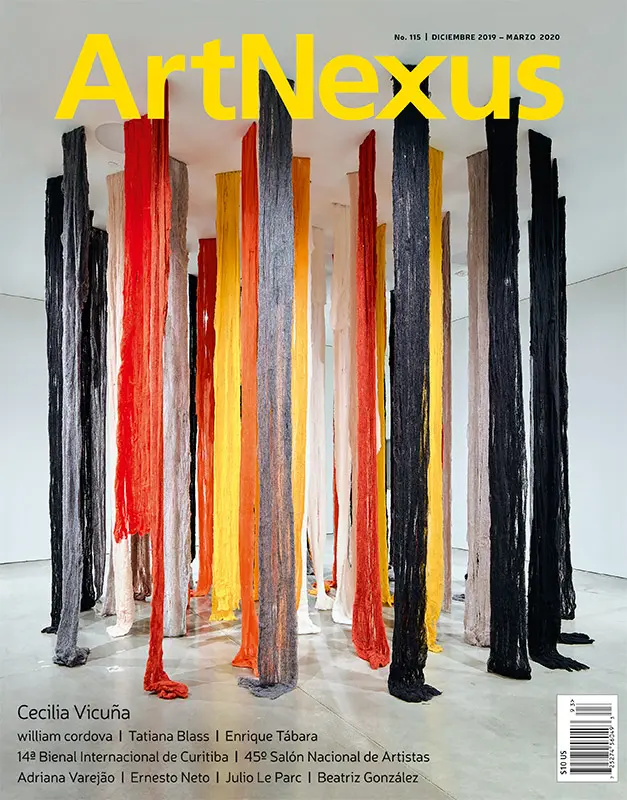
The work featured on the cover, Burnt Quipus, brings us closer to her woven pieces inspired by the quipus, ancient record systems of Inca origin that consisted of knotted threads of different colors. In the same way, the installation warns us to become aware of the destruction of forests and jungles, in particular of the fateful fires that occurred in California when she was producing this specific work. The materials function as an active force filled with meaning, salvaging traditions where language and weaving interact to reconfigure practices that invite viewers to see them again from new perspectives.
* Valeria Collao López. Interview in THECLINIC.CL,...
Issue Number: 115
Arte in Colombia: #161
Period: Dec 2019 - Mar 2020
You have 3 free articles remaining. Sign up for unlimited access.
Explore ArtNexus #115 with Nexo
Access 50 years of the artnexus archive through Nexo, the AI assistant.
Contemporary Latin American art
Exhibition room
The Exhibition Room offers a curated selection of the most compelling voices in contemporary Latin American art. Explore bold proposals, rising talents, and thoughtful curatorial projects.
Editorial directory
Guide
Explore the artnexus Guide, your essential resource for discovering Latin American artists, galleries, and institutions. Browse by category and access detailed information.
GUIDE
App
Download the Artnexus app and explore galleries, museums, and artistic events from anywhere.