After more than ten years, Carlos Altamirano returns to the Museo de Bellas Artes in Santiago, Chile, with a retrospective entitled O si no (Or Else), which also includes his current work.
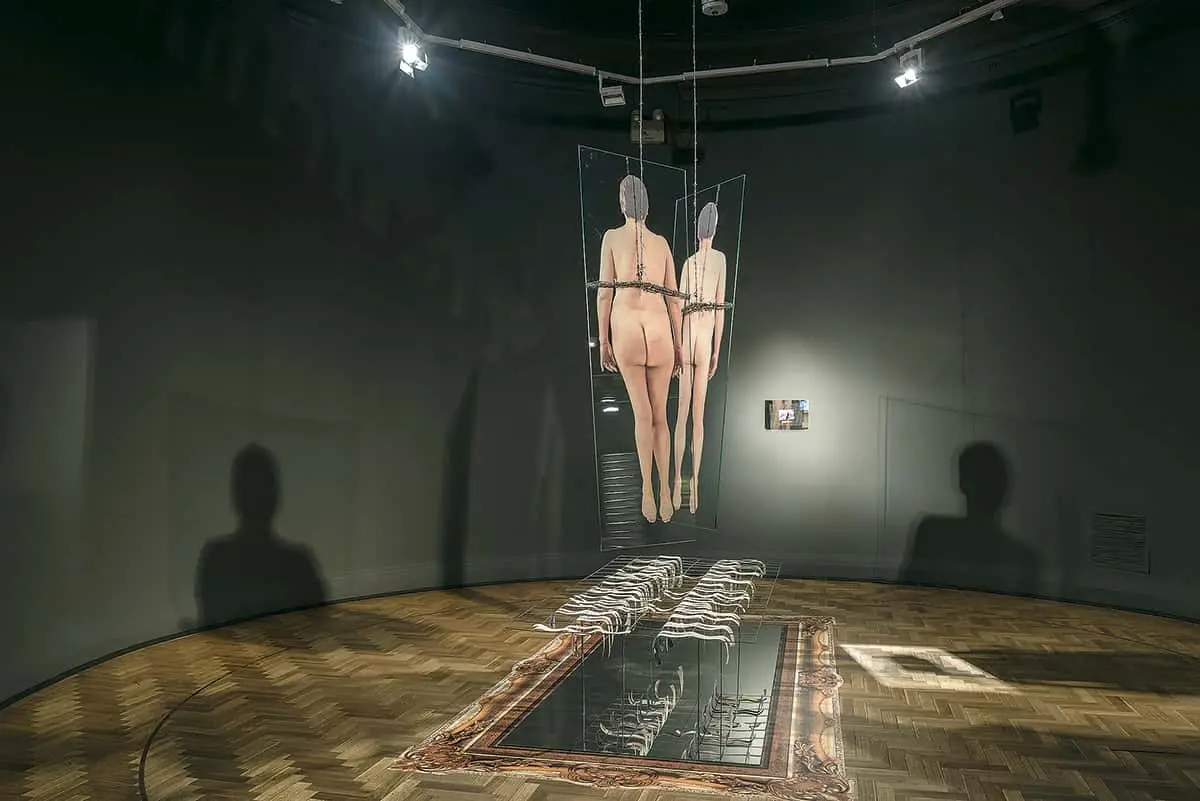
Although some time has passed since he last exhibited in this museum, Altamirano’s work remains unaltered. His pieces are anchored in the past, which does not change. What matters is the effect it has on the new generations who did not live during the period they were conceived. Hence, a simple work—the image of a couple, a man and a woman, hanging from the ceiling—provokes different reactions from visitors. Before, as now, people either openly reject it, give it a deceptive glance, or respond with manifestations of joy, revelry, amusement...
Altamirano does not seek to present a work of quality in terms of its composition, color, or light, but to provoke the observers and drive them to ask: Is this art? The answer lingers in suspense, and everyone can speak their mind. This way, the final goal of the work is achieved.
The rest of the artist’s past installations clearly demonstrate the will to embody his experiences—always real—such as the day-to-day existence in society and its consequences.
A warning is written at the entrance of the Roberto Matta Room, where the installation O si no is exhibited: “Those not willing to engage in dangerous encounters, stay away.” Maybe the artist wishes to warn visitors that they may not agree with the works’ political ideas or that some aspects of this installation may lead to accidents.
O si no constitutes a regression, a search in the past for incidents that have scarred our country. Altamirano rescues significant events that left an indelible mark on specific sectors of the population. He revives these events in the spatial dimensions of this installation, using objects that can be interpreted symbolically. There is a display of portraits of detained persons who may have disappeared, like thousands of others, in a country often indifferent and in permanent reconstruction, where nothing is what it is.
There is also a beautiful garden of aligned flowers, making this a work rich in meaning, with multiple visions, and corresponding shades of light and color.
For a deeper understanding of Altamirano’s work and his interplay with time, we must turn to his Obras completas, published in August 2007. Here, he recalls that “in the north of Chile, a drinking buddy told me that, according to the Aymara people, the past lies in front of you, before your eyes, and the future, invisible, is carried on your back. When I heard this, I thought it described, with unattainable simplicity, my longing for artistic work: a wandering through my worldview, where the past is visible and is consuming—along the way—the contents of my backpack. Stripped of certainties, except that of being there, the journey without a blueprint elapses across the unconquerable place of one who remembers what he saw and says what he sees, as one among many, unique and secular; one who testifies civilly, without hymns, and with the freedom of a Sunday painter fabricating a nontransferable story: mine.”
For O si no, Altamirano built a very singular garden in the middle of the Matta Room, composed of 1,044 wire flowers. Is this a cabalistic number? First question. Posted on the walls are portraits and written tales of persons that were arrested and then went missing. There are also rubble and people walking. A task for the observer: to add up these three sets and interpret them. Past, present, and past? Or perhaps they need to search the rubble, looking for those missing to bury them in the sea of flowers — a nice game for the observer.
ERNESTO MUÑOZ