We’re in the intermediate world. In a world that was created by certain gods and will be survived by others. We are a species that imagines the divine, projecting beings that preceded us (usually embodied in the stars) and whose creation is based on the questions we ask ourselves about the universe (cosmogonies). An intermediate world, a world of interstices, of lapses, of thoughts and speculation. Luz Ángela Lizarazo (Bogotá, 1966) works precisely in this space of grey zones that tries to give an answer about our origins (or about what lies between places, such as gardens and lattices).
This is why the exhibition at the Galería Jenny Vilá is called El mundo intermedio (The Intermediate World). According to the artist, hers is a very personal interpretation of Colombian indigenous myths (although the geopolitical limits of a territory called Colombia do not encompass the full potential of those stories). A series of drawings has as its starting point the Ø U’wa myth, or the beginning of the world according to the Tunebo people: “In the beginning, the universe contained two spheres: a world above made of warm, dry light, and a world below made of humid, empty darkness. Then came movement, and the worlds below and above merged, and as a result, the intermediate world arose...”
Unlike the Catholic conception, these spheres do not propose a Manichean rapport between good and evil; on the contrary, they suggest the hybridization of values, and above all, the search for the original source of the natural order. Thus, the upper (soft) sphere is white, and the original source of water; the lower sphere is red and related to fertility. However, we approach the complexity of this cosmogony as strangers, as agents who do not belong to this belief system; the very act of verbalizing the myth in our terms simplifies it. In this sense, Luz Ángela Lizarazo’s work manages to take a step beyond an interpretation or translation, for she stages and raises the possibilities of this myth according to its ideological weight. Since the artist’s work is highly sensitive to differences, she tries to place herself in her circumstances and untie new coordinates from the narrative. These could be assumed under interests such as femininity, life, and concepts that are also present in other projects, such as power, intimacy, and hybridization.
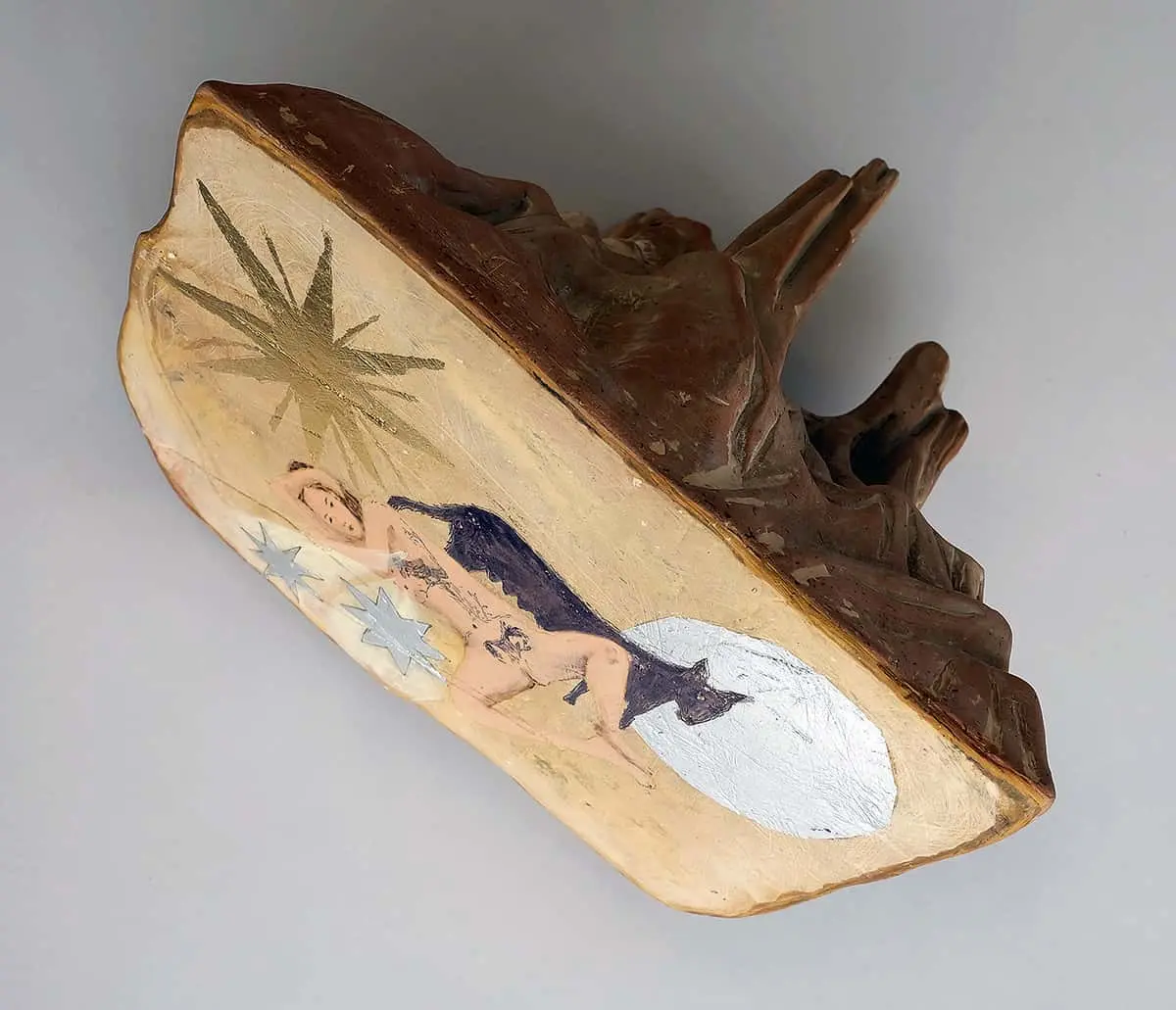
The Creation of the Stars (I and II), The Creation of Light, Chiminigüa, on the Creation of Light (a Muisca myth), The Boa of Names, Universe and Night of the Ant (all created in 2019) are part of a series of drawings for the gallery’s showcase. There is, however, something flawed underlying this exhibition; an accident, a thing that was broken and is now missing. This absence stresses a hidden meaning in the show, a fragility implicit at all levels: the oral condition disseminating as belief, language, life, and natural balance. A large ceramic vessel, representing a coiled snake with a human coccyx at its end, cracked when it came out of the oven. It broke like the historical spiral that connected us with the earth and seems to have disappeared in these times. Another object takes its place: a ceramic piece shaped like a mountain lying in the desert of La Tatacoa. At its base, we can see a woman with the Moon, the Sun, and (powerful) animals depicting how the divine spheres come together. They hybridize.
I am interested in the notion of hybridization in Luz Ángela Lizarazo’s work, as a poetic notion that alludes to the possibilities of life that originate in a dance where beings lose their contours (or in movement, which is the life-giving agent in the U’wa myth). The union of opposites is in itself the paradox of myths, which dialectical reason insists on overcoming.
In this way, power and fragility can inhabit the same body (as in the broken pottery or the lying mountain), just as fear and tranquility, and other values. I must note that analyzing Lizarazo’s work dialectically in itself demonstrates the problem of cognition. The attempt to write about a work that shows us the possible images and dances of the myth is confronted with the mythological germ, capable of syncretizing the bodies with a force that carries us from the woman to the river, from the insect to the Sun, from the light to the tree. There are no words, but the drawing itself, which is quite consistent with mythical properties: those belonging to a time when letters were not letters, but symbols, and the original inscriptions had the forms of nature.
This implicit language bears witness to the narrative’s oral condition, an orality that borders on floating and absent poetry that we might feel amid the drawings. A story not yet written because the original writing was mnemonic. The story that unites opposing nodes is the same one that merges the figures, hybrid moments of a feasible ritual. And it is feasible because the artist is part of humanity, asking about its origins, about life, nature, and its own condition, immersed in this specific moment of history. All of this is presented as a funnel effect leading to the drawings and to a recumbent mountain that does not rise as a center or a phallus, but lies down and flows, questioning once again the top and the bottom of the world.
BREYNER HUERTAS