The organization of human life is governed by things and the use we make of them. Despite the conceptual undergirding of the formation of social groups and roles, their application in practice, be it at a macro or a micro scale, depends on objects. We give such objects the status of symbols, representing before the collective the place, function, or dignity of a specific person, group, or institution. The idea of a king, for instance, is materialized in objects such as a crown, a scepter, or a throne. When we think of a fisherman, we imagine a boat or a rod. A Catholic saint is likely to be visualized with a halo around the head.
Many everyday items, from furniture to decorations, are present practically throughout the entire home. Materials and shapes can vary, but the functions they serve don’t change much. This universe of human-made things (be it artisanal or industrial) is what interests Mano Penalva. The artist investigates the common uses of these items and places them in unusual compositions, subverting their assigned roles and providing for them a degree of interpretive freedom. Through these operations, he can comment on the relationship between people and their homes or posit a critique of social structures. In some cases, he may even focus on the shapes and the materials in themselves and use them to create poetic or playful readings.
With the title Casa de andar (Multi-Level Home), Mano Penalva alludes to how homes with more than one floor are known in his native Salvador de Bahia. Set in such a home, in the Rio de Janeiro neighborhood of Botafogo, the exhibition occupies the three levels of the Portas Vilaseca Gallery. It can be seen as a large-scale installation since the works are autonomous yet dialog not only with one another but also with the architecture of the building and the space of the street. Penalva proposes an experience that reconnects the inside and the outside, the home and the street, and the subjective transits that take shape in that passage. To that end, he dislodges everyday objects from their basic functions, most often without changing their structure or covering the materials of which they are made.
At the entrance to the exhibition, visitors are welcomed by Orquídea (Orchid, 2019), from the series Jardín sintético (Synthetic Garden). It features an iron shaft from which two glass cornucopias hang. The titular flower is associated with abundance and fertility by the etymology of its name and suggests a warm welcome to whoever enters the home, a space in turn often figured as the domain of women.
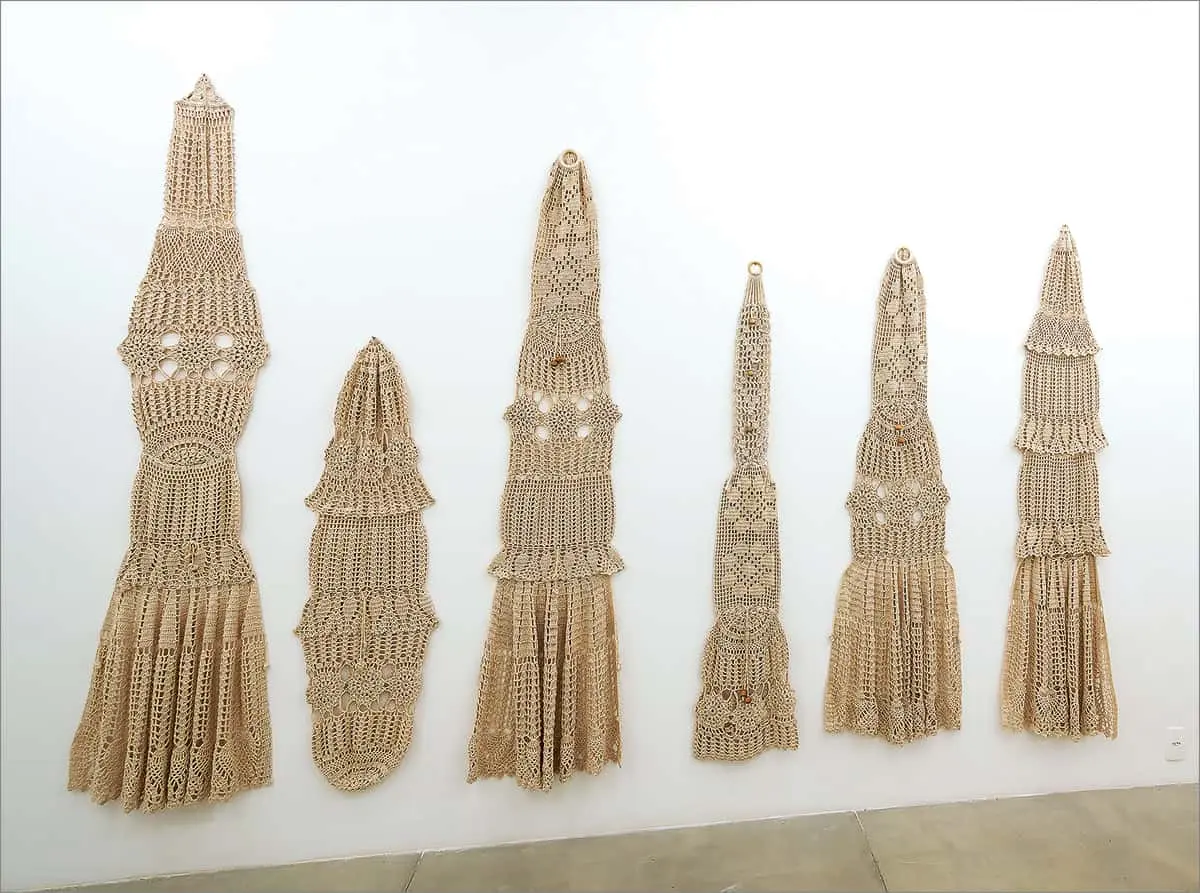
Penalva’s series of compositions formed by the union of different crochet covers for gas drums, water bottles, blenders, and mixers also dialog with the idea of the feminine, as do his bags for bags and his toilet-paper carrier. Arranged along a wall in compositions that bring to mind women in silhouette, with an airy and light-weighted texture, they all have the same title: Bailarina (Ballerina, 2019). Here, the status of this kind of artisanal item, made mostly by women to decorate the not-always-beautiful items associated with household labor, is elevated and brought center stage. Employing the new meaning assigned to these covers, the figure of the homemaker, whose work is invisible and undervalued, is transformed poetically into that of the ballerina, an object of admiration and applause. Disturbing the apparent stability of the system, situated at floor level, Colônia (Colony) brings together butter dishes and small plates cut in half and arranged horizontally along the walls, like an out-of-control proliferation of “nuclear” mushrooms.
Some of Penalva’s works comment on Brazil’s social and historical stratification through the allusion to architectural elements that signal the chasm between the upper classes and the workers. Wealthy homes in the colonial era had, under their tile roofs, a corrugated extension with three levels, called eira, beira, and tribeira. The poor could only afford one of these levels, the tribeira, and in that way, social differences were made visible in the public space. The series Ventana (Window), from 2019, deals with such subtle differentiations between lords and servants.
Beiral (Eaves) is a composition with lattice, glass beads, and chassis that integrates the whole set clearly, without hiding its condition as support. Paradoxically, its position on the wall obstructs the visibility-granting function of an actual window. Analogously, Tribeira explores the contrast between a luxurious, wood-framed, richly decorated straw divider and the pieces of glass placed on the back of the structure, which signifies danger and demarcates a private space.
The house exhibited by Penalva is examined from a variety of angles, from the idea of homebound well-being to the social barriers separating the have-nots from the haves. Objects acquire multiple voices that bring to the fore individualities in their many ways of being in the world.
SYLVIA WERNECK