WhatsApp is not just free or cheap; its algorithms are also generous in opportunities for plotting and conspiring. Thanks to this platform, Cubans inside the island are 100% connected to the rest of humanity, circumventing government snoops and eavesdroppers. In what amounts to a technological pantheism, WhatsApp is God, the divine app.
After months playing with the application, jorge & larry discovered its civic benevolence and used it to call upon their friends to create stickers to express their imagination, concerns, and points of reference. These half-encrypted mini posters invaded social media and spread like viruses. In parallel, the artists invited nine Cuban actresses living in exile to recreate a pre-established gesture. The resulting tiny performances were made into gifs primarily about annoyance, indifference, and antipathy. The combination of the stickers’ convenient display in the gallery and the divas’ presence via small tablets form the core of Gif Me Love, jorge & larry’s exhibition at Havana’s El Apartamento Gallery.
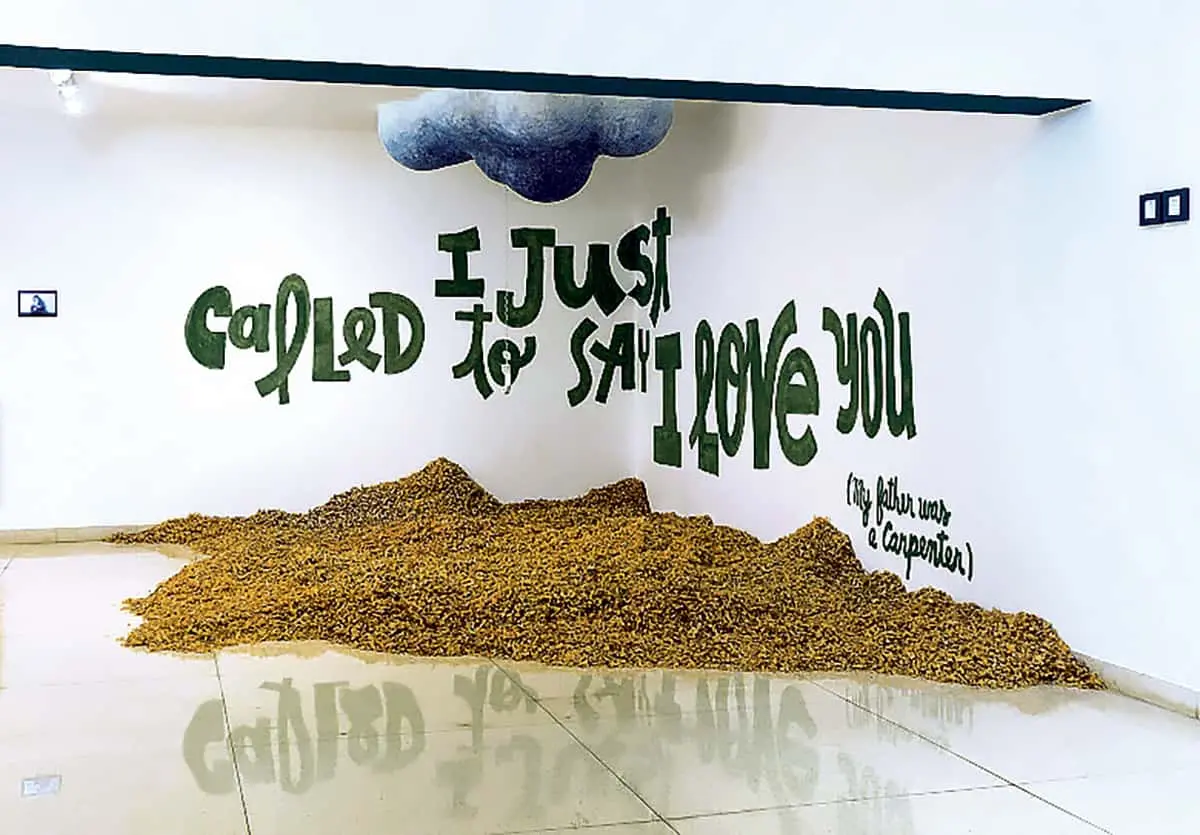
However, the all-embracing nature of their work drives them to hoard content from here and there, and to return it as a landslide: they added the site-specific I just called to say I love you (my father was a carpenter), where a pair of headphones hang from a sculptural celestial-virtual-salvific cloud, in consonance with the identity of the visual ecosystem, almost entirely green (like WhatsApp), that is the exhibition. It also rhymes with the digital invite: a traditional Sacred Heart of Jesus image, with a cell phone in his hand and an emoticon in his chest. It is probably this work that gives Gif Me Love its organic character.
Things, however, did not stop there. A series of medium-format canvases gracefully arranged around the entire gallery and wavering between bad painting, naïf art, and a specific camp tone—with a female dog1 and the names of feminist Hollywood stars as the common elements—were brought in like an afterthought. Each one was identified by a written phrase, filled with humor and a degree of political incorrectness that our era’s hypocritical, exaggerated linguistic politeness would not countenance. A sumptuous tribute, in a profane key. In this context, jorge & larry decided to court several artists who passed through the Instituto Superior del Arte, where Larry González was their teacher and who are now widely spread around the world. They did this in small paintings with the name of the subject and a detail identifying their work. Adding to this, because things do not stop here either, are four sculptures. From the crotch of each one of the saints depicted in them hangs a shapeless, grotesque lump with acidic and vulgar phrases.
Despite all this, however, Gif me love is not chaotic (although it is overwhelming). In its myriad moments of dialog and its gluttony for references, it is notably neat and tidy. Let’s take two examples of its up-and-down rollercoaster of associative voraciousness. The stickers, the result of a highly learned, encapsulated, and refined exercise, are filled with extremely local and pseudo-dissident gestures and jokes, but this is not a reproach, since the whole relational and processual operation supporting them is already effective as an experience, and those of us who share that cultural imaginary will split our sides laughing. These works are a daily lesson in history and culture, a social chronicle in a tropological key. The series with the female dogs and the actresses is at the other end of the spectrum: the phrases, written in English, a dialog (also with biting humor) with the feminist ideas postulated by each “star.” This datum highlights the cosmopolitan, illustrated, and sophisticated background of this artistic duo, to whom nothing seems to escape. Such has always been the logic of their creativity.
Each of the series is a show all by itself, spatially organized and integrated in such a way that, of course, it forms a complete whole! A text that tracks their entire narrative unfolding is almost impossible to write. Nevertheless, I was able to find some keys: WhatsApp appears as a resource and an ideological discourse, the ideal tool for a new type of linkage, one that is agile and filled with generational wit and jargon, and the stage for a new, perhaps even lighthearted, conspiratorial kind of undertaking. Gif Me Love also expresses a belief in camaraderie and in featuring as the basis for artistic creation. The cult of friendship, love, and women is not above hamming it up a bit here. The tribute acquires almost religious undertones. The incorrect humor that permeates each detail and the presence of writing as the indispensable unifying element are both distinctive elements, situating these works as a carnivalesque variation of conceptualism. They are indebted from beginning to end to an industrial culture and literature. Their obsessive fastidiousness projects a total and anti-model oeuvre.
One leaves the exhibition convinced that it is very much a jorge & larry event. A four-corner shootout, with rings upon rings of meaning. It places demands on one’s time, even in one’s mood. It demands sharpness, and it is filled with irreverence and homages. Gif Me Love brings forth the plagues of genius and is a profoundly endearing art show. It is “theory and practice against your evil eye” since things did not stop there, either, but on a large image of St. Lucia’s eyes. Gif Me Love is a harsh song to the present at its most acute. It is the kind of commentary we need now. It is a compilation, intended perhaps to bring a cycle to its close, as though there was no tomorrow.
NOTE
1. Perra, “bitch,” is an expression commonly used among gay men to signify a sumptuous yet hardened individual. It is a term of praise.
ELVIA ROSA CASTRO