First came Barcelona, and a year later, Puebla and Mexico City. The exhibition Melanie Smith. Farce and Artifice, held initially at Barcelona’s Museu d’Art Contemporani, was exhibited simultaneously at the UNAM’s Museo Universitario Arte Contemporáneo and the Museo Amparo. Curated by Tanya Barson and Alejandra Labastida, six juxtaposed nuclei separated by distinct chromatic atmospheres group projects carried out by the artist throughout more than two decades of work. Her visual production began at the height of neoliberalism in the 1990s. The postindustrial economy, consumption, the impossibility of a modernization project amid chaos and tensions between natural and urban environments, would become the ideas marking the conceptual axes of a work rich in layers of meaning and deep critical thinking.
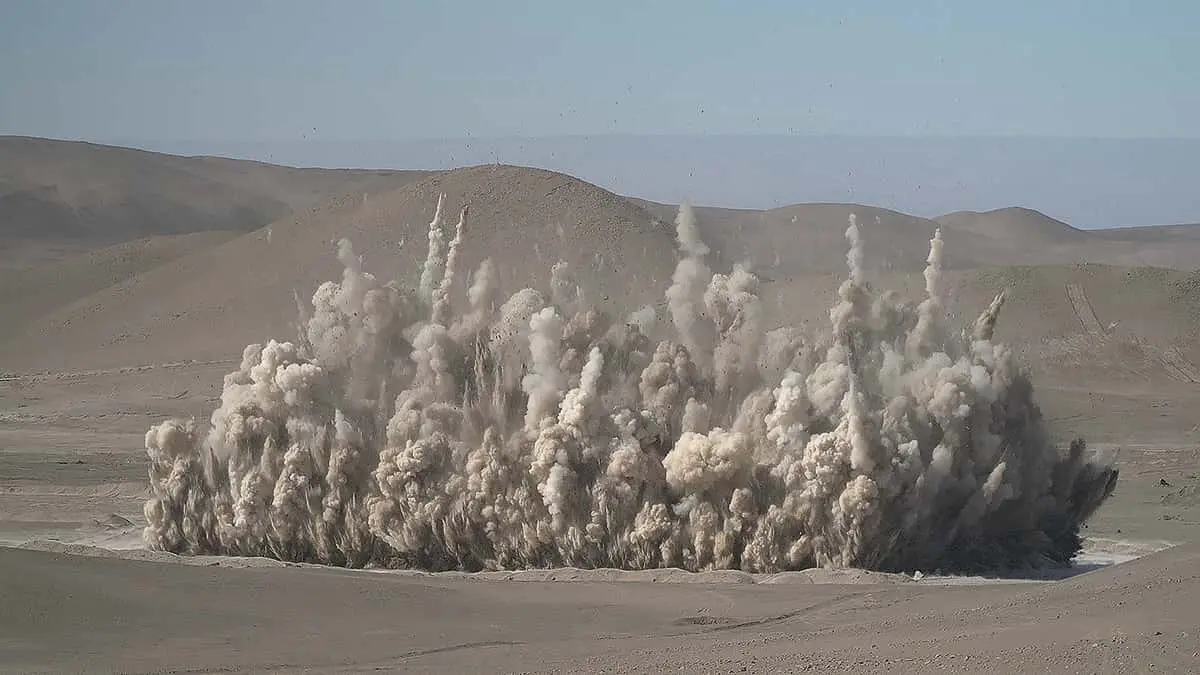
Far from any chronology and following the very nature of her work, the exhibition highlighted two overarching concerns. Firstly, the multiple edges of modernity’s collapse; a modernity that is both a farce—since it never happened in its most utopian dimensions—and an artifice—which has served to manipulate society in terms of political, economic, social, and cultural regimes. And secondly, the way in which the different media are interwoven, dismantled, connected, or fragmented, through a work that, while conceiving the present as a historical construction, also accommodates the absurd and the ironical as means of challenging a particular context: Latin American cities with their visual saturation and their daily experience in permanent friction. In this sense, it is not a surprise that one of her most recurring themes is to bring into question these forms of collapse in Mexico City.
The parallel nature of the exhibition in the two museums served to encourage two strategies to promote a distant connection. On the one hand, subtle peepholes were installed along the path that communicated one space with another in real-time. The gaze of whoever decided to look through them was immediately transported to the other museum through closed-circuit television. On the other hand, creating a specific work for the exhibition permitted the artist to pursue her ongoing exploration of the pictorial plane’s potential to be dismantled through performative gestures, installations, and videos. In Vortex (2019), a little more than a hundred kilometers separated a tableau vivant housed in one of the rooms of the MUAC from the control room inside the Amparo Museum. The image corresponded to The Circle of the Lustful (1824-1827), an illustration by William Blake for Dante Alighieri’s Divine Comedy. Smith’s attempt was none other than to explore pictorial gestures in the digital age, with a presence at a distance, simultaneous execution, and the overlapping of mediums and technologies in real-time. While at the MUAC the scenography was activated by the bodies of those who tried to compose the image, at the Amparo Museum the artist directed the work from a distance. In the case of both peepholes and Vortex, it would not have mattered whether these two spaces would have been one hundred or thousands of kilometers apart. After all, there is no difference if the image is in Mexico or Cuba, in Iceland or South Africa, at a narrow street in Seoul, full of luminous signs, or on the zigzagging slopes leading to Taksim Square in Istanbul, since time and speed have nullified every distance in contemporary life.
The tableaux vivants have their most immediate precedent in her project Obscuridades bucólicas (Bucolic Obscurities), presented in 2017 in La Tallera (Cuernavaca, Mexico). There, the artist drew from imagery by Pieter Brueghel the Elder and Hieronymus Bosch in order to activate several live paintings. The motifs often pointed to class relations and their unfolding over the landscape, and this way exposed the relevance of both Flemish painters for contemporary society. A total of seven scenes were produced during the three months that La Tallera became her studio.
With nods to the post-revolutionary construction of Mexican identity, statements about the collapse of the myths of modernity and industrialization, questions about the use of visually polluted landscapes, taking a stand against chaos and precariousness as viable conditions of the global, or the use of plural means to overflow the pictorial plane and approach the most current circumstances of the image, during the last three decades Melanie Smith has not ceased to propose a body of work in which chance and the bizarre attempt, almost always, to reveal farce and artifice.
JORGE LOPERA