I was surprised by the visual impression of Fernando Bryce’s work compared to reading about it. There was a significant conflict between the descriptions of his drawings, taken from mostly mass media sources, as “painstaking” and “meticulous” versus the distance from those sources they invoke in the viewer. Bryce famously calls his method “mimetic analysis,” which conjures a long Western tradition of naturalism (mimesis), but clearly, the process of analysis purposefully interferes with exactitude. Visually, they exist in a different non-naturalistic world. It reminds us that “mimesis” has a wide range of meanings and can refer to internal representations as much as exterior realities.
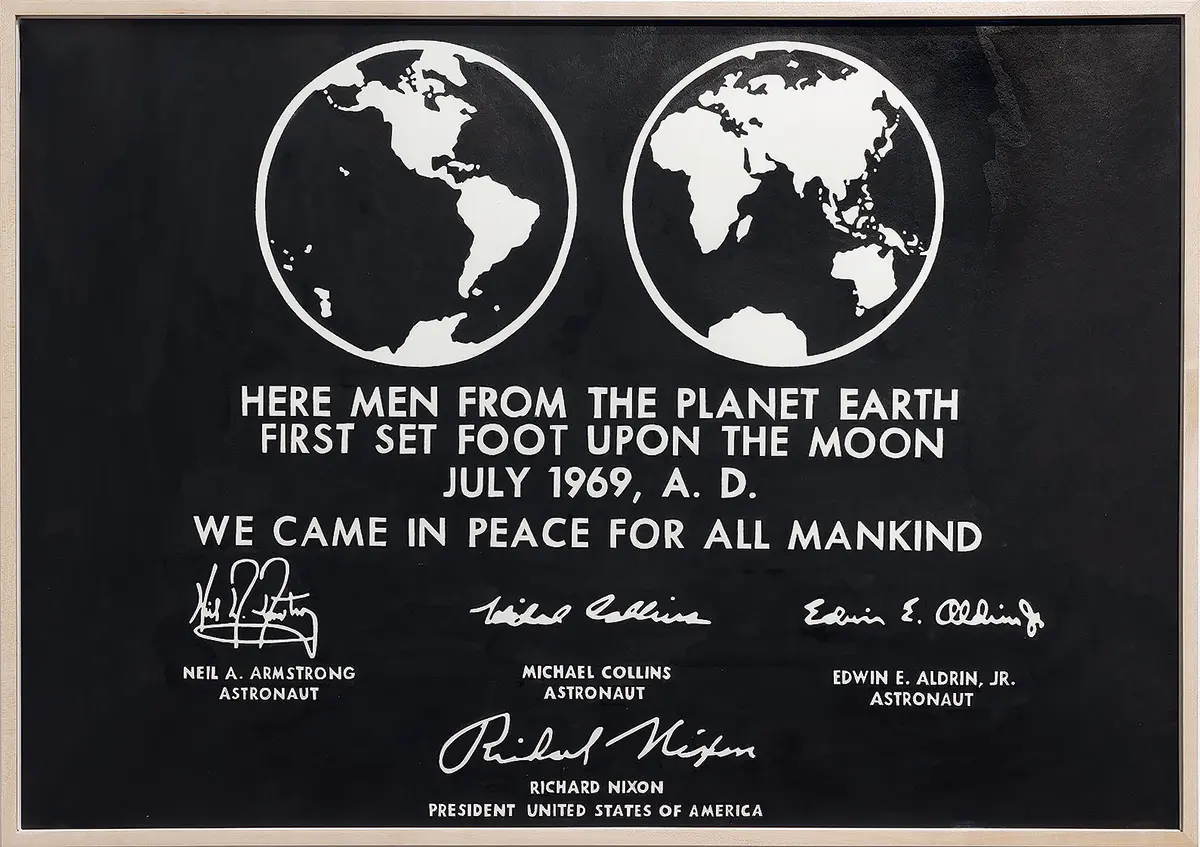
The first wall installation lets the viewer know his method through 15 individual and unframed silk screens that cover about 20 feet wide and 8 feet tall (ca. 6 x 2.4 meters). The title Allende/Apollo XI, a commissioned work from 2018, constructs an overall narrative by selecting two important but different historical events in 1969, the beginning point for Bryce’s global project for the entire exhibition, to provide a visual characterization of the 1970s decade. The themes here repeat elsewhere in several of his smaller works distributed throughout the gallery space, while the style and strategy relate to the much larger exhibition title piece in the next gallery.
Images of the two events—the February explosion of the famous Allende meteor in Mexico and the July Apollo XI lunar mission of US astronauts on the moon—are placed on the extreme opposite edges of the installation and rendered in color to contrast with the other 13 black-and-white images. They provide the visual and narrative frame, but in between them all but one of the connecting references is, strangely, based on the physical rocks in both events.
The two events are interesting in themselves but connected? And if so, how so, aside from both as sky-based events and rocks? The viewer has to decipher if their thoughtfulness moves beyond the factual events. And this is one of the hallmarks of Bryce’s aesthetic, the apparent, commonly used poststructuralist strategic shift from the artist to the viewer as the site of meaning. But is the author genuinely dead? Only a historian’s knowledge or individual research would suggest that Bryce did indeed have a master narrative in mind.
The meteorite fragments were of extreme importance due to their age (before the birth of the earth), their mineral composition, and at the same time because the scatter-field of the rocks was the widest known. The recovered moon rocks were also unique and widely scattered upon their return, mostly for scientific examination but also by US President Richard Nixon (1969-1974) for commemorative and national propagandist value. Both events propose a global reference point, a perspective that usually unites people, and a significant current of the 1970s. But not without counter currents. Bryce invokes both throughout the exhibition based on the volatility of the 1970s, but he does so very cleverly in this piece.
Collaged beneath a Westinghouse ad for its televisions that helped spread global visual coverage is a barely noticeable Spanish newspaper headline notice of President Nixon making a quick visit to South Vietnam. So what? Nixon needed the Vietnam War to continue to be elected in 1969, so his aides sabotaged the 1968 peace accords. Hidden political powers also sever the proposed shared unity (the global village). It seems little has changed since those days!
Bryce developed this theme of tension between the unity and the realities of rupture through the other works, less as a unified position and more at risk of being seen and understood as splintered and unconnected news clippings, reproduced from mostly based on mass media print sources by his ink drawing technique. Such a separation, a distinction between database and narrative, is integral to the largest work that carries the name of the exhibition, The Decade Review. The size of the installation—110 separately framed images with text in several languages, cover two 20 plus foot-wide (ca. 6 m.) sections on two walls—implies a unity. But the vast diversity of events selected and separately hung make the viewers experience one of a personal game of selection and cross-reference.
You can make a case for the artist and viewer to locate relationships among individual images and sections. For instance a drawing of the cover of Edward Said’s 1978 book on “Orientalism” can be seen to anchor a section given to images of events and people on the Middle East, but not have any apparent connection with the nearby images of the Newsweek cover of Margaret Thatcher or Time magazine’s cover of Pope John Paul II visiting Poland. Yet these two can be interpreted to relate to each other in several general ways. However, anyone who knows the general historical facts does not need the visuals, and here they do not seem to support claims for intense archival research.
Perhaps the most interesting element here is our dissociation from the events via Bryce’s variety of styles, along with the remaining pencil marks strategically left from the original layouts, that deny mimesis. The issue of the field of the meaning is not resolved here, nor is the negotiation between history as a narrative within an overall frame versus isolated mini-narratives. But that is likely the point; such tensions remain center stage today.
RICHARD LESLIE