Before addressing the solo show of the Nicaraguan artist, I want to provide some interesting information about the exceptional character of Villa Vassilieff, located at a charming alley known as the Impasse Fleurie, once an artery of Montparnasse’s vibrant and cosmopolitan artistic life at the start of the 20th century. Picasso, Modigliani, Zadkine, Diego Rivera, and others would often visit the atelier of their friend, the Russian artist Marie Vassilieff. Today, this same place (managed by the municipality) continues to build on its artistic legacy. Indeed, in addition to the permanently occupied ateliers, the space has incorporated an artist residency program sponsored by Pernod Ricard Fellowship, a temporary exhibition site, and a museum that houses the work of Frans Krajcberg, a multifaceted artist who worked there in the 1960s.
Patricia Belli (born in 1964) completed a three-month residence in 2019. Her exhibition entitled Ser, sin serlo is, in large part, the result of her sojourn in Paris, though some previous works are also included. She often attributes the deep motivations for her work to the weight of her country’s difficult sociopolitical context: a fierce dictatorship followed by deadly confrontations, repression, and exiles.
She also highlights something very personal in this exhibition. In addition to exploring how dreams and the unconscious—a double vindication—are present in her altered photographs, videos, and installations, she addresses the emotional effects of her congenital atrichosis—the total absence of body hair—, a difficult condition she’s had to endure since childhood.
When feelings as diverse as anguish, anxiety about our unavoidable fate, fears, the difficulty of affections or the terrors of motherhood and exile emerge in her aesthetic discourse; when the relationship with the body seems to predominate, we realize at what point the intimate is the center of everything. A dynamic of opposition pierces and shapes the works both materially and immaterially. Ideas of balance and imbalance, movement and stasis, darkness and light, fragility and resistance, or violence and tenderness underlie this contradictory oeuvre. When we take the time to observe it, we are led to immerse ourselves in a labyrinth of existential metaphors generated by the symbiosis, in permanent tension, between life and creation.
Sísifa (2 min., 2002-2015), a video of two fingers walking on a tightrope in the dark, communicates fragility and imbalance. This metaphor is completed by the video projection Equilibrista (loop, 2005), where several men in several positions appear to fall or get caught in midair, while clouds whizz through the sky behind them. Facing this work, on the floor next to a corner of the room, an installation entitled Pit (gravel, glass, 2019) presents a violent visual contrast; a sand pile divided in two by a glass plate, allowing fragments of broken glass to be seen from the other side. One is reminded of Roberto Matta’s interest in glass plates as “screens” that could fatally impair the dialogue between beings.
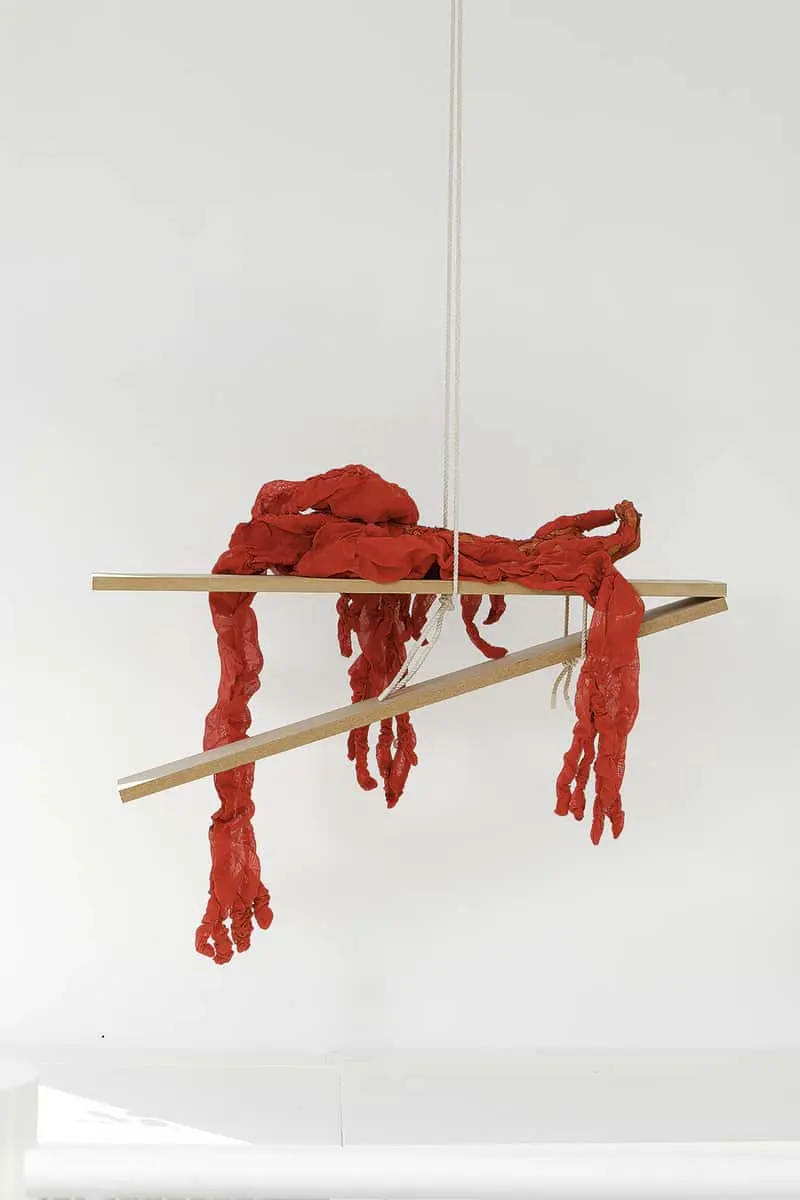
Beyond the violence and death, these pieces of glass and gravel evoke, Patricia Belli also takes us to a more organic—and even sexual—terrain in Exile (sand, ceramic, cement, roots, sound system, 2019). A sandbox of sorts contains three objects that can be handled by the visitor: a dry root, a sharp ceramic object, and an oloid piece conjuring the female sex. Beneath the sand, a microphone reproduces the squeaking of the objects’ rearrangements by the public. In fact, the footsteps of the exiled are not at all silent; the chance and uncertainty of the visitors’ actions are not as bland and playful as they might seem. The artist may be telling us that exile is painful, that it can harm us. A suspended piece, Muda 2 (ceramic, MDF, textile, cotton rope, 2019), seems like a torn skin emptied of its substance, abandoned. Two sets, composed of prints of drawings made with tops (Skies, 2019) or of paintings (Storms, 2019), suggest constellations (the sky, the night) and undulations (deep, turbulent waters). Water and sky are primordial elements, ever-present in our displaced lives.
In the last room, four installations in varying degrees of abstraction appear as metaphors for the absence of communication or difficulty to sustain a dialogue between human beings, as in Roots (ceramics, a lullaby, storm sounds, 2019): two heads are in opposite directions but stuck to each other. In Dialogue (ceramic, metal, nylon, rope, driftwood, 2019), the duality of relationships is represented by the “skinned” face of the Aztec god Xipe Tótec in close proximity to his intact double.
Conceptual and carnal at once, the work of Patricia Belli has a cathartic dimension that, at first glance, may seem hermetic. The joint and successive observation of her pieces opens paths of understanding as she questions us and comes to us, revealing the artist’s incessant desire to find one or more truths, individual or universal, at the very heart of the creative act.
NOTE
1. “Which roughly translates as “Being, without being it” (t/n).
CHRISTINE FRÉROT