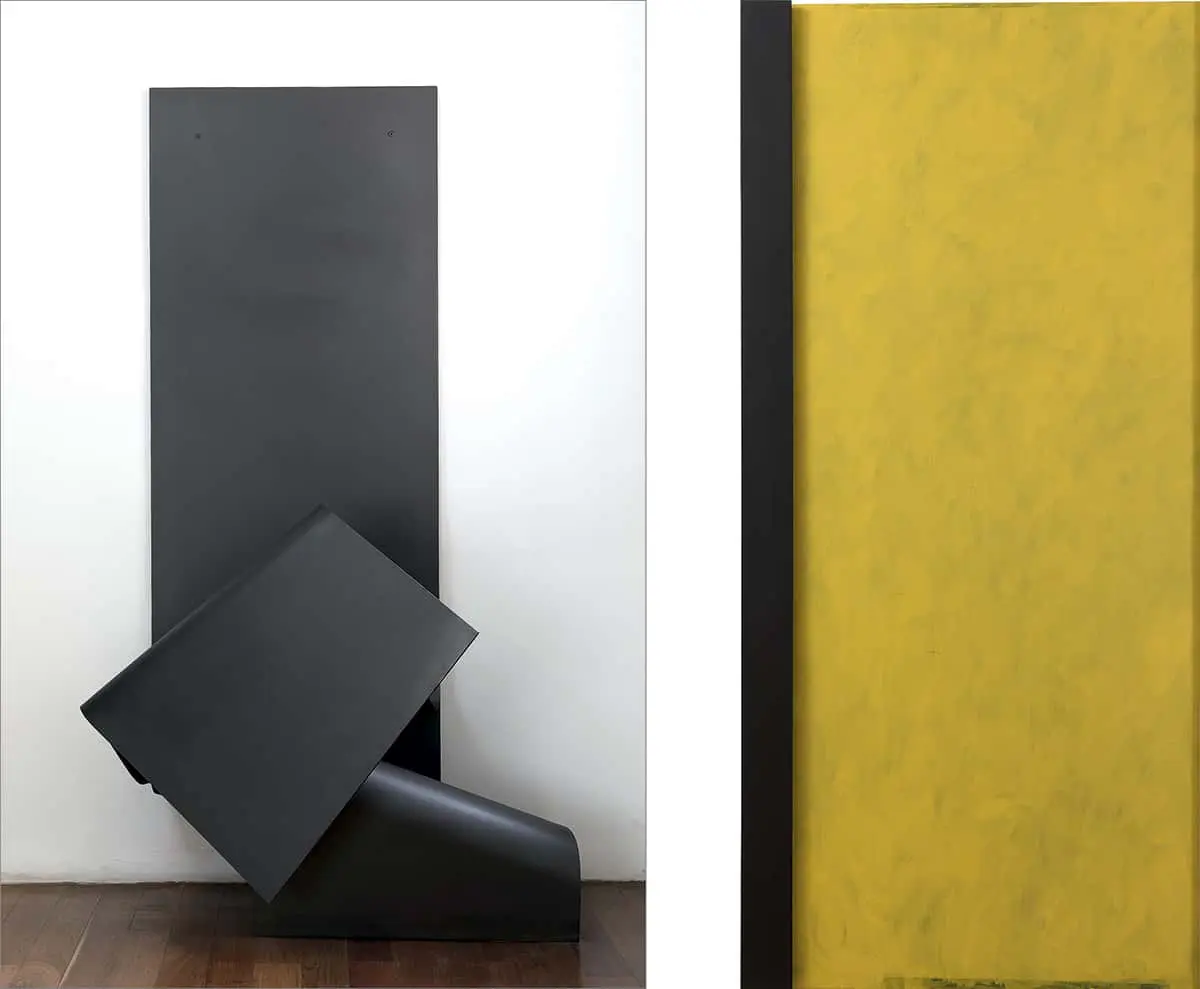
Two artists, two moments, two abstractions, but—as the title of the show reveals—also one fundamental objective. Los límites del vacío (The Limits of the Void) is, without a doubt, an exhibition that enables us to find close relationships between two artists who have been working in parallel for fifty years, each on their own side of the world: John Castles in Colombia and Jordi Teixidor in Spain. Since the beginning of their careers, abstraction, or even a taste for geometric forms, has been an unconditional pursuit: Castles explores it through sculpture and Teixedor through the two-dimensional plane of painting.
Let’s start with the void. A concept so complex and so abstract at the same time. What is the shape of emptiness? What is the origin of the idea of emptiness?
Nothing, absolutely nothing, can be so unfathomable, so ungraspable, as emptiness. Except perhaps for death? Are they akin? Do they resemble each other in their amorphous, unstable, and profoundly indefinable character? Let's try to approach a concrete example that comes fairly close to emptiness, to death: the nothingness behind the universe. The continuous moment in which the universe expands its limits towards infinity. We are told that the universe has limits bordering on nothingness, with an unbearable emptiness full of nothing. No light, no space, no nothing. Would this be the limit of emptiness, the place where the universe abuts nothingness? Is what we call ‘nothing’ a kind of creator god, a mystical structure that has helped to form religions and pacifies our permanent confrontation with emptiness?
The forms in this exhibition are definitely signs of places that let us glimpse their opposite: non-places, empty spaces, an unbalanced and unfair opposition of weights. Once they open, Teixidor’s pictorial spaces reinforce the struggle between form and antiform, between emptiness and the body’s desire to contain it, to appropriate it.
Pairing one of these paintings with a sculpture by Castles is a way of declaring similar characteristics: form does not exist if its limits do not exist, and limits do not exist if there is nothing beyond them. This beyond is what is cataloged as emptiness. A clash between two conceptual structures governed by abstraction. Surely this confrontation finds its essence in geometry. The search to articulate planes that suggest forces of power end up leaving us spectators with an anguishing ontological assignation.
All of the above points to two relevant issues that can help us question the human meaning of this exhibition: the scale and the political.
Aside from the forces mentioned above that surround and determine the forms created by Teixidor and Castles, it is interesting to notice some minimalist features that appeal to corporeality, to the human scale, and the body’s relation to the works. Undoubtedly, these pieces consider the body of the person who inhabits them and the exhibition space in which they are situated. There is an intrinsic relationship that speaks to us of scale, of architecture, and, therefore, of how bodies define spaces that did not previously exist.
Their relationship with the void, with the universe, or with the mystical, deals exclusively with the refusal to be named because their limits have always been mobile and strange.
On the other hand, when dealing with forms that extend and confront each other, their recourse to those created spaces invites us to reflect on the search for a “seizure of power.” The black color in Teixidor and Castles’ seductive but sometimes incisive curves leads us to understand that these works, in their profound abstraction, are fields of a permanent struggle between form and emptiness, the universe and infinity, or humans and their discontinuous nature, their mortal knowledge. Teixidor’s deep black, defined either on a minimal plane or on a vast surface, precedes other bodies or perhaps other forms, which, within their geometry, become unstable. Castles’ bodies arise from an iron plane that twists, cuts, and tears, becoming a struggle between that plane and the space it creates.
Both create spaces from nothing, suggesting that—as Heidegger said—space does not exist without the form that builds it. Even so, we have spaces that begin to exist beyond these forms, since they are spaces that are mentally expanding, just like the universe or the gods that govern them.
ANDRÉS GAITÁN T.