Nancy Friedemann-Sánchez was awarded this year with the Doctorow Prize for Contemporary Painting, given by the Jarvis and Constance Doctorow Family Foundation, in collaboration with the Utah Museum of Contemporary Art. As a winner, she was invited to present an exhibition, which opened in September and will remain open to the public until January 2020.
The exhibition is based on a body of work she began in 2011. According to the artist, it is a visual novel that started as a result of her move from New York to Lincoln, Nebraska) At that time, she wondered if she were a writer, how would she build her new house and, more importantly, her life. She devoted a lot of time to reading, and she even took a class of Chicano and Latin literature at the university, which inspired her to get out of the codes she had previously managed as a visual artist.
The exhibition includes two chapters of that “novel.” The first one is represented by a large still life on a black background, entitled Cornucopia (2016), based on the research the artist carried out on “Pasto varnish.” This technique, native to southern Colombia, her native country, has been used by generations of artisans to decorate wooden objects with the resin obtained from the wild plant known as Mopamopa. The delicate designs she discovered in the workshop of a restaurateur in Bogotá led her to question the origins of this hybrid artistic expression, and, above all, to ask to what extent this popular craft reflects the oppression and resistance of the indigenous culture. Mopamopa designs and their symbology work perfectly within the framework of her pictorial work, in which patterns of delicate lace, embroidered ornaments, colonial portraits, and botanical drawings, give rise to the exploration of notions of identity, memory, hybridization, and appropriation.
Like her previous series, this work has a feminist background. The still life’s flowers have a very particular iconography closely linked to classification and hierarchy. By representing them in monumental canvases, the artist enlarges and exalts the manual work related to feminine and household tasks. There are many narratives in the symbols depicted in Cornucopia. All the flowers represented are inspired by designs taken from Mopamopa pieces, which the artist documents in an iconographic archive. Tiny little men with weapons and drones, camouflaged among the flowers, symbolize not only the technology used at war but also the fact that we are being observed or permanently monitored by the advances of digital technology.
The second chapter of the “novel” deals with topics such as memory, migration, and the search for the American dream, and is inspired by “Casta” paintings made in the 18th century. As part of the Bourbon Reforms, the Spaniards classified the racial composition of the American population according to the different “racial crossings.” From the three original groups —Spanish, Indian, and black— different mixtures emerged and were documented by artists of the time, mainly in the viceroyalty of New Spain and Peru.
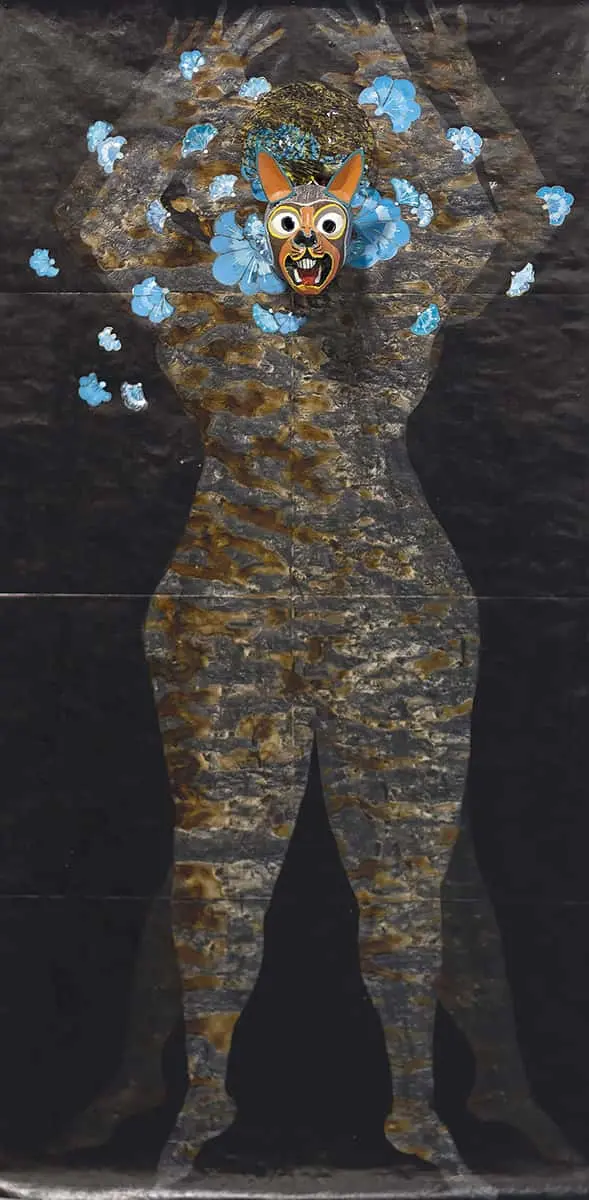
Friedemann-Sánchez uses this cultural framework and the conventions of “Casta paintings” to make sixteen canvases, through which she makes a critical commentary about racism, social classification, and even xenophobia, situations that are more valid than ever, especially concerning migration, marginalization, and displacement.
The exhibition presents nine of the eighteen paintings of the series. To create them, the artist invited different women of Latin origin to pose for her. She asked them to raise their arms as if they were going through airport security checkpoints or as if they were in danger and were shouting, “Do not shoot!” The figures, suspended at that specific moment, were painted on black backgrounds and decorated with meticulous designs made in ink and carefully drawn flowers. Also, each painting was adorned with a carved and painted mask decorated with a Spanish comb, representing a characteristic related to the mixed breed or classification that inspired the title of the work.
For Friedemann-Sánchez, these images symbolize the obsession that exists with social status, the complexity that results from the mixture of multiple ethnicities and cultures, and the power relations that they generate. Similarly, the exhibition constitutes a critique of the historical legacy and the modern continuation of racial hierarchies and classifications according to the physical appearance of individuals, a practice that unfortunately remains in force and affects social, cultural, economic, and political relations at the level world.
The exhibition will be presented at The Columbus Museum, Georgia, in 2020.
FRANCINE BIRBRAGHER-ROZENCWAIG PHD