“Art can be an action, a performance, a voice, a sigh...” Rafael Lozano-Hemmer
The Museo de Arte Contemporáneo de Monterrey (MARCO) is currently hosting the exhibition “Rafael Lozano-Hemmer: Unstable Presence,” a major review of the work by the renowned Mexican artist born in 1967. The show is presented for the first time in Mexico and offers a new approach to the artist’s production over the last eighteen years. It was organized by Rudolf Frieling, Curator of Media Arts at the San Francisco Museum of Modern Art, and Lesley Johnstone, Curator and Director of Exhibitions and Education at the Musée d’Art Contemporain of Montréal. Artimodular Studio (based in Montreal) was in charge of the museography.
The main axes of this exhibition are firstly, its poetic dimension; secondly, technology; and thirdly, its rapport with spectators, following the precepts of public participative practices. Based in Montreal (Canada), Lozano-Hemmer was the first artist to represent Mexico at the Venice Biennale, with an exhibition at the Palazzo Van Axel in 2007. This audiovisual artist possesses an extensive and outstanding international career. His production has been the subject of monographs and exhibitions at many iconic spaces in the international contemporary art circuit, such as the Manchester International Festival (MIF) in Manchester (2019); the UNAM’s Museo Universitario de Arte Contemporáneo in Mexico City (2015); SFMOMA in San Francisco, California (2012); the Museum of Contemporary Art in Sydney (2011); and the Guggenheim Museum (2009) in New York, among others.
The show is divided into three segments determined by the materials and the interaction with the works. The first segment throws light on the degrees of surveillance and control that facial, sound, and movement recognition systems exert on us. The second one revolves around our capacity to interact with the pieces in playful, active, and entertaining ways, and the third segment deals with the ephemeral presence of certain poetic gestures made manifest through multiple technological effects.
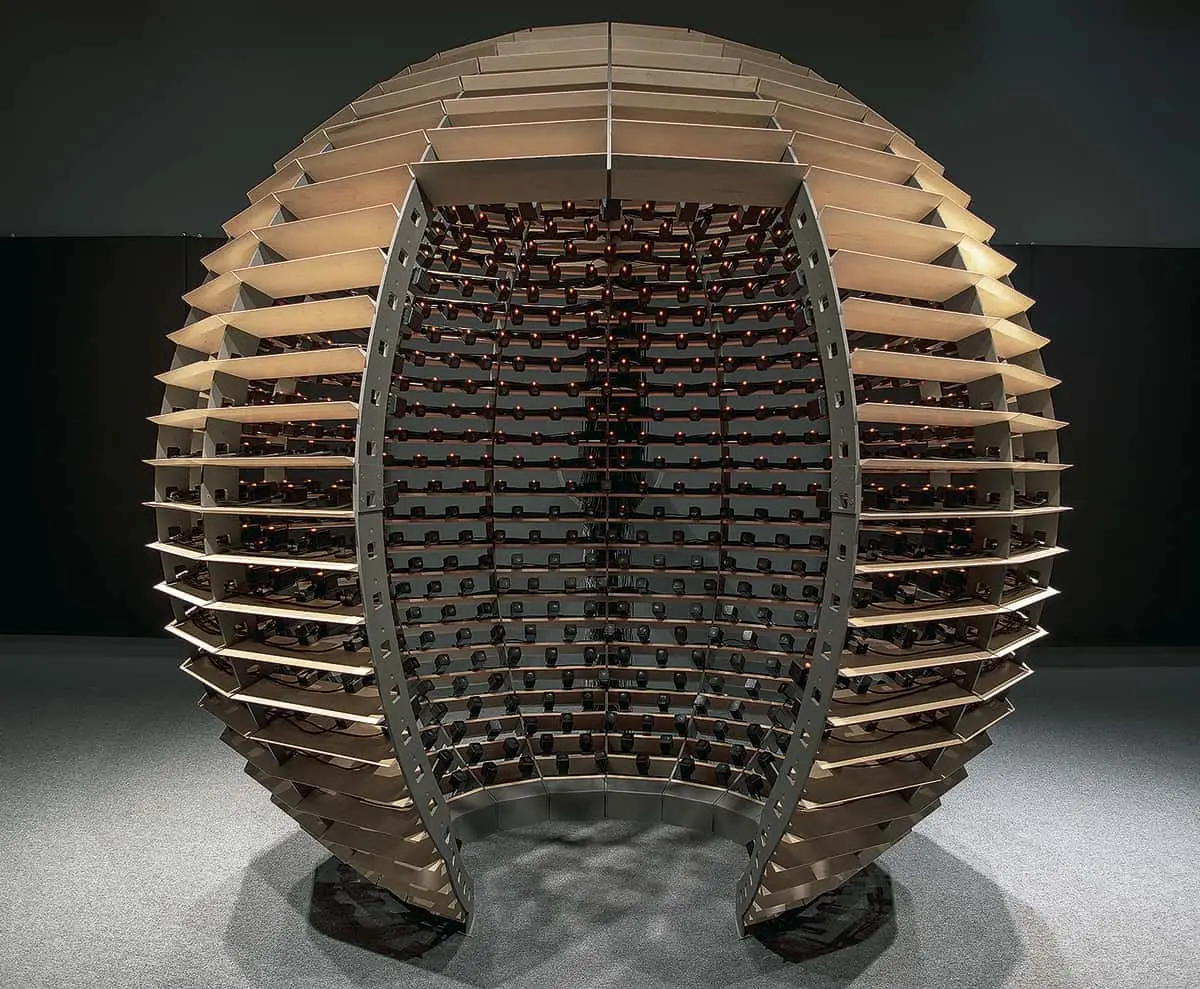
The exhibition welcomes us with one of Lozano-Hemmer’s emblematic pieces: Zoom Pavilion (2015), an interactive installation that surrounds the spectator with black and white projected images of faces and bodies in space. Twelve computerized surveillance cameras track the presence of those in the room and—through facial recognition, background subtraction, and automatic learning algorithms—record the spatial relationships between one another. This piece was made in collaboration with the artist Krzysztof Wodiczko.
A notoriously playful piece in this exhibition is called Pulse Spiral (2008), a spiral paraboloid lamp made up of 300 incandescent lightbulbs arranged according to mathematical equations by Pierre de Fermat (1607-1665), which records the heart rate of those who hold a sensor underneath. Each time a participant grabs it, his or her heartbeat is detected, triggering the lowest lightbulb of the spiral; after releasing the sensor, all the lights go out momentarily and then blink while the most recent pulse rate displaces those of its predecessors.
In the case of pieces that materialize ephemeral occurrences from poetic realms, a salient example is Call on Water (2016), consisting of a fountain that writes words in the air with columns of steam rising from a water basin. Dozens of poems by Mexican Octavio Paz arise in succession, making the air readable and transforming the atmosphere itself. The words become tangible, almost breathable, and soon disappear in turbulent steam. The fountain uses hundreds of computer-controlled ultrasonic atomizers, placed under the pool of reflective water, which produce columns of cold steam.
The experience of visiting this exhibition is very intense and proposes to confront the spectator to everyday technological media that guides, leads, and evidently dominates us. Surveillance, play, and our ability to be astounded by the unexpected are the tools used by Lozano-Hemmer to develop a state of attention and interaction that allows us to relate to the past, the present, and the new materialities of technology. With a total of twenty-six pieces in varied techniques—including installation, video, sound, light, photography, sculpture, and robotics—we can delve into the trajectory of this Mexican artist.
ROCÍO CÁRDENAS PACHECO