Man is the only being forced to construct an environment in order to inhabit it. So, to redefine man’s being, we must rediscover the key to his being there. It is thus convenient to deploy a gaze that (re)creates its relationship with architecture, landscape, and urbanity, understood as the figures that define the construction of a dwelling. This is one of the most urgent discursive strategies for tackling the problems of contemporary art.
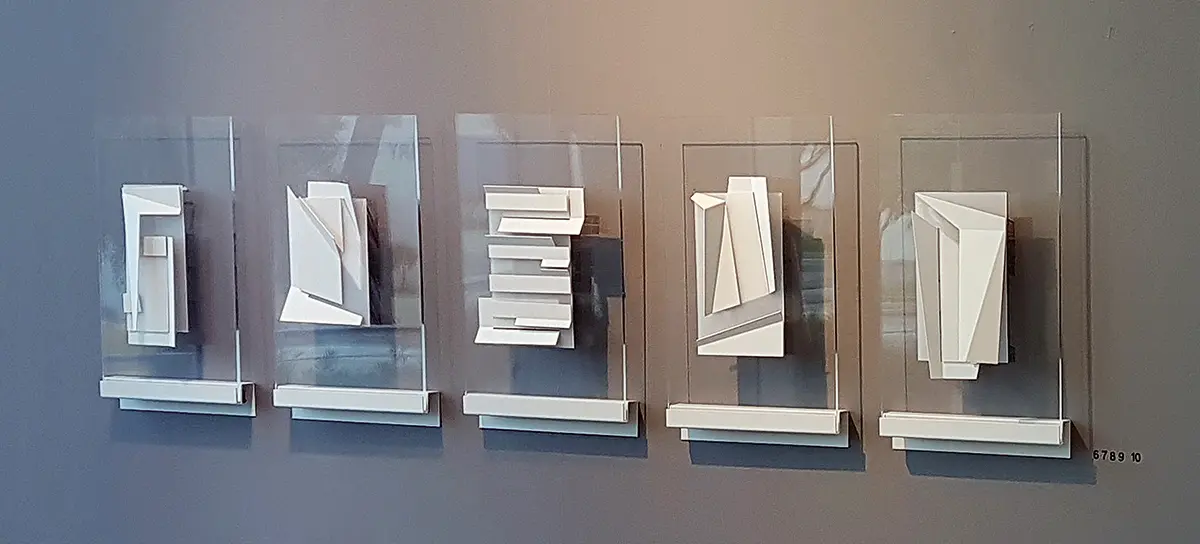
It is within this discursive context that the work of Juan Ricardo Mejía must be approached through an exhibition such as De-Construction-Construction (2019), where abstract-geometric poetry is clearly visible, although not predominant. This show presents sculptures, and also installations such as Urban Alphabet (2018). In both cases, their objectlike, geometric, and constructive nature stands out. Equally salient in the three-dimensionality of these sculptures is the use of materials such as steel, which has been cut, folded, and painted with an electrostatic coating, and to which photographic impressions have been added. Such is the case with pieces from the series Genius loci, Models, and The Color of Shadow Nos. 2, 3, 4, 5, and 6 (2015). Here, as in other groups of works, Mejía is an artist with a syntax that refers, on the one hand, to a purely geometric abstraction that, for instance, is evident in a compositional obsession to find balances between order and geometry. On the other hand, he is also a sculptor who constructs with distinctively minimalist modularity.
Mejía comes from the world of architecture, which manifests itself both in poetic and discursive terms in his work. The poetic dimension emerges, for example, through his draughtsmanship and his vocation for projecting images of objects in space.
A whole process of rationalization, of order, emanating from the drawing as a symbolic capital that “translates” the imagined to the three-dimensional is perceptible. It also materializes all the calligraphic richness of technical and artistic drawing in the sculptural object. This is distinctive of Mejías’ work. What is even more interesting is that—both in the series mentioned above, such as The Color of Shadow (2015), or the series Intimate Interiors. Places of Light (2017)—the interweaving of abstract geometric and minimalist elements is made possible by a poetic awareness of strong post-constructivist resonances. In some ways, this appearance is the result of a particular assemblage presented by the works and their conception of space, which is put together and built with a sort of calligraphy of planes whose projection laminates and divides the spatial and temporal dimensions.
In its discursive perspective, Mejía’s work reflects on the particularities of the city’s landscape, beyond the constructive and urban planning, and its calculated rationality in the design of both public and private spaces. It would seem that Mejía is interested in just the opposite: in the indeterminacy of the peripheries, in the instability of structures, in those frontiers where factory construction and human habitation may converge. Places where work and leisure, day and night, overlap, creating other planes of the quotidian. Dwellings that, in their precariousness, live and reproduce themselves thanks to the “ruptures” of traditional constructive and urban practices organized by the protocols of modernity.
It is no coincidence to witness in Mejía’s series (The Color of Shadow) a proliferation of planes thrown upwards or downwards from their own horizon. Or those twists and turns of expanded and undulating voids produced by the superposition of structures (Places of Light). They are works whose parts cast shadows on the plane, capable of assembling spaces across the distances that separate them. And they are sculptures that result from a symbolic discourse on a constructive regime, which in turn reproduces the unstructured or formless conditions where the being dwells under an existential state of permanent exceptionality.
DENNYS MATOS