Peruvian artist Cecilia Paredes (Lima, 1950) presented her most recent exhibition, Hay tanta soledad en ese oro (There is Such Solitude in that Gold), in Madrid. Previously, she held another solo show at the Museum of the Universidad de Navarra entitled The No Return, which included installations, photographs, and sculptures.
The first line of a poem by Jorge Luis Borges inspired the title of this new exhibition and captured its spirit:
“There is such solitude in that gold.
The moon of the nights is not the moon that the first Adam saw.
Long centuries of human vigil have filled it with ancient tears.
Look at it.
It is your mirror.”
The Galería Blanca Berlin selected an extraordinary series of prints on natural linen, in which the artist reinterprets the complex universe that links the human being to the sphere that superimposes it: the cosmos.
The artist uses as raw material some of the fantastic cartographies of the XV and XVI centuries, filled with images marked by the seal of exoticism. She embroiders on them phrases and figures to highlight the symbolic, allegorical, and descriptive richness of those first representations of the natural world, the Far East, and newly discovered territories such as the Indies.
By overlapping descriptive planes of the celestial vault, she enables the spectator to appreciate how different cultures throughout the history of humankind have delineated palimpsests around the stars, which have always been there with greater or lesser intensity, distance, or proximity. Suffice it to observe the ambivalent differences between the Mayan calendar, the Chinese horoscope, and the astral charts of the Renaissance.
Cecilia Paredes rescues the illusion contained in the graphic need to describe and build a bestiary that summarizes the varied treasures of the world. She asks us to reflect on her inflections, her phrases, and embroidered poems; on our place in the vast universe. Ever since the creation of the famous Italian studiolos or cabinets of wonders from the XVIII and XIX centuries, disparate elements were separated under labels like artificialia, naturalia, exotic, or scientific. These were later relocated to their respective places or inside museums of art or natural history. This amalgamation of mythological beings—mermaids, glyphs, and other creatures that seem extracted from Bosch’s imagination—were scientifically overthrown. However, on the eve of the second decade of the 21st century, the artist raises the need to retrace our steps and to connect with our capacity to imagine and reflect, condensed in the proposals selected for the exhibition.
Paredes also presented some of her photo-performances, which have earned her international recognition. Using her body as a powerful performative tool, Cecilia Paredes usually applies body paint to emphasize the mimetic qualities that allow her to connect with the world or the objects that surround her and have attracted her attention.
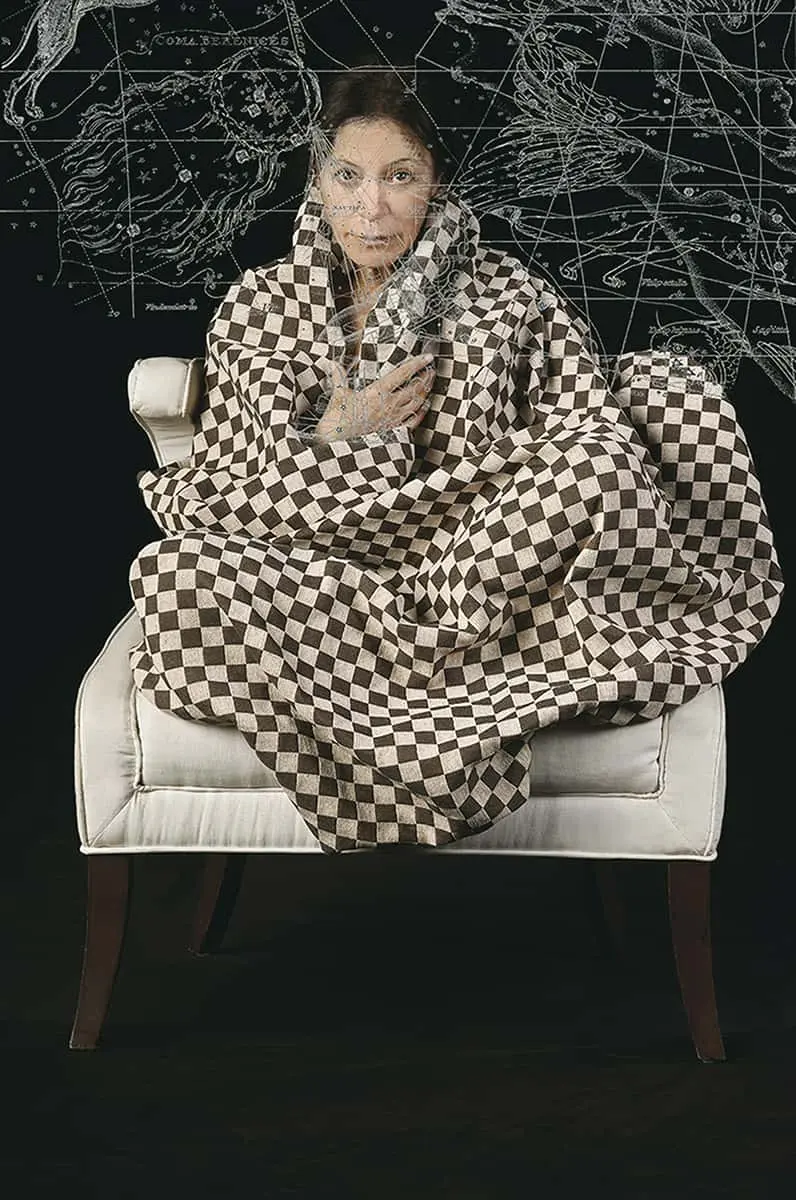
In her self-portrait Celestial Questions (2016), we see her draped in a plaid mantle, behind a delineated description of one of the many astrological cartographies she has rescued. She seems to summon us through these fables.
Not only geometric abstractions, animals, or flowers serve as a setting for her reflections, but also the presence of her discerning body inhabiting abandoned places. The resulting tension is the subject of spectacular photographs, such as The Weaver (2018), where she is dressed in an intricate gown made of shreds of bone-white, a color that so attracts her. She stands, with her back to us, in an abandoned textile factory, contemplating the industry that revolutionized productivity three centuries ago and that, nonetheless, has caused even greater precariousness and exploitation than the previous —at least more artisanal— system of guilds. Perhaps that is why she insists on embroidering her pieces with such detail.
The Periphery (2019) also stands out: a delicate mantle of silk scraps from India, into which the artist has woven a thought-provoking story underlying the cloth’s strange and broken white color. Paredes acquired the shreds discarded from the hems of the saris, the traditional Indian female dresses. These hems have lost their value and become corrupted after coming into contact with the ground’s impurity. A succession of narratives is configured by the artist, who uses this metaphor of contempt and rejection to allude to the role of women from the periphery, from the edge.
ELISA RODRÍGUEZ