The exhibition by Jan Hendrix at the MUAC deserves to be called outstanding not only because of the artist’s work but also for Cuauhtémoc Mdina’s accomplished curatorship, aided by the valuable contributions of Maco Sánchez Blanco. Also deserving of praise is the show›s spatial use of the MUAC. The much-esteemed architect Teodoro González de León would have enjoyed seeing it since the building seems to have expanded in its dimensions and gestures by activating communication with the outside through a room that reveals the external pool of water, recovers some “visual air” for those inside, and punctuates contrasting lights and proportions. This is also valid for the exhibition itself because Tierra Firme (Landfall) deals with nature, and, as such, a connection to non-construction materials was essential to it. In every sense, this was one of the best exhibitions of the year—and the decade. It will travel to the Museo Espacio in Aguascalientes and to the Bonnefantenmuseum in the Dutch city of Maastricht. The catalog, available free of charge on the Internet, is recommended.
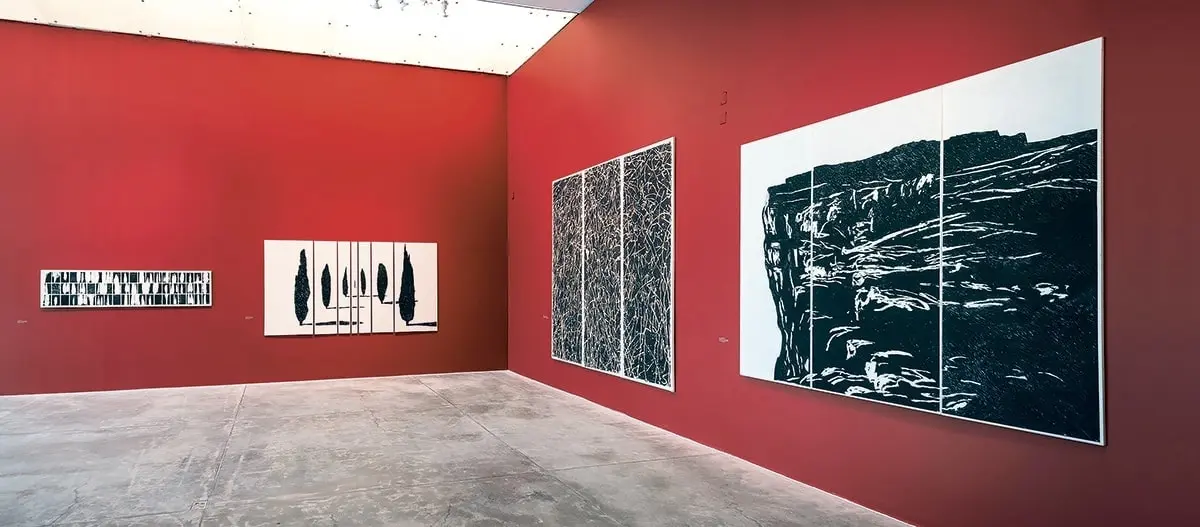
What does the spectator find in the first room? Starting from here, the monumentality-intimacy pair is established to evade any monotony. Jan Hendrix, an immigrant himself, has come to fully understand those European traveling artists who, using pencil and paper, as well as watercolors, have referenced nature since the 17th century. These observations interested the young artist, who was born in Holland and lives in Mexico. Both countries possess remarkable natural features, and Hendrix’s perception reveals them in extreme and opposing magnitudes: “To confuse or to use scale well is always very important, and working with enormous sizes also flirts with details, conveying that double perception of dimensions.”1 Gunnera A and Gunnera B—two acrylics measuring almost 8 x 3 meters, cut with laser and later painted—open the way for the visitor. These pieces characterize the author’s working process: drawing, exploration of materials and techniques, technological application, design—all integrated with the same level of creative respect. Many years of futile discussions about whether artists should do everything or whether it is acceptable for them to employ assistants and workshops are resolved here with the transparency of Perspex or other materials, and above all, with visible results. Indisputably, this author knows the processes, which have allowed him to obtain better results.
Books and tapestries ratify the artist’s broad interests. The books are mostly collaborative productions with poets close to him, especially Seamus Heaney, the Irish Nobel Prize laureate, with whom he traveled; with his death, he closed the Yagul series for Jan Hendrix. His first retrospective proves that this artist is a lifelong landscape painter and traveler, as well as a born naturalist with a chosen residence. The tapestries would require a separate essay; they are exciting accomplishments that offer an extremely warm and provocatively operatic environment. They were made in Mexico and three European countries.
A total of sixty-five works, organized in curatorial nuclei and chronological steps within each nucleus, trace his physical journey since 1974. The aforementioned introductory room is followed by The Golden Bough, Postcards Between Continents, Drawing the Distance, Aeneid, Book VI, and Raw Material. Paper, acrylic, the occasional metal, and textiles such as silk, wool, and chenille predominate. Although not perceived in the exhibition’s circuit, Raw Material is the marrow conjugating all the scenes. A wooden cabinet—measuring 5.80 x 5.80 x 3 meters—with material involving Jan Hendrix’s working process from 1975 to the present—composes a catalog-display room of collected elements, sketches, pre-projects, and ideas materialized in nature and synthesis: seashells, travel tickets, notes, drawings, samples of materials, successful and frustrated experiments... They are organized in showcases and drawers that the visitor can open or close at will, exercising “a certain right as a spectator.” This area is completed by El Sur (The South, 8 x 8 meters, 1986), a silkscreen on acrylic, and Mirror Pavilion I (4.20 x 3.60 meters, 2014), a double cylinder of polished cut aluminum.
Raw Material, curated by Pilar García, gathers countless elements that place Jan Hendrix in action, even if he is not physically there. The room motivates the spectator to imagine the artist in his monumental desk in the Roma neighborhood; having done his drawings at a distance; reading and writing to his poet and artist friends; thinking about the technical output of each project, be it a drawing, silkscreen, collage, photograph, or book; checking his polaroids; considering the proportions to which he will want to display each work, at what distance will it be projected; if it will be integrated into the architecture or suspended and free, and if it will act as a screen or be a polyptych of countless units, as in Postcards between Continents. In literature, the visual arts, music, and the exercise of criticism, when beginning and end touch each other, round works are made manifest. This is also the case with Landfall.
NOTE
1. Telephone conversation with Jan Hendrix in October 2019.
GRACIELA KARTOFEL