Kuri (Mexico, 1970) uses matter as a connecting thread to—literally—classify his works, imbued with a high dose of conceptual content. In the exercise of reinterpreting his own work based on a trash-recycling logic, the artist is able to categorize his production into paper, plastic, metal, and construction materials, which indeed are the labels proposed to organize his first institutional solo exhibition in Brussels, featuring more than seventy works. Zoë Gray curated it.
Informational flows and the principles of commercial and symbolic value are compressed to different degrees in the works on exhibit. Consumption habits and physical tension (between the density and the weight of the materials Kuri assembles) produce a disconcerting feeling of precarious balance.
The show’s route and spirit are in evidence in tidy devices that evince the simplicity of an idea and the forcefulness of a metaphor, as the one contained in Kuri’s metallic wastepaper basket from 2009, which visualizes, in a circular diagram, how a discarded item can be compartmentalized, how it can be reordered.
Casting aside all linear chronologies, Kuri assembles not only different materials but also divergent ideas he has gleaned, like treasures, from various objects extracted from equally multiple geographies. Detritus is meticulously sifted for its aesthetic or conceptual value, which Gabriel Kuri exalts, literally opening up a reflexive path, as is the case of Donation box (2010-2019). This installation allows visitors to make their way through piles of sand dotted with cigarette butts and a few coins. How can the great oceanic masses or the generous sandbanks respond to our carelessness?
Works like Tongues and Holes (2019) configure eroticism based on everyday objects such as a paper towel dispenser with pearled seashell applications, an object naturally associated with the feminine.
Kuri also underscores his discourse based on declassified mechanisms for the reckoning of information. The perforated cards at the core of the earliest computers are not signs of a bygone era. With Felt Data Cards B.1 and B.2 (2019), made in PET felt encrusted with black beans, Kuri emphasizes, in a comedic key and with a keen aesthetic and conceptual sense, how this method can be overwrought and, in a way, ridiculed. Nevertheless, set against the complex data cards used in computing, a basic method such as counting with beans acquires a second use, no longer in the calculation but in the provision of aesthetic pleasure. The felt cloth on which these works are done connotes the absorption of sound, signaling a conceptual quality in the material, as Joseph Beuys also understood.
Following the same logic of “soulful uselessness,” with Quick count 1 (2017), Kuri represents accumulations of black beans, this time, however, represented graphically on five black panels, so that they become practically imperceptible as they blend into that background. The three sets form a minimalist composition.
The installation Box for four (2017) reflects on the action of making use of that which we need. Instead of a receptacle with plastic drinking straws, whose “pernicious uselessness” is reflected in the context of other works, this time, the artist arranges several banknotes, categorized according to their denomination, inside the same container devices. A nod towards the ambivalent “necessity” of paper money or the ambivalent necessity of disposable plastic objects.
Disposable but necessary is the docility of a latex preservative that, inflated with air, alludes pointedly not only to data on fertility rates but also to their connection with the distribution of wealth and their impact on the planet. The fragility that the material connotes in contact with menacing shapes serves to set up a variety of conceptual games.
The aseptic properties and appearance of the stainless metal, along with its aesthetic value, are resources that permit Kuri’s assemblages to acquire different layers of meaning. Contrasting it with plastic, latex, with a rusted object, produces different sensorial results. The metal assumes responsibilities of resistance and protection.
The galvanized gold- and silver-colored metal strips in Looping Trajectory Through Collapsible Mountain 01- 01 (2015) comprise a symbolic loop, a kind of Moebius strip on a complex, chaotic structure. It is a metaphor for the clumsy flow given to the value chain of precious metals.
It can be assumed that Quick Standards, from 2019, is a poetic form of protest. Kuri deploys emergency thermal blankets as shimmering banners. The message is implicit, as these “blankets” are a “practical solution” for keeping those immigrants who escape the fatefulness of disaster, a product of that very distorted value chain. This is why the artist also uses coins as metaphors for feces, and why he makes them useless, in cardboard.
Untitled (stages in an Event line) (2019) emphasizes plastic “and its uses.” In this installation, the familiar expiration date label found in self-sealing bags is maximized and enhanced to provide support for a stout structure that drives a tensed nylon thread across the room. Sadly, the pace of distribution and decomposition of a food item insists on tensing up and becoming ever more profitable. Meanwhile, Thank You Clouds (2004) presents common supermarket bags with harmless messages for the consumer, inflated by fans that produce an unsettling sound.
The reinterpretation of disposable pieces of paper, specifically receipts that reflect levels of everyday consumption, made in wool, results in beautiful ad controversial tapestries. Those receipts not only emphasize the fleeting flow of money, but they also give shape to a consistent series that defines Kuri’s body of work and even makes it possible to engage its visual potential by fraying them, showing errors in their printing, or contrasting their pale colors.
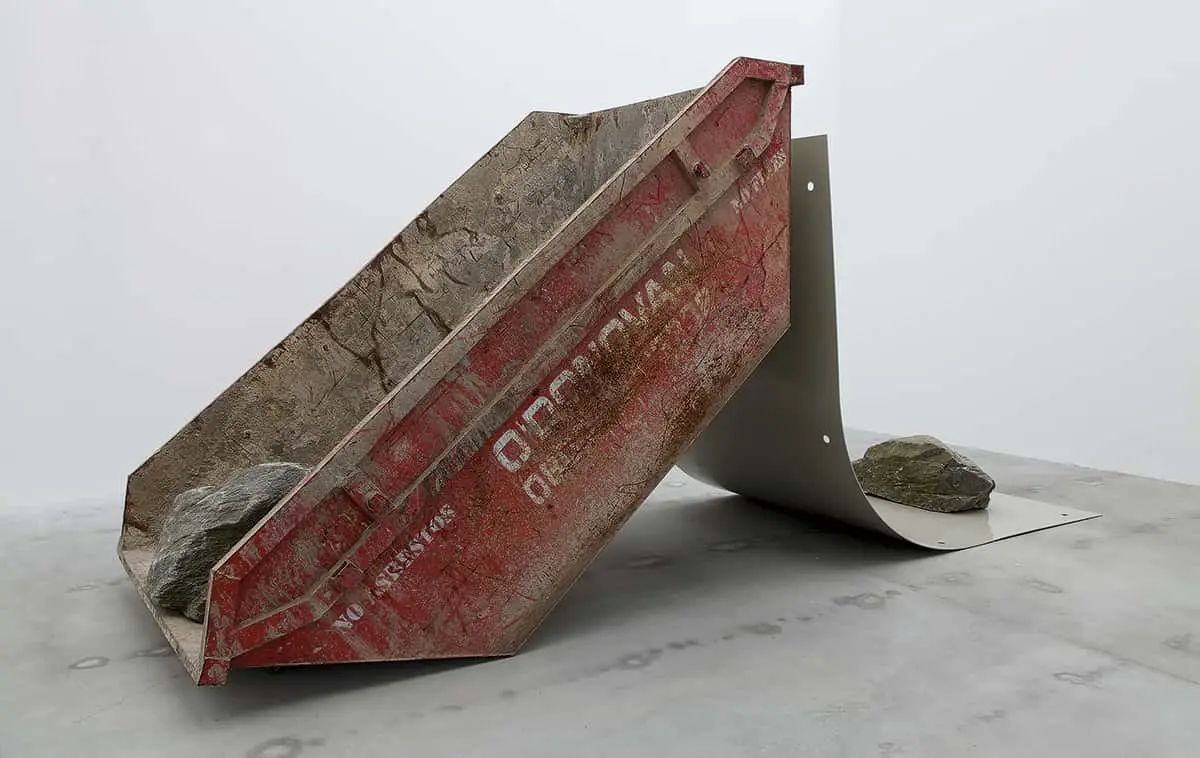
The construction materials accentuate the weight of the show and connote the abrasive process that gives agility to the constructive, “civilizing” machinery. This is an everyday spectacle gleaned from a precarious curtain Soft opening (2011), which invites us to bring our visit to an end.
ELISA RODRÍGUEZ