With solid individual careers and momentary intertwining of proposals, Ramsés Larzábal and Doménica Aglialoro joined discourses in a poetic and aesthetic experience aimed at deepening the theme of Memory and Absence. They came from other lands to develop their artistic work in Venezuela, with contributions that have always moved between the margins and the dispossessions. In this case, their relationship was established through Aglialoro’s words and Larzábal’s assemblages. They maintained their discursive independence under a binding relationship that began with the title: “YO”. The terms of the self are defined in games of contrasting readings: the self that I am and defines me philosophically and existentially as a person; the self of the spectator who travels through ports of identification with objects and texts; and the deconstructed self that can be Ramses Larzabal and/or Doménica Aglialoro, interchangeably, in the exhibition space.
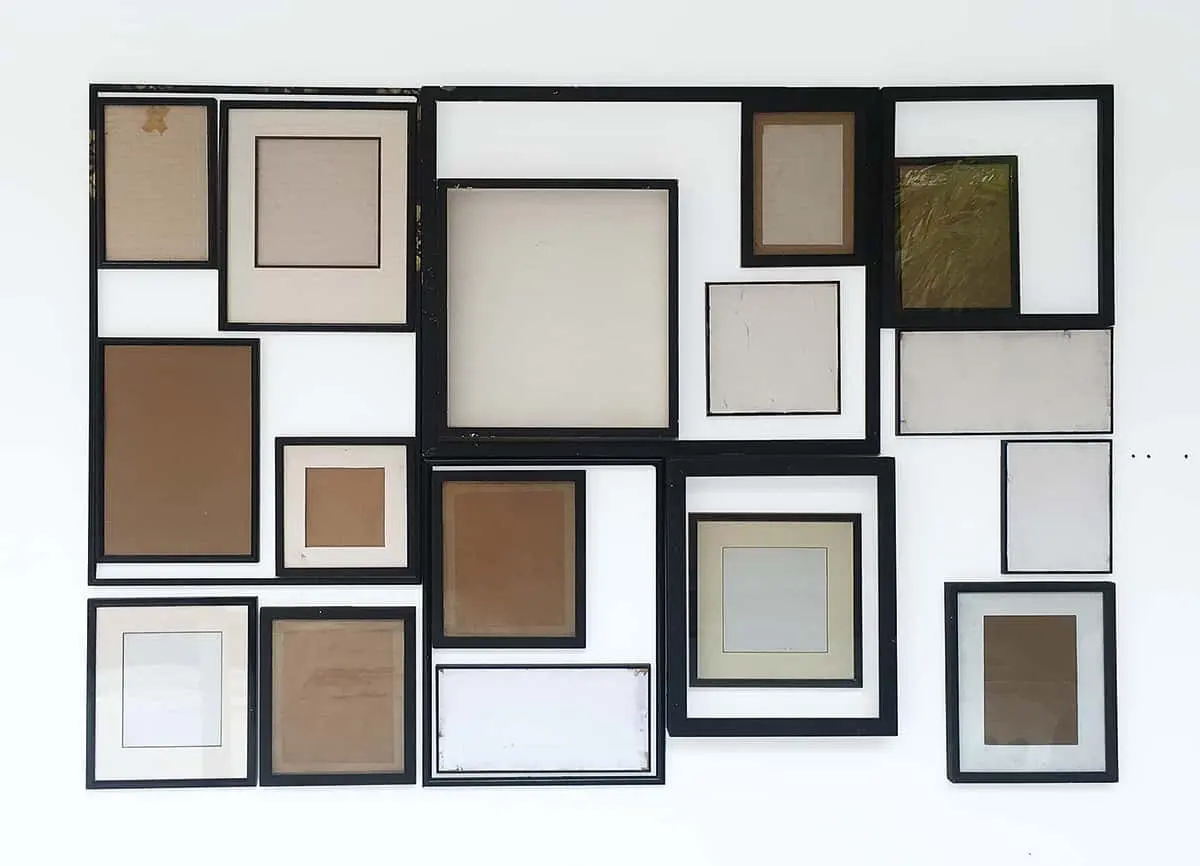
Larzábal’s work has been characterized by a strategy of opposition between the fragility of found materials and the solid structural construction of his assemblages. With delicate straws of transparent plastic, for example, he has fabricated amazingly stable reticuláreas1 that simultaneously move like some species of jellyfish in space, while reinterpreting modernity’s legacy. In this case, he stops at the grid and resumes an interesting conversation with one of the classical elements of the artistic tradition. This system of horizontal and vertical rows that generates right angles has been an efficient pattern of organization spanning from the Egyptians, Dürer, Da Vinci, and Alberti, right up to the likes of Mondrian, Malevich, and the minimalists, who strengthened its presence in the twentieth century. By retaking the grid, Larzábal’s works in this exhibition delve in paradox: on the one hand, they articulate space; they are powerful and rigorous. But when analyzing the materials and objects they are made with, their voids and abysses become perplexing. In this sense, they function as a metaphor for neglect, for what has been left behind, for waste. He uses slide frames, racks, worn-out bobbins, archival photographs, documents, folders, passports, cartons, and other elements that evoke absence and emptiness, as opposed to the systematized structure of the grid. This framework loses its transparency and regularity to become a set of opaque recollections, absences, and unmoored memories. For Untitled (Ektachrome), Untitled (Memory, Visual Arts Center), and Untitled (Kodak Contacts), he used photographic contacts and empty slide frames, and linked them with staples, fragilizing their structural condition. In Untitled (Michelena in front), rickety and empty picture frames make up the grid, while in Untitled (Michelena behind) the frames are shown from the back, generating a clash of textures that destabilizes the gridwork. Similarly, Untitled (Optical Formulas) uses stickers to join the parts, making it even less plausible to keep the flimsy grid tidy.
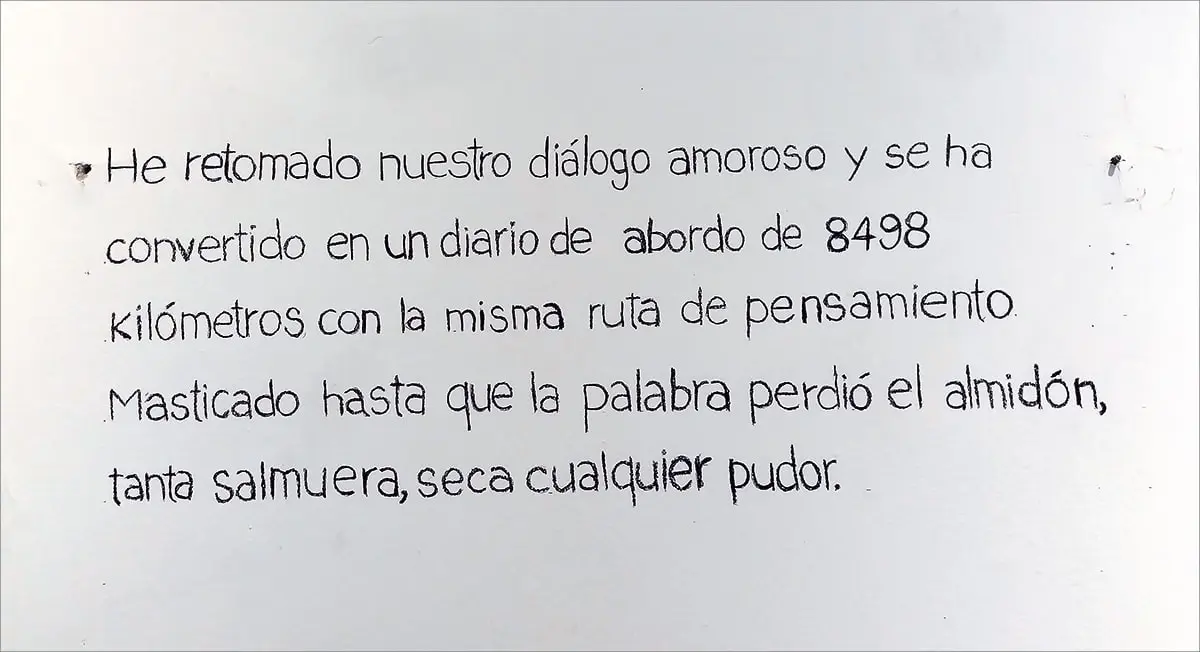
While Larzábal appropriates found objects to trace the visual narrative of absence and emptiness—what is gone—Aglialoro develops a kind of autobiography or chronicle of intimate experiences. Her texts are woven as incisions stressing absence and emptiness. They are revelations about the exile of this unique artist who uses the written word to highlight the distance between two friends, their feelings, and memories: “Our dialogue has become an onboard diary / 8,498 kilometers on the same road of chewed thoughts / until the words have lost their starch / so much brine / can dry up all modesty.” Despite the distance, both have created projects to understand and break the desolation that hounds them. In this sense, their individual selves slide towards a collective self, united in word and memory. Both testify to their lives, fears, nostalgia, and emptiness. Still, they recover the unity in a curatorial fabric of texts and objects: “What they call passion / adorns me / rumples me/ shakes me / blinds me / what they call temperament / confronts me / hardens me / poisons me / what they call character / enslaves me / tempers me / what they call intensity / ravages me.” I am also us: those who live between the cracks of a world that seems structured but is gradually becoming disjointed. As spectators, we associate our memories and remains to the processes narrated by the words of Aglialoro. The curatorship was conceived as a large installation of twenty individual assemblages, each one working in relation to the central tone of the exhibition: individuality amid unrest. As spectators, we reflect on a society of spoils, but we also tenuously unite the brittle structure that sustains us through words and affections.
NOTE
1. The term that Venezuelan artist Gego gave to her famous wire grids (translator’s note).
MARÍA LUZ CÁRDENAS