Like most of the working projects by Puerto Rico-based American artists Jennifer Allora & Guillermo Calzadilla, in this post-medium age, their current exhibition is a complex combination of independent materials and multiple cultural cross-references used to embody their socio-political readings of current situations. Typical is their interweaving of several threads of inspiration—in this case, at least four—into a tripartite structure.
The exhibition title Cadastre is also the name of the large center installation. The word is arcane, used to describe a land recording of real estate, an administrative system used to define size and dimension of property usually for the purpose of taxation. As such, it sits at the heart of a legal system that usually reflects the economic substructure of a country. Karl Marx wrote of it extensively, then known as the Enclosure Act in England, as the new economic system of capital slowly turned Feudal commons land into a privatized and closed system. Today it remains a legal process under different names and common to all taxpayers. Relevant to Allora and Calzadilla’s projects during several decades, the root word for cadastre means boundary or line.
A second major source of inspiration for their project is less visible but signaled by a small black-and-white picture on the wall as you enter the front door, one bypassed by many. The photograph is a 1941 group portrait of European refugees arriving from Marseilles, France, into Martinique, an island best known to contemporary tourists as a vacation destination in the West Indies in the eastern Caribbean Sea. It is also legally a colonial possession, a region (région d’outremer) of the French Republic. The refugees were artists and intellectuals fleeing France from the Nazi take-over of Paris and included the Cuban artist of Afro-Cuban spirit, Wilfredo Lam and his wife, among notable Surrealists, others. Later, in 1943, after Lam’s return to Cuba, he painted his famous The Jungle, a work that uses the sugar canes of Cuba as jungle backdrop to his half-human, half-animal figures from the realm of Surrealism. The formal language is that of Cubist-inspired figures in high modernist style and used to reference Cuban colonial slavery embedded through what Lam called “a psychic state” inspired by Afro-Cuban mysticism.
All of this is important for two reasons. The painting will be the inspiration for the soundscape created for the exhibition by Pulitzer and Grammy Award winner David Lang, titled “Penumbra,” a word of multiple meanings, from shadow to obscurity to, more importantly here, given the nature of this project, an implied body of rights derived from an explicit bill of rights. The non-linear sound plays lightly but foundationally throughout the gallery experience as a combination of tones (from a distorted violin source) that effectively, for this viewer, created a double layer of a quasi-technological or industrial-like base sound with a more ethereal overtone that seemed to encode a dual spirit of the main installation.
The second source reason for this arrival in Martinique, according to the artists, is that Martinican poets Susanne and Aimé Césaire met the European group, and it was Aimé’s collection of poems titled Cadastre that provided a primary influence, by which they meant his well-recognized stance against colonialism. I found the direct connection a nebulous claim, but there is no doubt that Allora & Calzadilla placed anti-colonialism in direct relationship to the contemporary and specific consequences of the aftermath of the destruction caused in Puerto Rico by the 2017 Hurricane Maria, that destroyed the homes and infrastructure of their island. These threads are woven together in the six by 70 feet installation that carries the exhibition title.
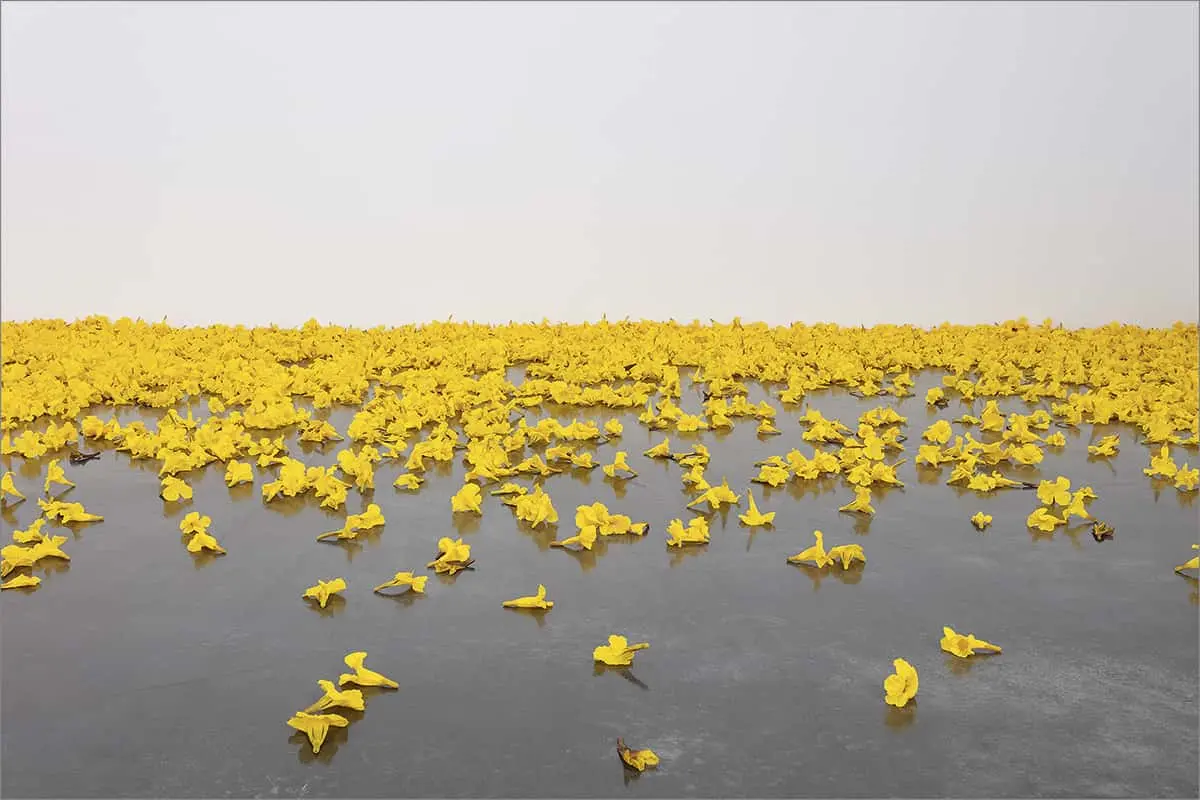
The multiple white canvases mounted continuously end-to-end along two gallery walls have dark black iron filings that form strong horizontal lines across their lengths, accompanied by smaller sections whose abstract swirls of small black specks invoke organic forms that call to mind vegetation as well as the swirls of birds flocking together. And nature is an ever-present element in the exhibition. Strewn across the floor, as if swept by winds, there are thousands of flowers from a native area tree intended to evoke nature’s destruction by colonialism and climate change. But the title Graft, tells us more of the artistic intent than the claims made by the flowers.
Corruption is a central motif here, and it is the process of creation that ties together the physical and conceptual elements. The electromagnetic force field used to create the patterns came when the artists ran current under the canvas using a breaker switch in their studio. The electric power was supplied by the Puerto Rico Electric Power Authority (PREPA). It is in the post-2017 restructuring of the Puerto Rican electrical grid infrastructure where Marx’s critique of capitalist enclosures, colonialism, and artistic conceptual materialism merge.
The electrical grid, like so much else in Puerto Rico, has always been directed by capitalist forces and corrupt graft from outside and inside the island. Today, the considerable replacement costs and the bankruptcy of PREPA have provided a new opportunity for the same socioeconomic power alignments. Since 2017, PREPA and its creditors have restructured to privatize, enclose, the electric power supply with billions of dollars at stake. Here, the lines of formation, the iron filings, are the boundaries or “cadastre” in the continuing process of colonialism by capitalism, with the burden placed, as always, on the people. The immense and unclear subtitle to this piece ironically makes clear the point: (Meter Number 18257262, Consumption Charge 36.9kWh x $0.02564, Rider FCAFuel Charge Adjusted 36.9 kWh x $0.053323, Rider PPCA-Purchase Power Charge Adjusted 36.9kWh x $0.016752, Rider CILTA-Municipalities Adjusted 36.9kWh x $0.002376, Rider SUBA Subsidies $1.084)
Translation: you pay “them” for it.
RICHARD LESLIE