Cassino, at Luciana Brito Gallery, was Caio Reisewitz’s sixth exhibition. On this occasion, the São Paulo photographer presented a new series of five large-format images. A critical essay by Luisa Duarte accompanied Reisewitz’s clearly abstract photographs.
These works are part of Reisewitz’s research of the semantic discussion of the space where the images were captured and its dialogical relationships with the current political moment in Brazil, marked by the fetish of post-truth, along with the effect these events have on the artist’s emotions and his memories of a childhood lived under the country’s military dictatorship. The main sign of those feelings is emotional depletion, transposed into nothingness using a game of illusion and ambiguity.
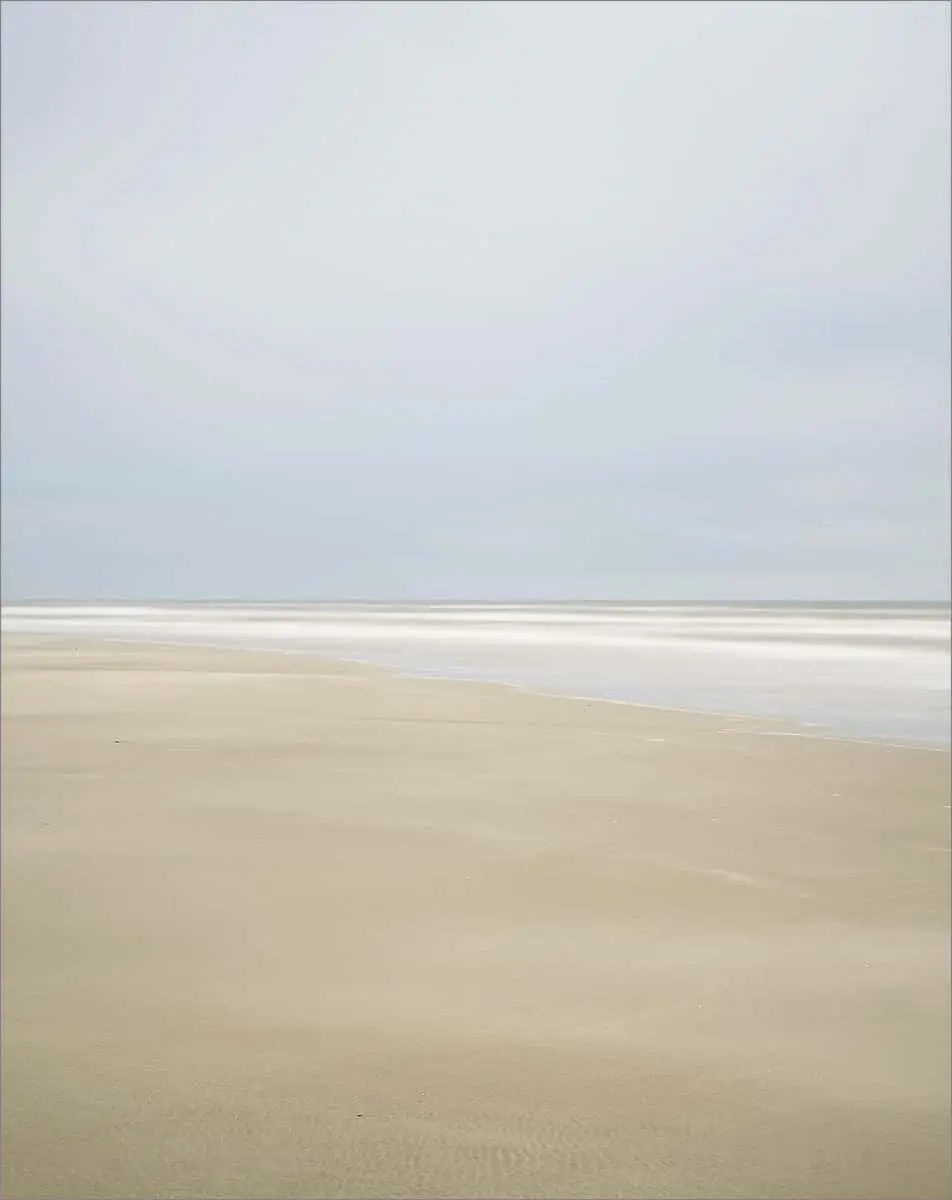
Cassino activates its viewers’ sensations, prompting different layers of meaning and opening itself up to the possibility of multiple readings. The five images edited for this exhibition were shot at a beach of the same name as the title, and immediately situate the observer in a scheme through which Reisewitz seeks to connect with fantasy, with illusion, and sets up a wager between his own formal investigation and his reflections about contemporary political reality.
Praia do Cassino, the location chosen for the photographs in the exhibition, is in the municipality of Río Grande, well in the south of Brazil. The photographs, constructed as pictorial compositions, with particular importance given to gray hues in the creation of the images, push the senses towards feelings of melancholy while at the same time confounding our vision of the sea as it vanishes into the horizon.
Reisewitz’s quest for minimalist oneness is connected to his strategy of using the representation of emptiness to signify emotional depletion. According to the artist, “there is in this series a powerful drive towards the outer boundary of photography, empty space, which is a way of dealing with the situation we are experiencing in Brazil and the world.”
Caio Reisewitz invests in a dialog with games and playfulness, connecting his memories of a childhood lived during the final years of the military dictatorship in Brazil with the country’s current political moment when angst and emptiness materialize and move backward in time.
Metaphorically, the photographer plays with the anecdotal chaos that is experienced today in Brazil and also has some connection with the site, Praia do Cassino, which provokes ambiguities in time and space. A kind of war cry, of provocation, in the time of “post-truth” inaugurated by the ascent of authoritarian-leaning governments. Those elections were contested in a sort of virtual casino where imaginaries are manipulated through fake news, massively disseminated through social media to befog the minds of voters. The Cassino Spa, inaugurated in 1890, is the oldest in Brazil. In 1994, Guinness World Records erroneously named Praia do Cassino as the world’s longest beach.
The word Cassino in the exhibition title has a dual connotation. “A casino is a gambling establishment set up to swindle its customers; they believe they are in the hands of pure chance, but in fact, chance is always slightly manipulated in favor of the house,” Reisewitz explains. “The title of the show refers to the location where the photos were shot, but I am more interested in its ambiguity because the illusions of the casino also express our experience of Brazilian politics in recent years.”
The artist makes his wager in this interplay, abstractly displaying the images of a beach whose very name is a metaphor of illusion and manipulation. Poetically, Reisewitz recovers the idea of emptiness, the fortuitous, the falsity that defines the relationship between what appears and what is, and he does so masterfully. The images fuse into one another in the refined color palette he has chosen; the drastically reduced number of elements keeps all expectations contained. Reisewitz throws onto the table his gambit towards emptiness, towards fantasy as a critique of the contemporary, like a roll of the dice, with the artist’s intention as one more layer to be discovered. His provocation demands that we pull back the veils disguising a false, constructed, manipulated reality.
In these five photographs, Reisewitz explores that emptiness, outlines that melancholia, and illuminates the clashes and interplays of interests involved in each deceptive win. Still, the winner is never the player: it is always the house, the casino.
Deeply critical, Reisewitz humorously threads the lack of perspective, the combination of water, horizon, and hue, together with the name of the location and its fake history as the world’s longest beach, which frays the citizenry’s vision and leaves it with space for nothing more than a leap into emptiness in order to dispel all the layers of deception.
HÉLCIO MAGALHÃES