When entering Gabriel Silva’s solo show La tercera expedición (The Third Expedition) for the first time, we might think that this artist, born in Bogotá in 1955, is going through a new stage in his painting. In the art world, we think in terms of stages, but what if we changed it to births? A new birth for someone who confronts a world to be discovered and has to leave aside previous solutions to find other ones. As we wander through this exhibition, we seem to inhabit a familiar but alien cosmos, like those astronauts in the story that the artist drew inspiration from to create this group of works. Finding the same things in a completely different place is no guarantee of affinity or compatibility, but rather a symptom of strangeness. If I’m in a completely different place, why does it look similar to what I already know? Where does it come from? Let’s say that the origin is one and the same; the same raw material, although the artist wants to escape his tricks, vices, and solutions, enlarging the world of shapes and colors, setting his hand free, and varying the characters and the landscapes they run through.
One becomes familiar with the worldview of certain artists, and time after time, it may make us happy to confirm that the world has not changed. However, for an artist, this can mean a total sclerosis in creative thinking. In Silva’s case, when feeding off science fiction literature—specifically a story by American writer Ray Bradbury included in his Martian Chronicles, which deals with interstellar travel—, he is committed to expanding and challenging his way of seeing the realities of his surrounding world.
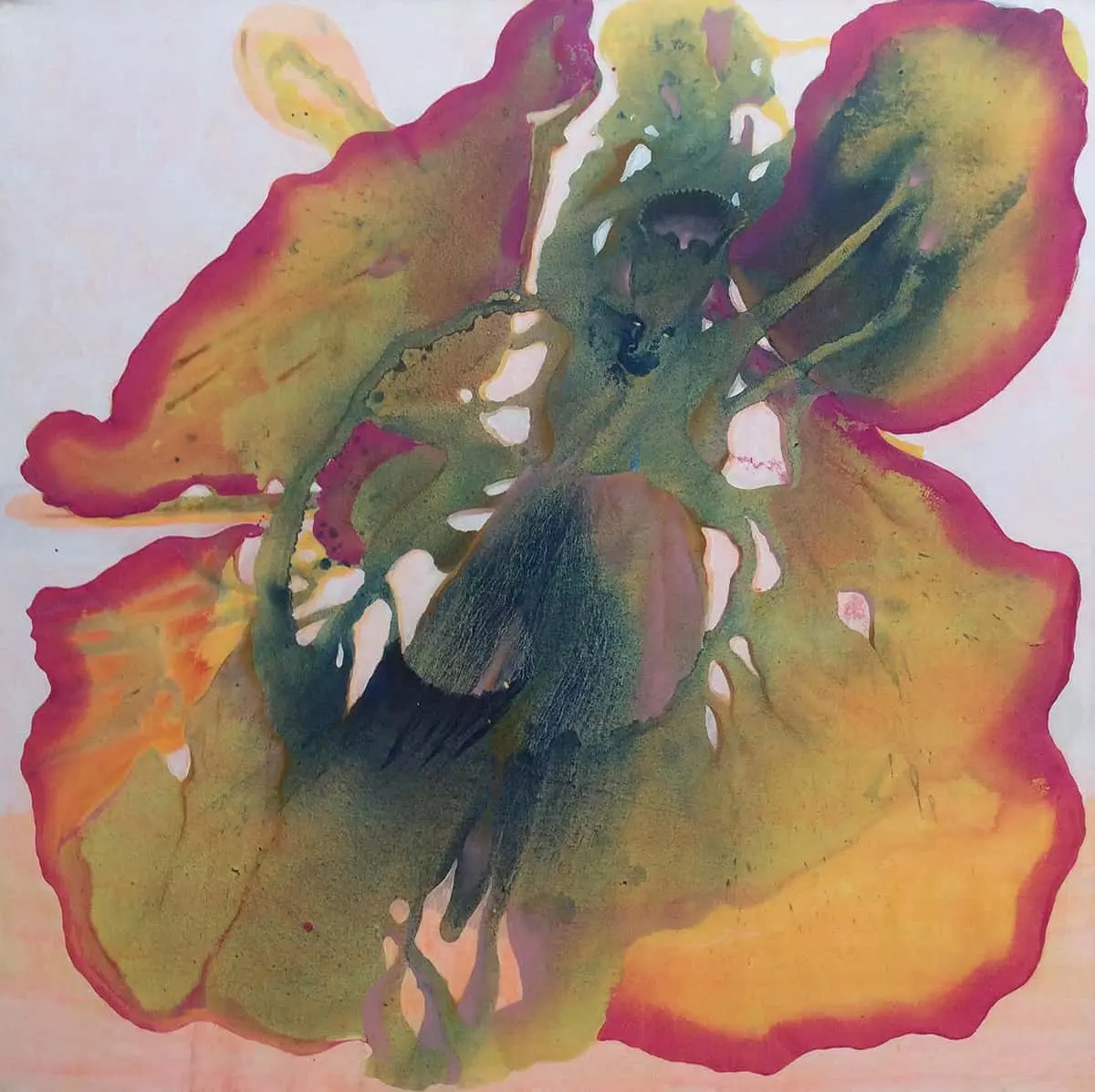
In this exhibition, a clear protagonist is color, which has now become expansive in its abstraction, bright, contrasted, and containing figurative forms that we sense by observation, and which the artist invites us to discover in all directions. The canvases—as usual with Silva—can be turned on all four sides without affecting the “correct” meaning of the painting. Compared to other series, in which the figurative contained the abstract, the opposite occurs in most of these pieces. The shapes open up, resembling Rorschach spots: like suspiciously random colored surfaces that suggest forms determined by our unconscious. For example, yellow expansions outlined in red bring us closer to the inside of a possible flower, or possible flowers transform into a blue landscape, and in turn, become a character at the edge of an unknown world. These new images do not offer the distance and the compact literary vision of Silva’s previous landscapes, but instead, confront us with a world less contained within the four edges of the canvas. As a painter who generates his own world—not a common occurrence—, Silva creates with a multitude of references spanning from the medieval through the surrealist and up to contemporary illustration, to which we can add the automatic irrigation of literature, which in this case means science fiction. With these ingredients, the artist generates his own sample of characters, bestiary, and herbarium, this time encouraged by the idea of escaping his obsessions and accumulated neuroses after decades of battling against wind and storm to establish an independent and free world, almost like an autonomous school. As a predominant element, it would be relevant to point out the role of nature in this exhibition, as something that receives attention from the artist, as forms that open, grow, and breathe shape and color in front of our eyes. Another protagonist is the explorer, who is forced to change scale and ways of thinking throughout his journey to define a new world that opens in all directions.
The hand and the mind are freed to find other paths and travel without losing sight of the broad horizon, while also refreshing the visual universe that emanates from the artist’s imagination. The word imagination is deliberately used because it seems that contemporary art should not invite us to imagine, but rather to reinterpret what already exists, understandably. However, this artist precisely grabs the possibility of freedom to generate non-existing worlds to reverse the known order established by the prevailing canon. The Third Expedition represents a new painterly birth that makes us wonder which course will be taken by this generator of myths and characters in the pictorial and three-dimensional field.
CARIDAD BOTELLA