We live in a world of noise, a world saturated with urban sounds and plagued with information. Contradictory and polarized voices reach us through specialized media and social networks; many of them allude to climate change and come both from those who pretend to ignore it and those who, powerless, cry out for change. Recently, in horror, we watched the Amazon rainforest burn under the indifferent gaze of the President of Brazil. We have seen a polar bear clinging to a fragile piece of ice, and we have daily access to images of areas ravaged by deforestation caused by the misuse of natural resources—gold and oil— as well as by drug trafficking. Money and power prevail over the right to life. Despite countless protests, actions that threaten life on the planet continue to do seemingly irreparable damage. For many years, while the subject was not so heated, Liliana Durán had been giving signals in defense of nature. In the eighties, she carried out different actions with keen ecological awareness with her students at the Escuela de Bellas Artes of Cali, and ever since, she has continued this path in her personal work.
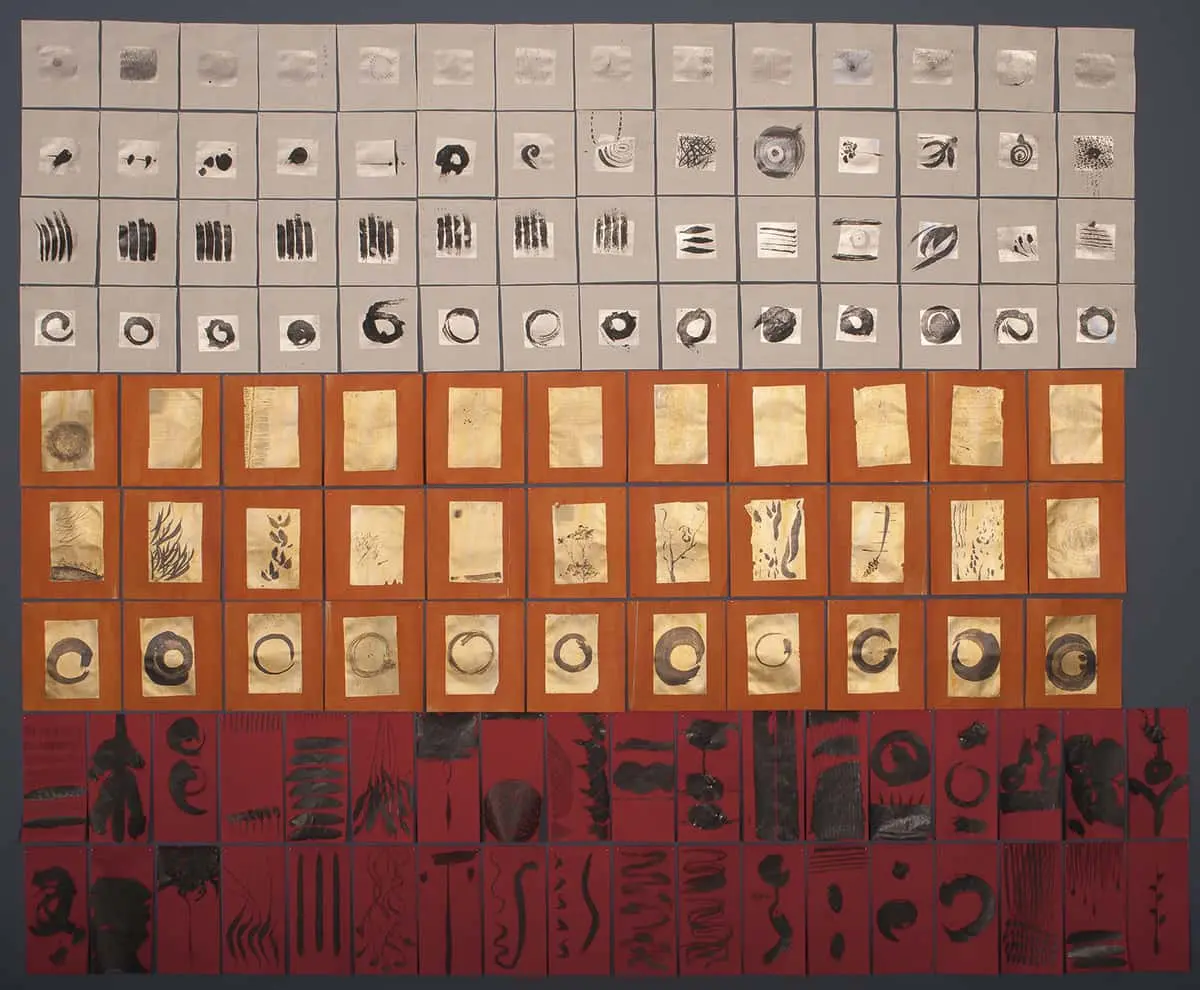
In her latest exhibition, entitled Silencio (Silence) and curated by María Elvira Ardila, she brought together a group of drawings and paintings produced in recent years. As the curator points out, the show was divided into three sections: works inspired by the I Ching—the Chinese oracular book—, landscape and animal triptychs, and the rolls of drawings extending from ceiling to floor, in which, through a meditative process, lines and graphics were drawn in a continuous manner using the Sumi-e technique. (A way of drawing and writing originating in China and appropriated by the Japanese and Buddhist monks. This technique, besides special brushes, requires extreme precision and must be preceded by a meditative state that allows capturing, not the appearance, but the essence of what is painted.
The title of this exhibition seems to counterbalance the boisterous contemporary world. With it, Liliana Durán asks her viewers to relate to the work in a contemplative act where words do not mediate. The very process of creating these pieces also relies on a silent, meditative act, linked to ceremonious attitudes inherent to Eastern culture, and which are closer to gesture than to words.
In her studio, located far from the city, in complete solitude, and in direct contact with the natural landscape, one of her most significant works emerged: Homage to the Planet (2009), made up of 365 small-format drawings portraying how life languishes day by day: landscapes full of color and detail, in a long succession, gradually fading to extinction. Since then, her work seems to be marked by this obsession, which, far from being a figment of her imagination, has become a dramatic and pressing reality.
The animal triptych exhibited in Silencio—in my opinion, the most important work of her recent production—alludes to species in danger of extinction. The first canvas is painted on raw linen sealed with rabbit-skin glue, giving it a subtle shine, and is delineated with great precision and detail in black ink. In the next canvas, the animals occupy the same place. Still, their features are disappearing. In the third painting, only a weak Sumi-e trace prevails, leaving an almost imperceptible mark of their existence. The large size of this work—which goes from the ceiling to the floor—, the masterful draftsmanship, and the idea that sustains it, make us witness in silence, poetically, with an absence of words, the annihilation of hundreds of species, as we feel our impotence before our current world’s devastating panorama.
This triptych, in addition to its power, reveals an exquisite refinement that is also present in the other pieces. The delicate drawings of the I Ching composed a mural: one half was drawn on white paper and the other half on orange paper. Both were executed with the Sumi-e technique and point to a ceremony denoting long days of work. The landscape triptychs combine gold leaf with the implacable weight of charcoal and black ink. Austere and exquisite. These qualities are also present in the very long rolls that were preceded by an act of meditation that detonated freedom of expression through a continuous graphism. They evoked both oriental calligraphy and the moment when Western artists, fed up with the disasters of the Second World War, looked at other worlds, other spiritualities, and other cultures, just like Liliana Durán.
On closing day, some drawings of the series Homage to the planet were donated to those who brought trees to be planted at the Sabana de Bogotá. It was a way to compensate for the damage caused during the many centuries of domination that man has exercised over nature. This exhibition was imposed as a silent act of refined and forceful resistance to the loud destruction that threatens the fragility of life.
MARTA RODRÍGUEZ