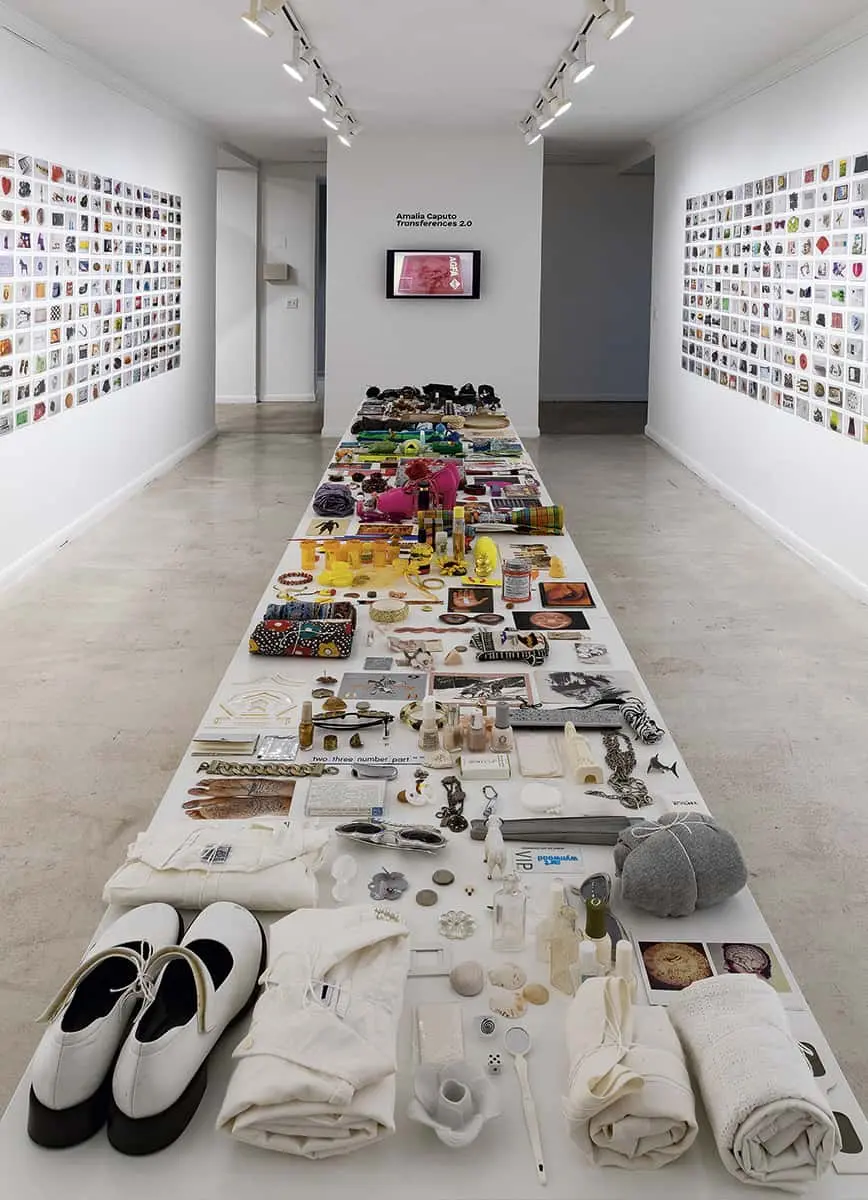
Transferences 2.0, an installation by Venezuelan artist Amalia Caputo, was presented at the Art and Culture Center in Hollywood (Florida) from September to October 2019. This work—the second version of a similar one installed in Caracas in 2012—deals with the concerns that persistently and from various approaches, the artist has been manifesting on the nature of memory and the subjective mechanisms involved in its construction.
On this occasion, Caputo goes back to the collection of small and simple objects or “memories” that she has been gathering and treasuring for years. The work was installed in a room in which a long central table was placed to display shoes, nail polish bottles, toys, photos, postcards, coins, tickets to a show, ornaments, old documents, pencils, and many more things of her particular memorabilia. The spectators were invited to choose and take any object from the table. On the walls of the gallery, like two large mural-size albums flanking the table, she showed the photographic records of the objects exhibited. In the end, a video showed a montage of the images that showed each object for just a few seconds.
The exercise of preserving her own memory through small things has been present in Caputo’s life since she was a child and has been linked to the moments she has experienced, especially important milestones such as moves and farewells. After she left her native Caracas in 1999 to live in New York and during her subsequent sojourns in Barcelona and Miami, the treasured objects became minimal witnesses of the past. They were physical bridges to subjectivity, whose existence and revisit conjured uprooting. The first stage of this installation is located there, far from the room, in this process of collection and preservation, intimate and methodical.
The photographic record of the objects came from her interest in the construction of visual archives. It emerged initially from the practical need to physically get rid of a part of her copious cluster of memories, preserving them through the image. A reflection accompanied her realization on the dichotomous drives of keeping and discarding, about the nature of photography as a tool to “remember,” to “freeze” time, and about the dynamics that digital photography shoots in the contemporary world.
For Caputo, the excessive production and consumption of photographic images through social networks have led to the creation of “photographic lives” that run parallel to real existence. In this sense, one of the conceptual centers of her digital image archive is based on the observation and integration of this process, in which a physical-real file is replaced by a collection of digital photos (which are only information translated in bits) that act as a kind of platonic mirror of our era. This idea is accentuated in the video where the images are shown in short and regular intervals, which barely allow you to think about what is observed. This relentless flashback awakens unconscious associations and creates a poignant and moving atmosphere.
On the other hand, the photographic archive allowed her to establish a second layer of memory mediation by creating a set of “memories of memories” and therefore deciding to “let go” of some physical objects. The idea of allowing the public to take the objects was to generate an exchange of meanings, memories, and subjective contents. Caputo reflects on the relationship between things and people’s existence, taking an interest in the emotional and deeply psychic charge we place in them. She also wanted to point out to the valuation the public gave to the objects taken from the table, as these came from an exhibition held in the museum’s sacralized space.
Amalia Caputo’s photographic work always proposes to “think about photography” as a medium. What is its nature? What is it for? What are its purposes? These are some of the questions that arise within the broad reflection that her work proposes on the eminently subjective nature of the photographic image and the many layers of significance that her mediation provides.
Transferences 2.0 is rich, intelligent, and moving. The installation builds a poetic space to “say” the memory, in which each object, each image, and each exchange of the many that it provokes speaks from the quiet space of an unattainable, irrecoverable past. Objects and photographs remain as glimpses to reconstruct the memory fictions, promoting their emergence as a subtle weave nourished by the immaterial.
KATHERINE CHACÓN