Since 1998, artist Mika Rottenberg has been developing—mostly in New York and Europe—a consistent body of work in video and video installation, for which she has received various awards and participated in significant shows since the start of the 21st century. This fact must be highlighted because critical notes and artist-spectator relationships in video manifestations are less frequent, even though the technology and the medium are more than five decades old. Mika Rottenberg offers the viewer a conceptual approach that differs from most videos, both in themes, critical emphases, and her social and postfeminist reflections. Similarly, the artist brings diverse dynamics to her films, which affect the rapport that the spectators establish with them. A dozen of her works from 2015 to 2019—except one made in 2012—were recently exhibited at the New Museum of Contemporary Art in New York, and later traveled to the Museum of Contemporary Art in Chicago.
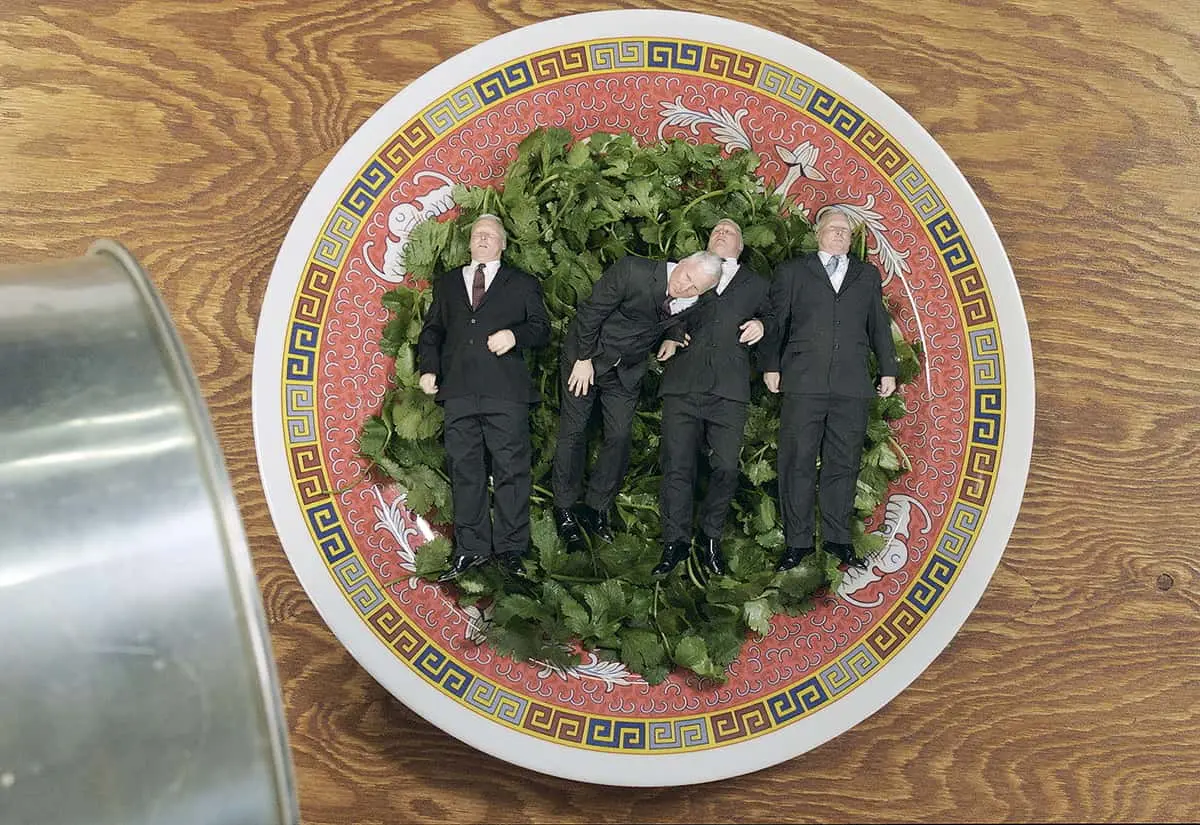
The artist named the exhibition “Easypieces” in homage to the theoretical physicist Richard Feynman, who managed to transmit the fundamentals of physics with ingenuity and great communication skills in his book Six Easy Pieces. Evidently, Mika Rottenberg understands the principles of quantum mechanics, energy, atoms, gravitation, and other elements, but also shares with Feynman the talent to convey difficult and complex issues with inventiveness and offer creative examples. Her videos do not focus on quantum physics or anything akin, but some of her fabrications seemingly resort to physics in ironic, laughable, grotesque, metaphorical, and liminal narratives. In some instances, they reach levels of displacement from reality, introducing crazy inventions, as well as revelations and reflections on society. In her work, the structure is fundamental, like the architecture of the world or the architecture of bodies. After this reference, it is essential to add that her videos are usually shown in spaces that ratify motivations in the spectators, who don’t stand in front of a monitor, but are instead confronted with duplications of the textures of the walls and ceilings that appear in her videos and with decorative motifs that bewilder the viewer with reiterations of the scenes or with three-dimensional, often kinetic, elements. This aesthetic strategy is evident in the 2016 sculpture entitled Ponytail (Orange): a long, thick, moving orange-haired ponytail fastened with a blue elastic band protrudes from a small hole in the wall. Untitled Ceiling Projection (2018), screened on the ceiling, focusses on consumerism and the mass production of useless objects by featuring elements of a Chinese supermarket, visual saturation, superfluousness, and the need to dazzle the customer. Rottenberg also researched the production of artificial pearls, contrasting the sweatshops with real pearls extracted from the grand ocean. The artist also highlights beauty “treatment” places and alludes to extreme sensuality, always handling sarcasm fluently.
Mika Rottenberg is a perfect example of those Argentineans who—especially since the 1960s, and rightly so—are called citizens of the world. Born in Argentina, they leave to study and work in various latitudes (in her case, she studied in Israel and now lives in New York). They become proficient in diverse fields and stand out as individuals, unlike the anguishing massification and alienation of their native country’s population. This description is one of the few acceptable generalizations that apply to Mika Rottenberg, daughter of postmodernity, and in this, our current transmodernity.
Another distinctive feature in her video installations and sculptures is the presence of women with large bodies: characters who are the antithesis of the Argentinean woman, very concerned about her proportions. The artist’s interest in architecture establishes a simile with the female body as a receptacle, both maternal and sexual. Sound inhabits her creations in diverse dimensions, such as bodily noises, occasional music, and untimely altered silences. Mika Rottenberg’s work is hilarious and somewhat kitschy, surrealistic, and elegant.
GRACIELA KARTOFEL