En el principio fue el nombre. Cecilia Vicuña. Incluso antes de que esta poeta, artista y activista chilena –nacida en 1948– comenzara de niña a entrelazar palillos y hacer pequeños tejidos en miniatura –como aquellos que en el universo andino ancestral se ponían en las tumbas de los sacrificados, imitando el gesto de las manos de su madre que le cosía muñecas, “seres o criaturitas” para ella–, ya estaba marcada por la línea materna conectada al milenario pasado de la América indígena. Y por el apellido paterno, Vicuña, nombre de origen vasco, que coincide con la palabra quechua wik’uña, que designa a ese animal sagrado en la cultura inca. “El pelo de la vicuña –dice– es absolutamente sagrado. Mientras más difícil y hermoso era el tejido que se hacía, mayor importancia tenía, y una vez terminado, lo incendiaban para ofrecerlo como ofrenda. El tejido se sacrificaba para que la imagen ascendiera”.
Ofrendar, ofrecer en sacrificio –del latín sacro, y de facere, hacer–, es “hacer sagradas las cosas”, honrarlas, entregarlas. Vicuña, inmensa poeta de las pequeñas cosas, ha elaborado textos y tejidos, ha hilado palabras y piezas textiles, transformando la cotidianidad del mundo con su escritura y con sus prácticas artísticas para recobrar una visión más cercana a lo inmemorial y sagrado en este oikos (hogar) común que es la Tierra. El sentido de la ofrenda permite entretejer los tiempos de una vida que es un acto de creación continua. No una trayectoria. Más bien, una forma de resistir que se remonta al momento en que a los nueve años la exiliaron de su infancia de “niña silvestre” que escuchaba y miraba todos los reinos naturales, y la llevaron a un colegio bilingüe en Santiago. Entonces ella –que también tiene sangre irlandesa– decidió asumirse como indígena desafiando las hegemonías de una sociedad que desdeña las voces ancestrales. Seis décadas después de esos juegos de identidad, en los que se ponía en la cabeza (y ofrecía a otros) plumas, sigue reafirmando en sus obras las cosmovisiones nativas negadas, con el potencial de una imaginación que no solo pertenece al pasado: es una memoria de “lo que va a venir” si queremos permanecer como especie.
Painting is still going strong. This is an indisputable premise today, despite the verdict at the end of the last century that insistently announced its death. Fashion issues have been reevaluated today, even by the very same people who at the time had released them, like Saatchi himself. And painting still exists today because of artists like Guillermo Londoño, who has been painting for decades, always with an intelligent approach. But what does it mean to paint intelligently, you might ask? The answer is simple: to paint intelligently is to overflow the purely technical plane and complicate painting; that is, to fill it with content, not just pictorial matter. The striking title of Londoño’s exhibition aroused my interest: Lo que el ojo no ve (What the eye does not see). What does the eye not see? I immediately connected this phrase with one that has haunted me since time immemorial and inspired me in my research on photography: “Photography shows us what our eyes do not see.” Wim Wenders makes this statement while driving across a desert in the United States, with mountains in the background framing the landscape. The scene is from Alice in the Cities, and the photos coming out of the Polaroid camera show that landscape.
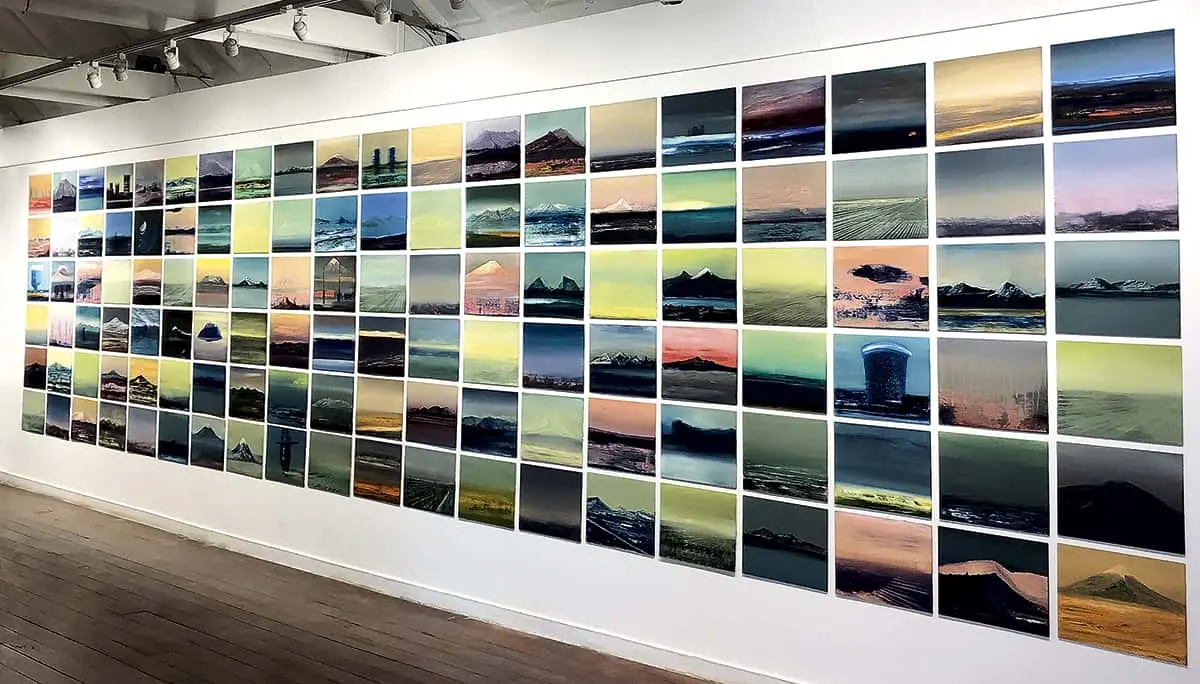
I couldn’t help relating these two phrases, since beyond the visibility and the impossibility of seeing, what is evident here is the landscape. The small-format paintings (more than 120) that make up a large mural generate a landscape that reminds us of those once captured by the chorographic expedition: the mountains and valleys of the Andes, our mountains. But what is surprising is that these landscapes, no matter how familiar they may seem, are absolutely imaginary. In other words, the painter made them as if inspired by photography or reality itself. Real landscapes allowed him to configure his images, no doubt. Let’s see what Guillermo Londoño tells us about the act of painting: “One of the many ways to make a painting in technical order relies on ideas and drawing; and from the drawings, the color of the form is born. My paintings initially start from the color, which I randomly mix and spread on the canvas. And so, like someone who goes out to hunt for figures by looking for shapes in the clouds, my paintings are constructed from accidents and controlled stains that create apparent invented places or a distant memory. They are abstract landscapes amid fogs and mountains, devoid of human figures but not of their marks and scars, which alter and transform the latter, such as roads, lights, or crops. These invented landscapes may refer to moments or places previously seen, to out-of-focus photographs, or reflections on glass. They are landscapes that the observer believes or expects to recognize, apparently common geographical places, but absolutely virtual and given meaning by the individual’s sensitivity. Small bright spots, unidentified flying objects, remind us that everything is possible, that perhaps we are not alone in the universe and that imagination and reality are closely related, meeting and merging in mystery.”
Indeed, this link between reality and the imagination fills the void that now becomes landscape. What our eyes do not see is, therefore, an homage to those interior images that populate our unconscious. To see those images, we have to look inwards; to look with our eyes wide shut. Only then, Kubrick would say, will the images we have never seen become visible; more so now, when we can no longer see them simply because we are immersed in a kind of collective blindness and an excess of images prevents us from seeing what needs to be seen. “What the eye does not see,” the artist makes visible. They are in charge of filling the desert of nonmeaning with images, no matter how invented or false they may be, because we must not forget that art itself is a fiction that ends up generating truths and realities. Like when Guillermo Londoño discovered that the Nevado del Tolima once belonged to his family. When I first saw those paintings in the exhibition, I thought: “What wonderful landscapes.” Now I realize that we owe this feeling of wonder, even if they do exist in the real world, to the artist’s ability to show us what our eyes do not see. Is this not art?
RICARDO ARCOS-PALMA