Rio de Janeiro’s artist Sonia Andrade is widely recognized as a significant referent for video art in Brazil’s contemporary scene. The country’s first-ever solo video art exhibition was hers, in 1977, at the Museu de Arte Contemporânea de São Paulo. Although she had a large retrospective at Rio’s Hélio Oiticica Municipal Art Center in 2011, her works with appropriated objects, photography, and design generally receive less attention. Those series are gathered into what the artist calls “sets”: groups of artworks that can only be shown as a whole, in a specific space.
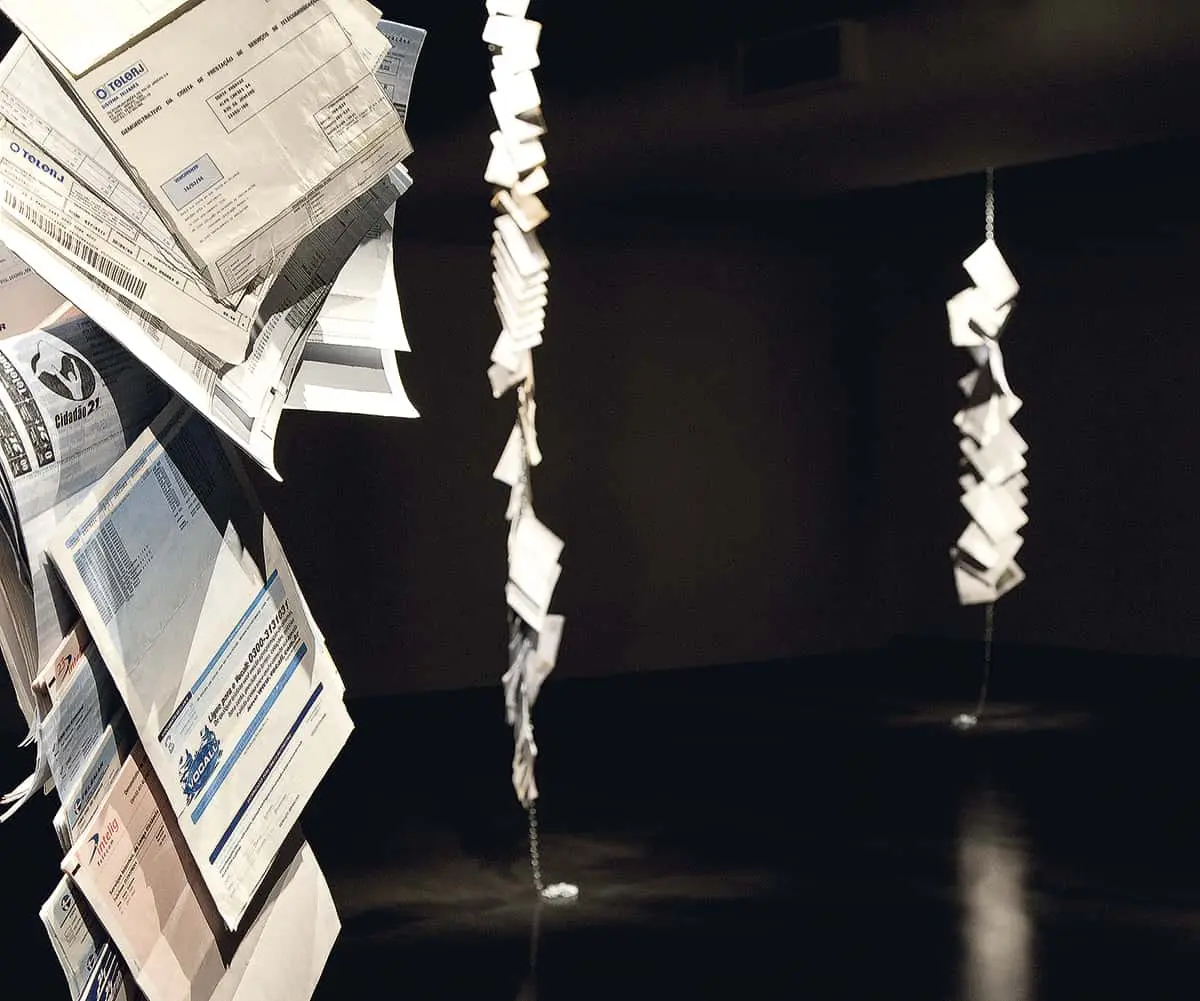
Andrade’s recent exhibition at the Museu de Arte Moderna do Rio de Janeiro is not different; it also features a set of works, in this case, never before exhibited. It is interesting to note that, rather than appropriated, these objects were collected over decades of the artist’s life. What they are is announced in the exhibition title, ...às contas (…the bills): household bills—electric, water, sewage, landline, Cable TV, cell service, Internet—spanning five decades. The order in which these items are listed is not random: the type of bill changes along with technological development in the world. The temporal arc from the landline telephone to the Internet says plenty about the vertiginous changes in communications during the last decade.
The artist sets it up in a space with limited natural light, something essential for her installation’s dramatic effect. The spotlights situated between the walls of the ample room make it possible for us to focus on the various sets of bills, distributed throughout in an organic way. Our body, then, becomes a necessary, active participant in Andrade’s installation, allowing us to move from one set to another.
The pieces of paper are all attached to another relatively unexpected object: chains. These connect the ceiling and the floor in the exhibition space and help arrange the bills asymmetrically, like fruit wedges or sets of keys. The chains can be seen as a formal element giving structure to the work, and also as a symbolic object: are we not chained for life to such inescapable payments to public utilities or private services? How many payments’ due dates make a human being?
Walking around this archipelago of bills, one startling aspect emerges: through a single individual’s bills, Sonia Andrade’s, it is possible to trace an accurate inventory of Brazil’s stories. Some bills included texts praising the military regime, while others—from the 1990s—promoted a campaign against forest burning in the Amazon. What remains, and what is forgotten in that temporal arc? The coloring of the bills signaled their age, as did their formats and design choices. Black and white gave way to color printing, numbers to be keyed in gave way to barcodes and QR codes.
This exhibition, in this way, gives continuity to Sonia Andrade’s discreet but sustained and solid career. Her videos and photographs reveal an interest in image sequences and in exploring the multiple meanings that can evolve from that option; a similar effect is achieved in her installation through the concentration of different temporalities in a single space, one underneath the other.
Finally, let us not forget that the title remains open and invites imagination: What is omitted in the term “…the bills”? A subject, a verb, a second noun setting up a comparison? We can’t tell—it is an essential element, without a due date.
RAPHAEL FONSECA