La Casita, located near the San Felipe neighborhood in Bogotá, has significantly expanded its exhibition space. A large area dedicated to the permanent collection was added to the project rooms. In mid-September, this new space opened its doors concurrently with the inauguration of Alberto Baraya’s La Granja (The Farm). As usual, the project was paired with a work belonging to the collection, in this case, one by Bernardo Salcedo.
The Farm consists of paintings, drawings, and engravings that blend in the La Casita as one large installation, and which the artist himself describes as part of an exercise in Comparative Landscape Studies.
For more than two decades, Alberto Baraya has been researching the cultural, social, and political aspects of the notion of nature. One of his best-known compendiums is the Herbarium of Artificial Plants, which has been shaped by a large number of variables that, in turn, have given rise to very heterogeneous pieces over the years. During this same period, he has also paid attention to other dimensions of the notion of nature, such as the idea of landscape, not only for his Herbarium project, but also in different directions, both in video and in painting, since one of the most prolific Romantic genres of the nineteenth century was precisely landscape painting.
The origins of this project can be traced back to a trip he made in 2008 to the Hacienda Nápoles. There he made some of his first attempts to pictorially document the surrounding landscape, with very different results from those achieved by mechanical means such as photography or video. Pablo Escobar founded the Hacienda Nápoles in the 1980s to create, among other things, a zoo of worldwide exotic animals whose simple entry into Colombia was already a sign of the disproportionate power and subsequent corruption generated by the drug trade. After the capture of the capo, only a few hippos survived. These have reproduced profusely and begun to “colonize” parts of the central area of the Magdalena River basin.
The Farm conjugates different fantasies around the idea of nature, such as the Romantic landscape, on the one hand, and animals both domestic and wild on the other. Baraya resorts to painting, drawing, and engraving because they entail other social logics, cultural conventions, and temporalities. His different scenes connect us to the pictorial cultural baggage, enabling the fantasies he proposes to be seen as hypothetically real in the imaginary space that historically has shaped painting. In his paintings, Baraya quotes English and American landscapes, which share the same stylistic treatment; however, impossible encounters occur between distant situations in time and space. Incidentally, Baraya came across a study of residual waters in five British rivers, which explored the presence of illicit drugs. Only cocaine was found. Baraya also draws attention to the fact that the landscapes depicted in English Romantic paintings already incorporated traces of human alterations by agriculture or cattle ranching, as is now the case. Some English landowners back then—just like Pablo Escobar—could afford similar whims when importing plant species from elsewhere for their estates.
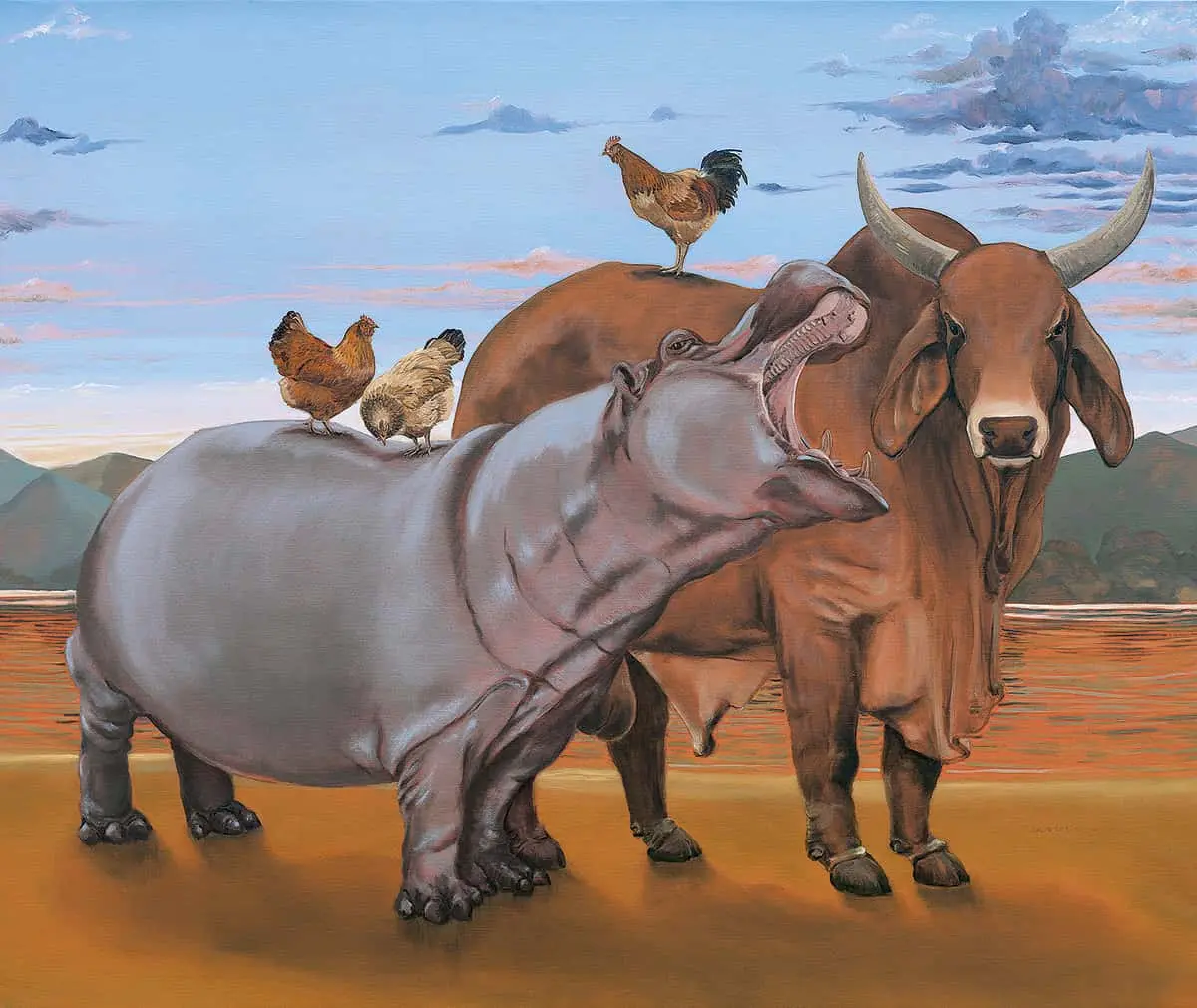
Based on a previous exercise of “Comparative Landscape Studies”—where he reviewed scenarios bordering both the Hudson and the Magdalena rivers—, Baraya invented fables involving different animals, some local and others exotic, in often capricious compositions, cross-referencing various cultural representations where animals tend to usurp human behavior. In one painting, he refers to the hunter hired by the Colombian government to kill one of the first escaped hippos; the scene is represented according to the conventions of English Romanticism but in a local landscape. There is another scene with a hippopotamus and a zebu cow, which, considering the current circumstances, could actually take place anytime in the Colombian Magdalena Central Basin.
Appropriating the Grimm brothers’ fable of the Bremen musicians—in which a donkey, a dog, a cat, and a rooster standing on top of each other to overcome adversity—Baraya composes scenes in which animals of different origins act likewise, so as to explore other ways to survive or to generate possible crossbreeds.
JAIME CERÓN