An art full of paradoxes. Garbage with a sense of aesthetics, abstractions that reflect reality, matter turned into philosophical thought. Such are the works of Adán Vallecillo (Honduras, 1977), an artist and sociologist who is dedicated to archeological explorations in the present and of the recent past, in search of objects that he appropriates and alters to convey his musings and criticisms. Over the years, he has used discarded tires and old lithographic plates to create non-objective works; flexible meters, construction levels, and padlocks as metaphors; worn bricks and pigments extracted from waste dumps as symbols of human nature and unacceptable socio-political situations.
As on previous occasions, in his recent exhibition entitled Hypercapnia, curated by Johann Wolfschoon and shown at the Diablo Rosso gallery in Panama, Vallecillo showed works of art that incorporate irony and contradictions. Upon the first impression, the exhibition appeared to be a minimalist, sophisticated, and installation within a classic white cube. However, the neat three-dimensional artworks on the walls and on pedestals communicated with each other and, undoubtedly, challenged the viewer with a significant conceptual proposition.
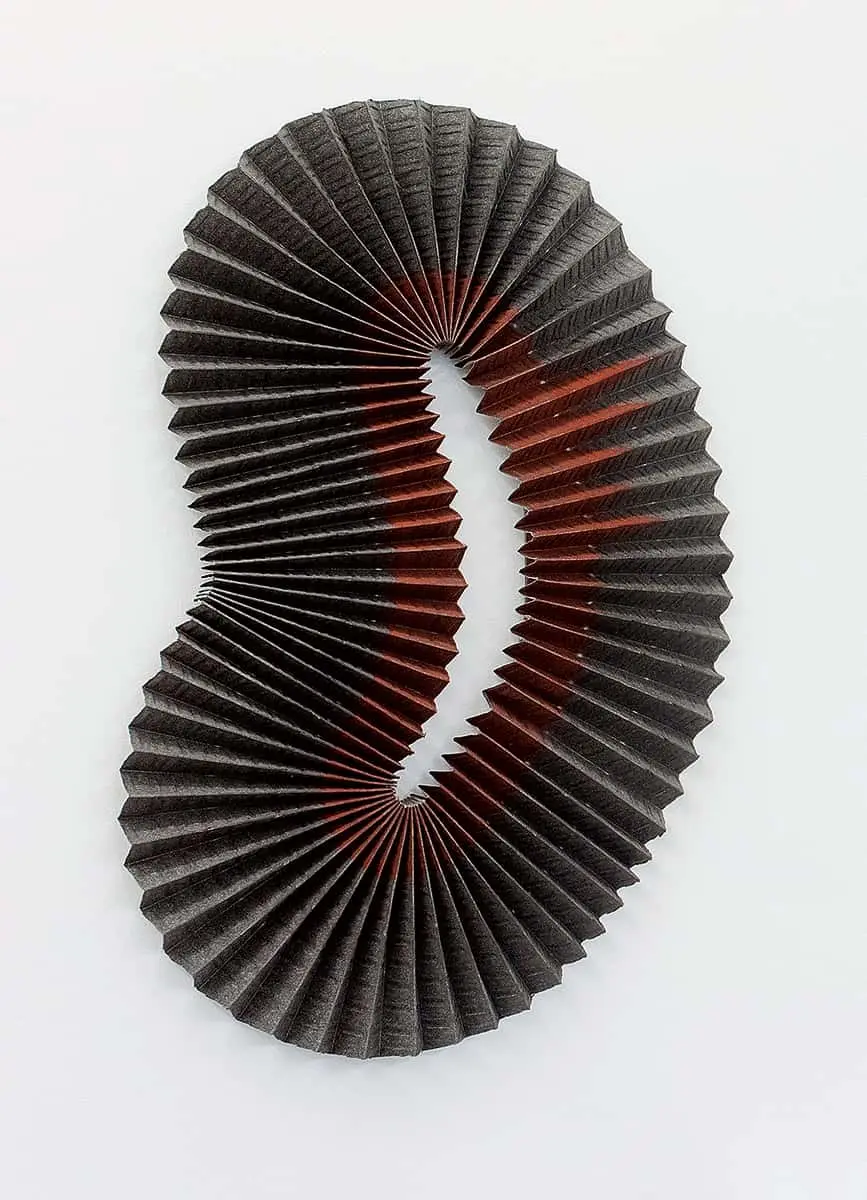
Hypercapnia (from the Greek hyper = above; and kapnos = smoke) is the name of a disease caused by excessive carbon dioxide in the blood-stream. Besides, the artist relates the word to the tonal variations in drawings, as well as the use of materials made from carbon –such as graphite and charcoal—in the arts. Carbon dioxide is an integral component in the works in the exhibition, all of which were created with the clogged diaphragms of automotive filters, where their purpose is to sift contaminated air.
Vallecillo had begun to work with this type of engine part two years before when he participated in the 2017 edition of the program called LARA - Latin American Roaming Art. The residency (curated on that occasion Gerardo Mosquera) took place in Panama, where Vallecillo became interested in researching the industrial waste produced by the recently completed widening of the Panama Canal. In the final exhibition at the Museo de Arte Contemporáneo, he showed a series entitled Expandables, which included works made out of old oil filters from the heavy machinery used during the canal project. Subsequently, while carrying out a residency in Flora Ars+Natura in Bogotá (whose director José Roca is the curator of the LARA collection), Vallecillo discovered a new creative alternative when he began visiting mechanics’ workshops to collect used car filters.
The process of removing dirt particles from the air to avoid problems in an automobile motor’s combustion leaves subtly colored stains on the fiber membranes inside the filters. Through a process of appropriation and different degrees of intervention, mainly through drawing, Vallecillo gave life to a collection of works that are apparently abstract, but which are also the product of specific aspects of urban life. The filters are manufactured in different colors, with multiple accordion-like folds and, depending on the type of motor, can have rectangular, cylindrical or conical formats. As soon as they become saturated with dust or dirt, they are replaced by new ones.
Through the works in Hypercapnia, Vallecillo presented the type of paradox between art and waste that has characterized most of his oeuvre. On the gallery’s furthest wall, a narrow accordion (Saturation #1) hung from halfway up the wall and unfolded vertically towards the floor. With a surface, reminiscent of the variations in a mezzotint print (a la manière noire), it looked like an open book with its dark intimacy spread out for the viewer. On a nearby wall, there was a large filter in organic-looking tones of red and gray (Expandable IV), was presented in the shape of a kidney, the organ responsible for filtering out the impurities in human blood. Other works, in variations of yellow or gray, had the rectangular shape of blinds, like shuttered windows with their inherent sense of privacy. In the gallery’s main space, an installation of three-dimensional pieces on an oblong white pedestal brought to mind the timeless sensation in Giorgio Morandi’s still-lifes. Just like the Italian artist’s vases, these small vertical towers composed of filters in the shape of torsos or conical skirts, evoke the relationships between human relations, who are close here, but not in actual contact. With his typical sense of the absurd, the artist entitled them Las Meninas.
Through his process as a modern archeologist, his ability to find beauty in unusual places, and his interesting epistemic diversions, Vallecillo turns quotidian, anonymous objects into the transmitters of both conceptual and personal messages. His delicate drawings, faint shades, and abstract purity offer immediate sensory pleasure, but a more careful and sensitive perusal reveals an interpretation of many of our time’s sociologcal issues. Their stillness, austerity, and purity produce a reversed echo of today’s relentless movement, excessive consumerism, and distressing environmental pollution.
MÓNICA E. KUPFER PH.D.