In the beginning, was the name. Cecilia Vicuña. Even before this Chilean poet, artist, and activist, born in 1948, began as a child to interlace toothpicks and to make miniature weavings like those that in the ancestral Andean universe were placed inside the tombs of sacrificial victims, imitating the gesture of her mother’s hands as she sewed dolls for her, which Vicuña deemed “beings or little creatures”, she was already connected to the millenary past of Indigenous America through her maternal lineage. And also through her paternal family name, Vicuña, Basque in origin yet coinciding with the Quechua word wik’uña, which designates an animal considered sacred in Inca culture. “The hair of the vicuña is absolutely sacred,” she says. “The more difficult and beautiful the weaving, the greater its importance. Once finished, it was burned as an offering. The weaving was sacrificed for the image of ascending.”
To make an offering, a sacrifice—from the Latin sacro, sacred, and facere, to make—is to render things sacred, to honor and deliver them. An immense poet of small things, Vicuña has threaded words and textiles to create texts and weavings, transforming the everyday world with her writing and her artistic practices to recover, in this shared oikos (home) that is the Earth, a vision that is closer to the immemorial and the sacred. The meaning of the offering is to make it possible to interweave the times of life as an act of continuous creation. Not a trajectory; instead, a way of resisting that harks back to the moment when, at the age of nine, Vicuña was exiled from her life as a “wild child” who observed and listened to every realm of nature, and taken to a bilingual school in Santiago. Then, Cecilia—who is also part Irish—decided to identify herself as indigenous, defying the hegemonic structure of a society that spurns ancestral voices. Six decades after those games of identity, when she adorned herself (and offered to adorn others) with feathers, Cecilia Vicuña continues to affirm denied indigenous worldviews in her work, with the power of an imagination that refuses to belong only to the past: it is a memory of “that which is yet to come” if we are to survive as a species.
If one thread connects Vicuña’s images and poems, the performances that combine her lyrical voice and the flow of her body, her small or outsize ritual installations, and different collective practices, it is the idea of restoring the poetics of the world, its beauty, from the margins, resisting the heteronomous. According to Vicuña, had the Eurocentric idea imposed on the world been a wise one, we would not now be in the midst of an ecological disaster. She calls for a rituality that may straighten the course of time and history.1
Since the time she dreamt, as a child, that light danced in a dog’s fur, Vicuña has kept a notebook to write down—and tie down—all that exists. Aldo Pellegrini’s Anthology of Surrealist Poetry was a revelation for the artist at the age of 14, helping ground her universe in the same way that the later discovery of Kurt Schwitters Merzbau would reaffirm her own practice. “It was a marvelous intellectual confirmation of the value and potency of the bedroom as a base of operations. I had already turned that place into a spaceship filled with drawings that hung from and twisted along on the walls. That’s where the idea for El Quipu que no recuerda nada (The quipu that remembers nothing) emerged from. A quipu [the complex system of knotted cords used by the quipucamayos to send messages] that has forgotten its message, because memory was exterminated,” she says. That idea, not materialized, gave origin of a large number of variations on the theme of the quipu, the “talking knots,” as offerings intended to conjure and transform reality.
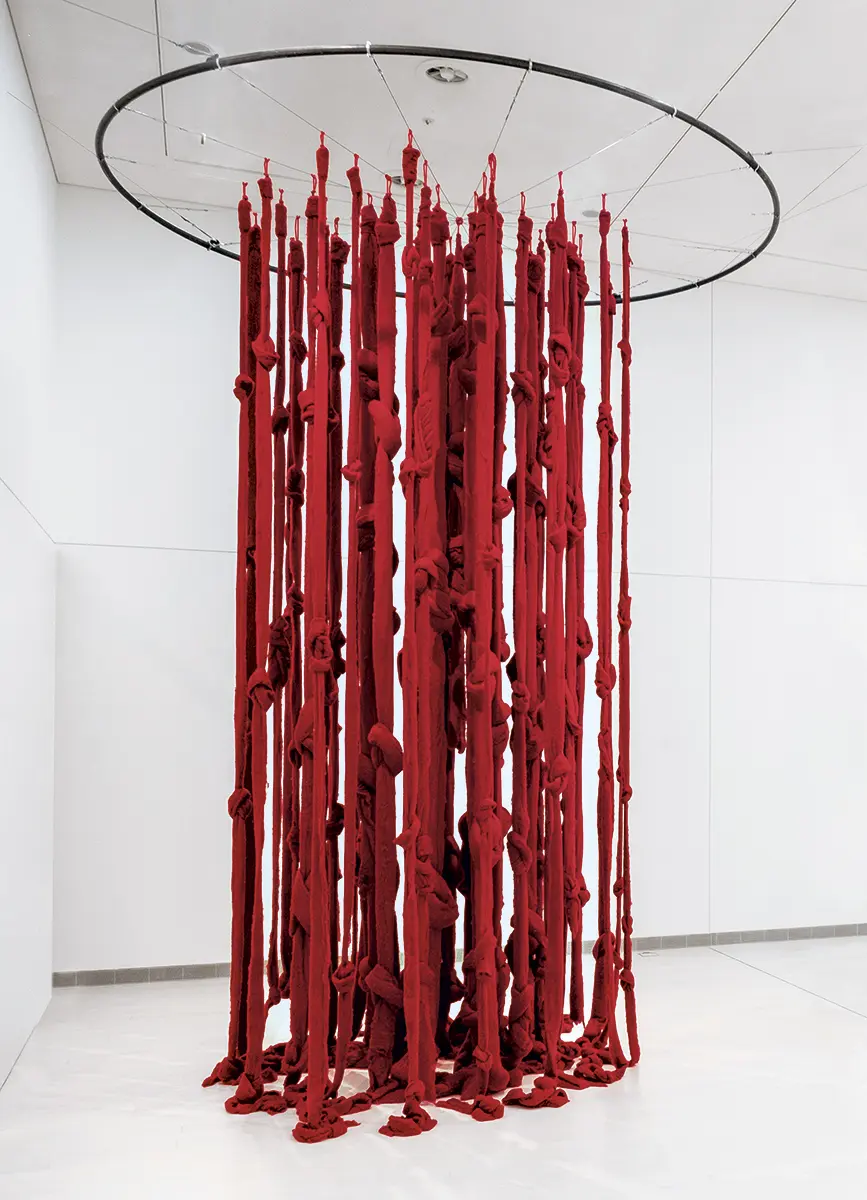
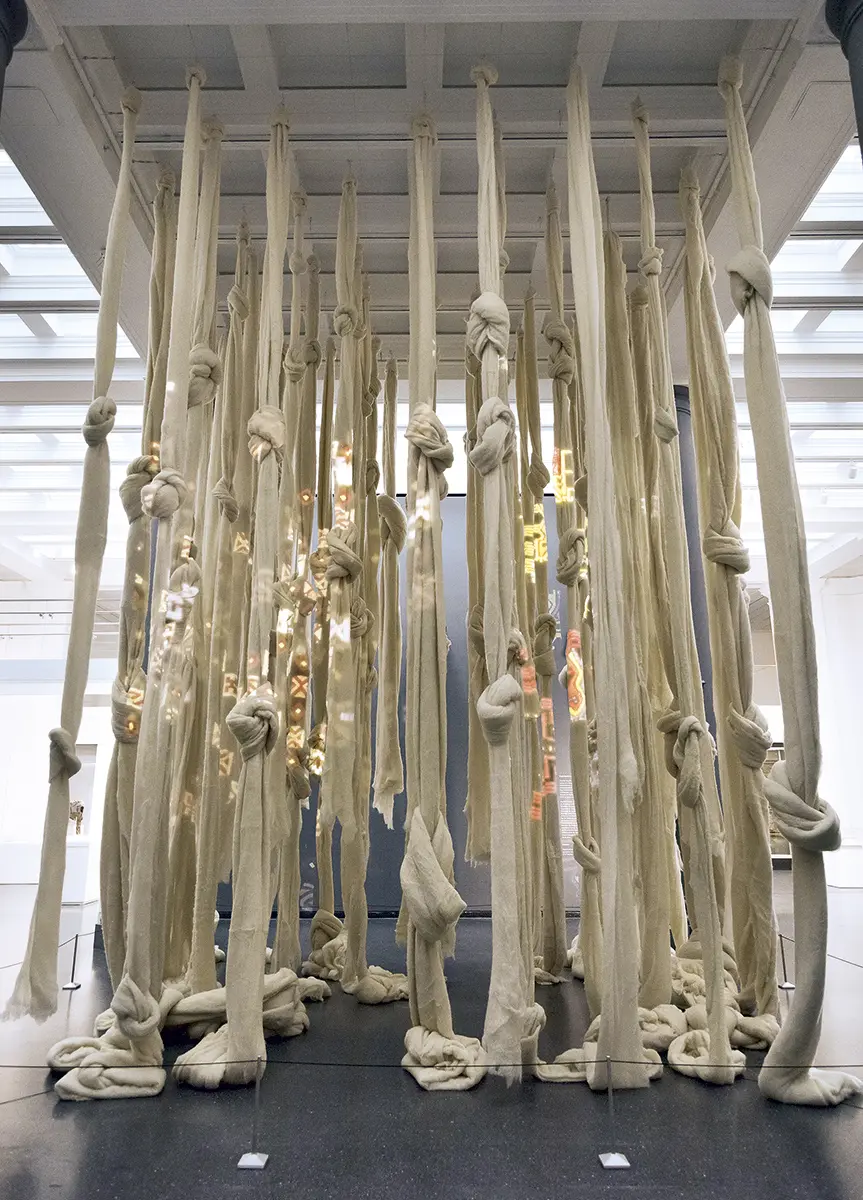
For Cecilia Vicuña, the physical act of making art is a way of expressing consciousness. Countervailing the burning, burial, and erasure of so many such messages after the Conquest, or their display in Western museums that ignore their meaning, this maker of new “speaking” quipus has had her capacious versions installed in a large number of institutions. At the age of 71, her long, natural hair in a braid and the words somos semilla (we are seeds) embroidered in white thread onto her black dress, Cecilia Vicuña set up a giant quipu, made in pure red wool—a metaphor for life—at the Witte de Witt Center for Contemporary Art in Rotterdam (The Netherlands) in 2019, and had it extend like a river around the bodies of visitors at various levels. Miguel A. López, curator of Cecilia Vicuña: Seehearing the Enlightened Failure at the Center, writes in the catalog: “Vicuña drapes herself in pieces of cotton: thick or thin; white, red, or multicolored. She covers herself. She ties herself. She sways from side to side. She ties you and then the person next to you. She makes each one of us into a knot, and in that way, little by little, she makes a weaving. (At times, she sings; at times, she dances). It is titled Guante (Glove, 1966). It is titled Cloud-Net (1999). It is titled Amor. Tejiendo en todos los lugares equivocados (Love. Weaving in All the Wrong Places, 1981). It is titled Allqa (Unión de Blanco y Negro) (Allqa [Union of Black and White],1997). It is titled Amarrando Bogotá (Tying Bogotá Down, 1981).”2
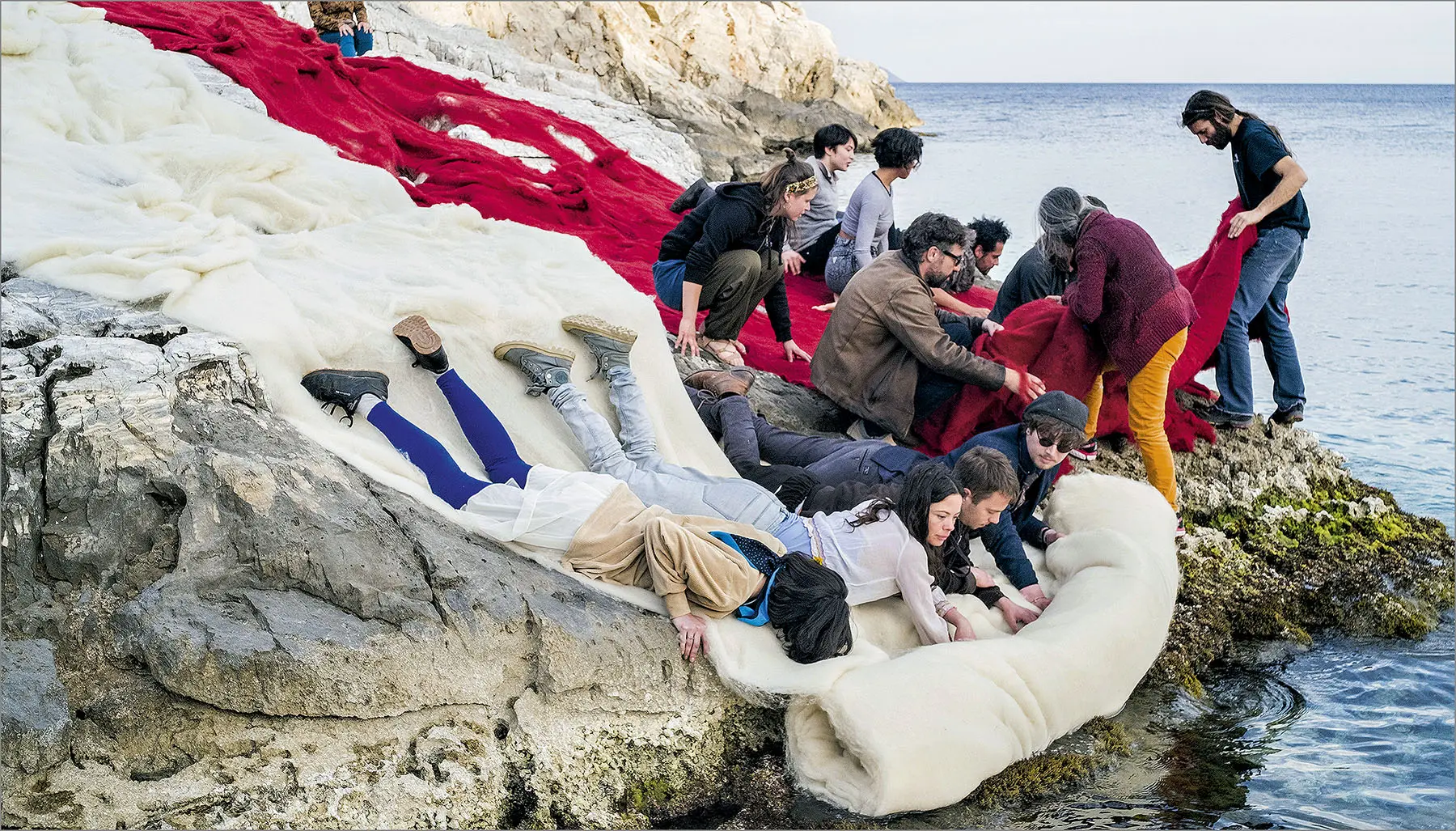
Vicuña has deployed other large quipus in iconic spaces: London’s Whitechapel Gallery (1996); the Biennale of Sydney (Australia, 2012); Chile’s Museum of Memory and Human Rights (2014); documenta 14, Athens and Kassel (2017); or the Brooklyn Museum of Art (New York, 2018). She has also created myriad quipus as invocations, fragile and ephemeral “unannounced art,” draped around the bodies of beings from all the realms she has traversed: the Empire State building; the heights of the Andes where vicuñas roam; the Earth’s distant seas. Most of her works have been and continue to be receptive to being undone by the elements. They are fleeting creations by an artist who “came consciously to terms with ridicule” since childhood and remained “underground” for half a century. But even today, when institutions the world over exhibit her monumental artworks, which often combine assemblage and a call to rituality, she creates in parallel works meant to be returned to the Earth. In the case of Quipu Womb (The Story of the Red Thread), from 2017, exhibited at the National Museum of Contemporary Art in Athens, Greece, during documenta 14, Vicuña also made the offering to the sea of the remains of that powerful, blood-colored woven structure in a communitarian ceremony, so as to have the deep currents connect two original sources of mythology: Athens and the Andes. The sea appears as a mother figure in the origin stories of several indigenous cultures, and Vicuña’s rituals are a way of “turning around the waves of the system.” Public or private, her offerings are intended to restore the world’s wounded memory. They are an art of the Earth, a political, feminist, ecological, and conceptual art as reparation and invocation of other possible futures.
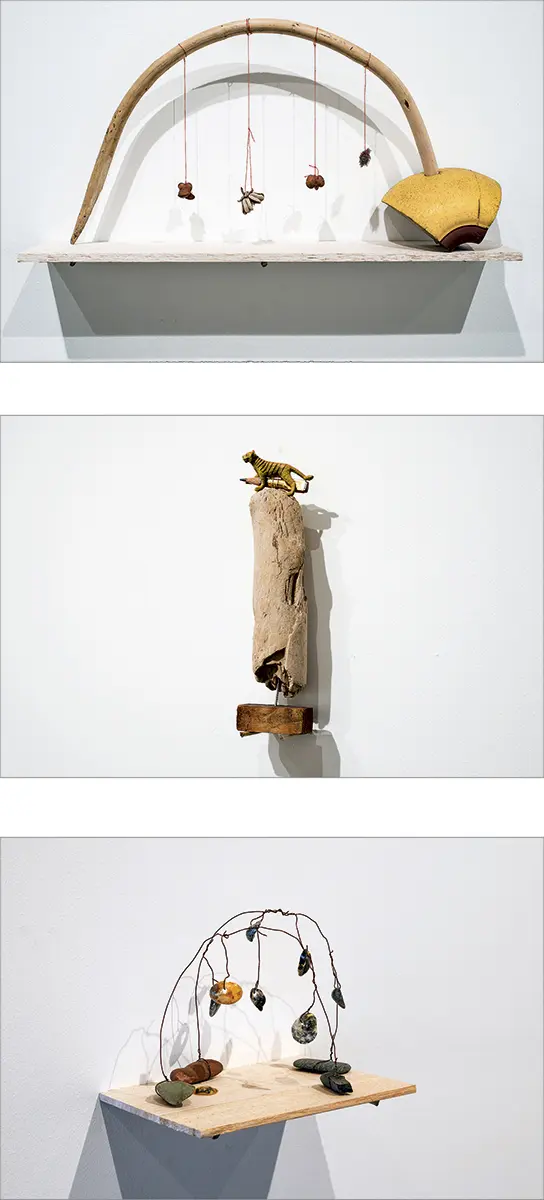
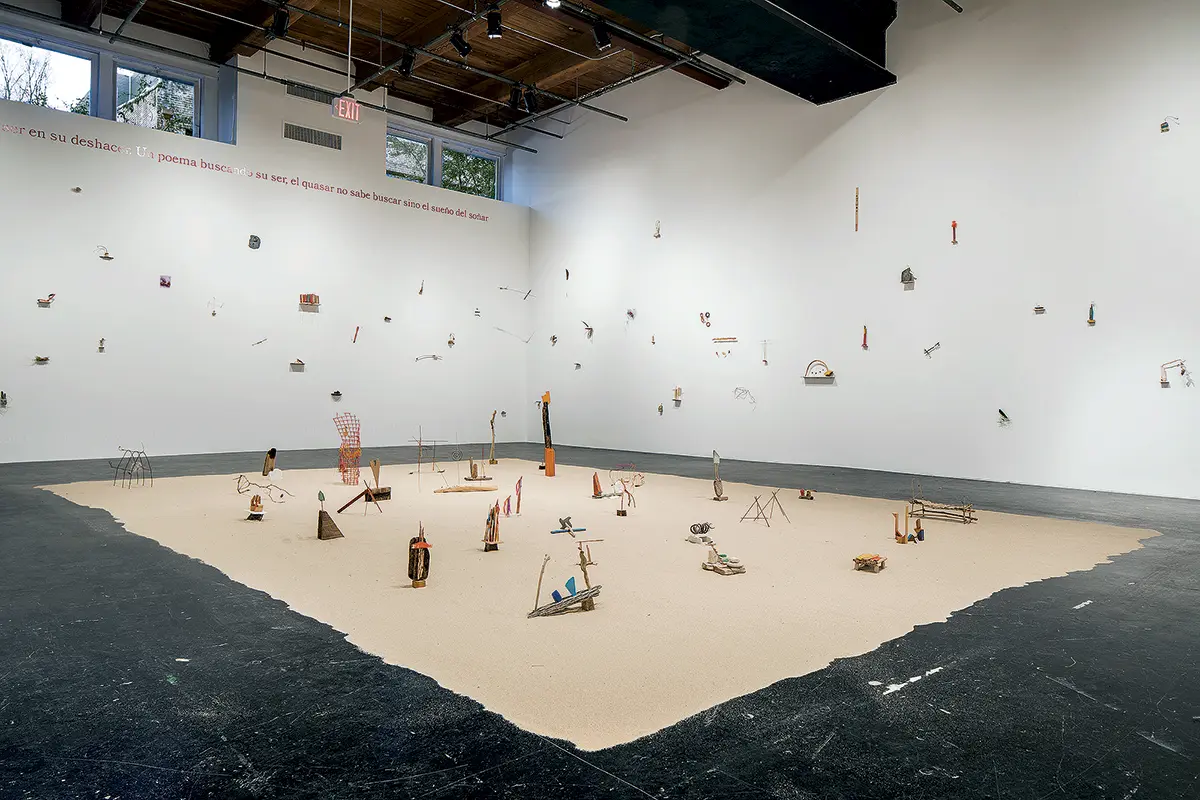
In 1966—at 18, when she began as a student in the School of Architecture, and around the same time her early poems were accepted by the legendary journal The Plumed Horn alongside those by Claudio Bertoni and Marcelo Charlín, members of Tribu No (thus called because “it was nothing, just an unorganized group of friends, and that was the beauty of it”)—Vicuña began to create Precarios (Precarious) and Basuritas (Little Garbage), objects made from elements discarded by nature or by civilization. At Con Con beach, a little-known location in Chile where Mount Aconcagua and the Pacific Ocean meet, she drew spirals on the sand and erected cities using sticks, feathers, bones, seashells, seeds, husks—constructions destined to be swallowed by the waves. Lucy Lippard notes that Vicuña’s installations anticipated Robert Smithson’s work in Land Art, and Juliet Lynd points out that her performances on the land and her drawings on sand preceded Ana Mendieta’s and Atsuko Tanaka’s, respectively.3 Precarios is certainly “a decolonized name, an autonomous category” for these ephemeral works connected to collective rituals, and these performances based on dissonant sounds in concert with her shamanic chanting. The artist connects precarious and precis, the origin of the term plegaria (prayer), but, as Catherine de Zegher observes, Vicuña’s Precarios are not a way of pleading as much as they are an answer, a way of acting between what is and what can be4. Zegher made a long journey with Vicuña to reconstruct works/offerings like El guante (The Glove, 1966-1994). In 2000, for the show Chile 100 años. Tercer período 1973-2000 (Chile 100 Years. Third Period 1973-200), curated by Justo Pastor Mellado at the Museo Nacional de Bellas Artes in Santiago, Cecilia Vicuña reconstructed El hilo azul (The Bue Thread), from 1972, the spatial weaving in the bedroom of her small house in Con Con. Year after year, Vicuña returns there in order to officiate her ritual art, since the seminal image of transience she encountered as a child in the death of birds and other animals is inseparable from her understanding, indeed reached in Con Con, that light, rocks, waves, birds, leaves, are all interwoven parts of a universe where everything is conscious and dies and is renewed with unending joy.
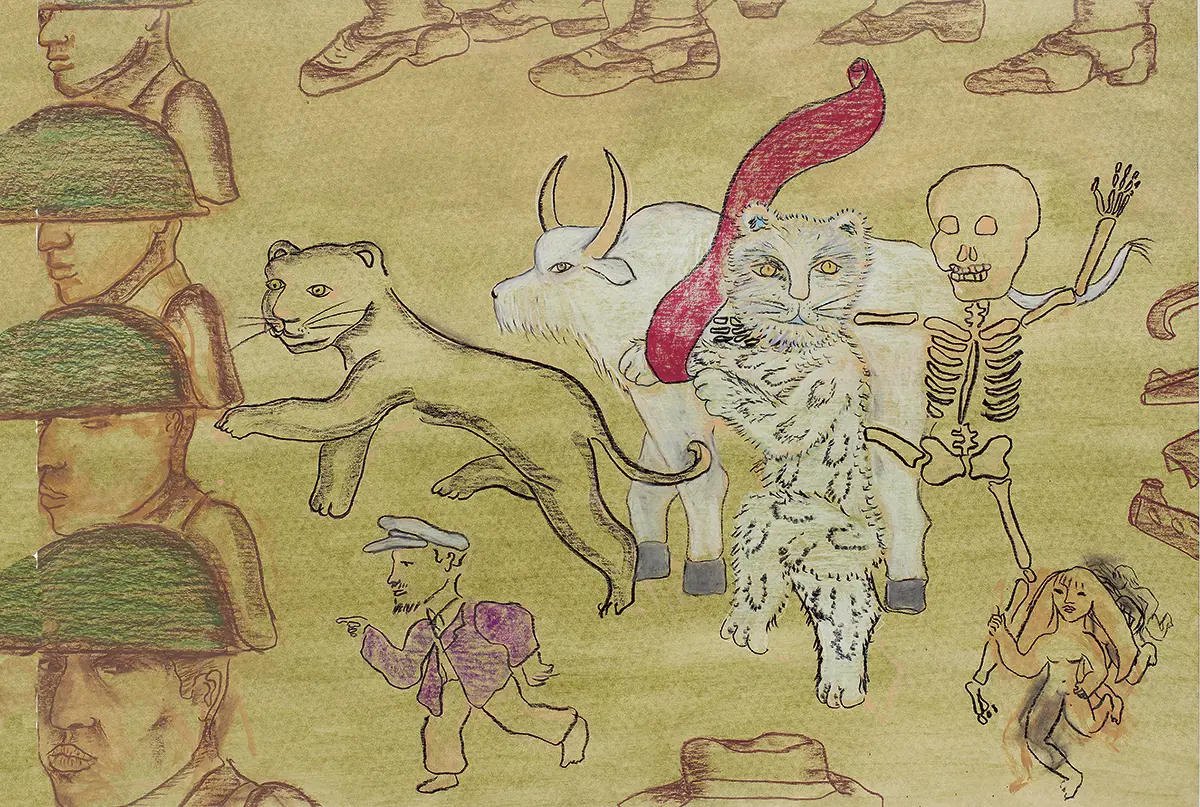
Vicuña’s Precarios, then, contains life and death, and a mode of cultural resistance made from almost nothing and infinitely recreated. As Vicuña wrote in the 1990s: “They come from prayer and predict their own destruction (…) They will leave no trace. The history of art written from the North includes nothing from the South. So, they speak in prayer, precariously.”5 But she—who resisted half a century of silence about her work—has gradually shifted such polarities and inscribed her name, for a long time written on the margins (albeit with shades of the sacred). In 1969, Vicuña began to produce oil paintings, which resisted and have recently reappeared with her little drawn threads, almost always red. That is why she sings in a high-pitched voice that comes from the very center of her being: “I am life, like a trickle of blood.”
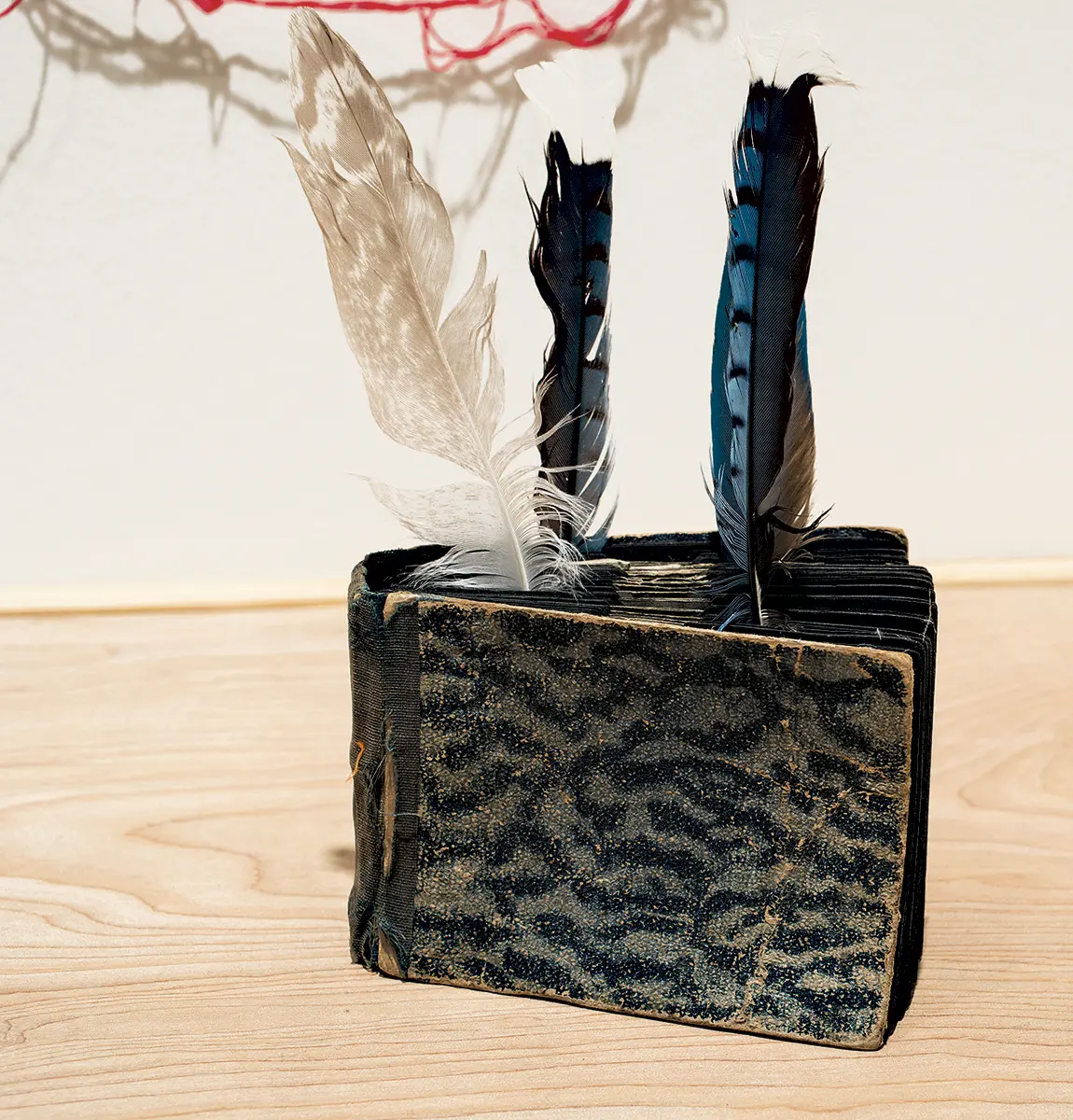
After a period through the early 1970s devoted to improvising performances in the streets of Santiago with her hand wrapped in color threads—actions like the ones Cortázar imagined to confound everyday life and infuse it with strange and transformative beauty—Cecilia Vicuña traveled to London with a grant. It is difficult to talk about the possibility of encoding art with messages that will impact a vaguely foreshadowed future, but the pre-Columbian vision of time is the threshold from which that dimension of Cecilia Vicuña’s work can be appreciated. Since 1972, a year before the military coup and the death of Salvador Allende, she constructed a diary with fragile objects made from discarded materials—small quipus with knotted, precarious threads—invoking an atmosphere of effervescent creativity that would soon be extinguished, and in a way exorcizing the ill-fated course of history. In 1973, she built the name of the democratic leader between veils and exhibited that diary as an offering and a spell, so that one day the shadows could be lifted. Today, Precarios: A Journal of Objects for the Chilean Resistance (1973-1974) is held at the Tate Modern London, in the same city where the dictator who overthrew Allende was put under house arrest. Also there, the unforgettable Felipe Ehrenberg, cofounder of the legendary Beau Geste Press, invited Vicuña to publish Saborami (Tastelikeme), a title that she appropriated from a popular song, conjugating and altering it in her own way, with an aesthetic approach that marshals the resources of folklore in order to flout the hegemonic canon. About to celebrate a decade of activity, Cecilia Vicuña was exorcizing “the sorrow of those times.”
Listening to her performances with poetic chants accompanied by improvised musical compositions emerging from a precious dissonance, the ethnographer Dennis Tedlock (1939-2016), renowned throughout the continent for his translation of the Maya Popol Vuh and for revealing that it contained, in cipher, the ritual calendar of a culture possessing a masterful knowledge of time, told Cecilia Vicuña that she embodied the mysteries found within the sacred book. The sacred twins (who are also Venus and the Sun) return to the Earth, cleansed by the waters of the river that is time to irradiate their light. In the mid-1990s, Vicuña created her Hilumbres (Threadlights), weavings that illuminate. And in 2006, in response to the destruction of glaciers in Chile, she made El quipu menstrual (The Menstrual Quipu) and recorded chants. Nine years later, to extend the Guarani wise man Karai Miri Poty’s call to “resist with beauty,” the record label Hueso Records relaunched her Kuntur Ko LP, with performances and rituals that recreate, rather than merely repeat, the recording.
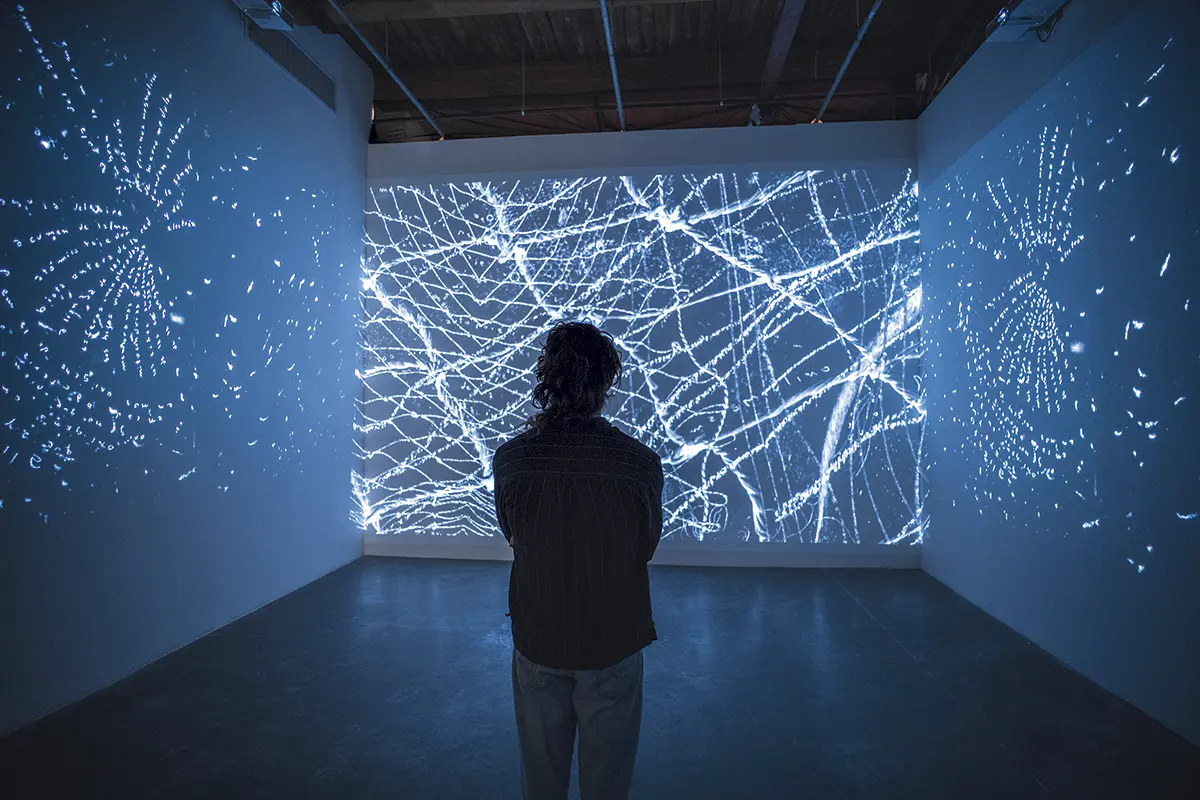
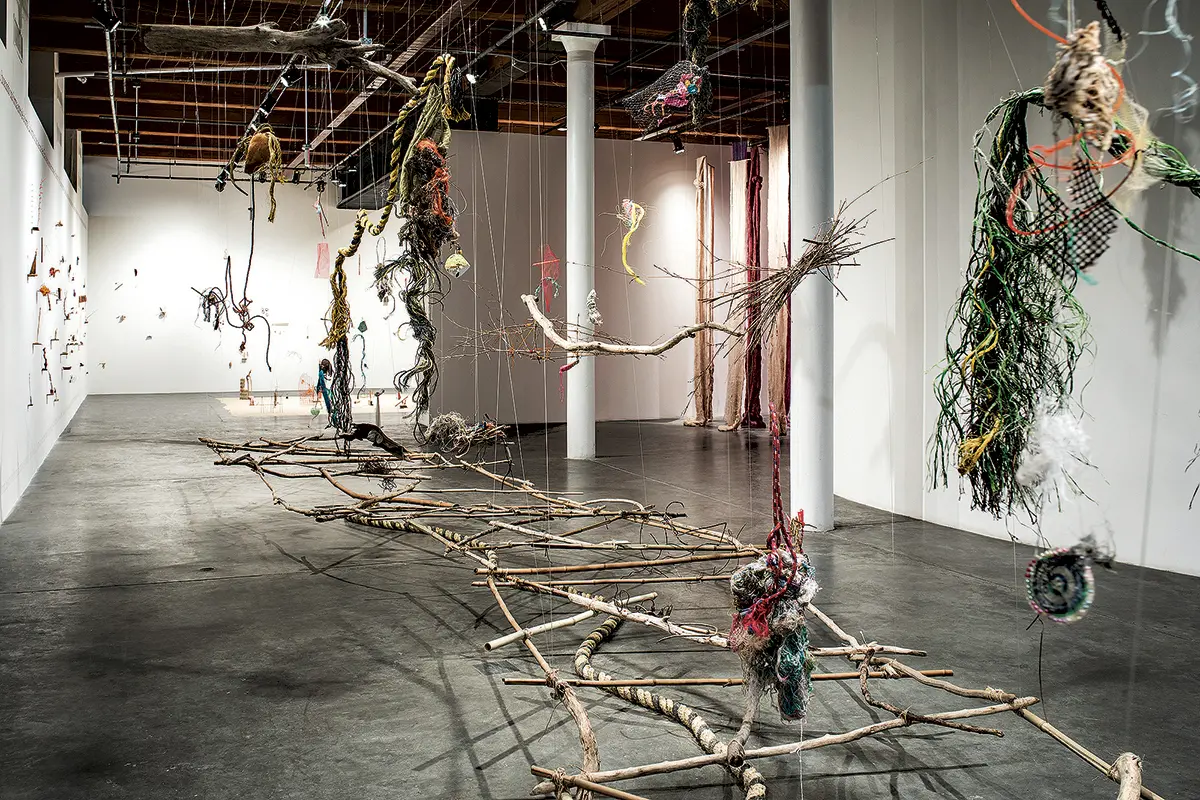
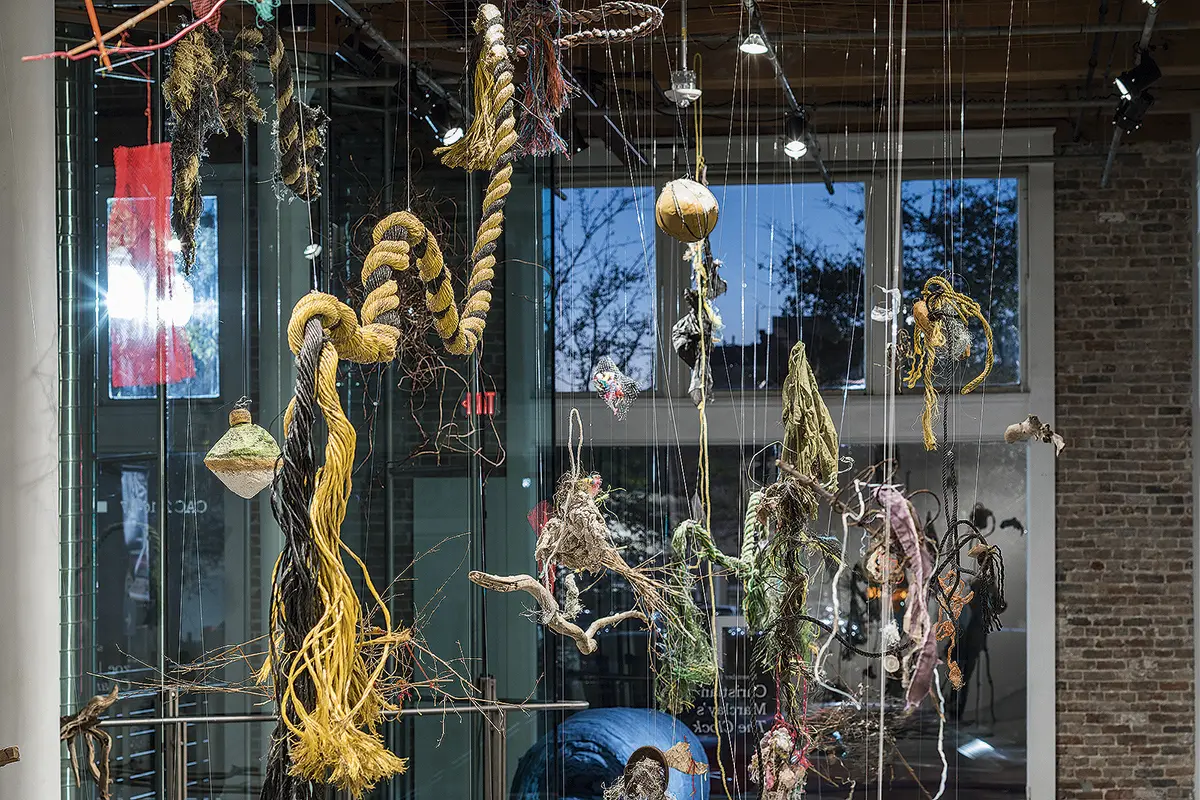
The gestures of making and unmaking are key to understand the genesis of an oeuvre that gives shape to—and embraces—totality. In Cecilia Vicuña’s oral performances, what her letters and poems put in writing (she wrote them with carbon copies) is transformed into a flowing voice, and what takes place is not a “reading” but a kind of trance, a deep way of accepting the power of an inner opening to the forces of the universe. It is from these forces, rather than from any other material that Cecilia Vicuña’s texts and textiles, ultimately interwoven into her performances, are made. Hers is conceptual art that, above all, embraces life in a dimension where everything is discarded or unmade, but can be renewed. For her first retrospective exhibition in the United States, Cecilia Vicuña: About to Happen—which began at the Contemporary Arts Center (CAC) in 2017 and later, after traveling to four other institutions, opened at the Museum of Art Contemporary of North Miami (MOCA)—Vicuña created Balsa Snake Raft to Escape the Flood (2017), in memory of the victims of hurricane Katrina, using objects gathered during the collective cleanup of the “ever-shrinking” Mississippi coast.
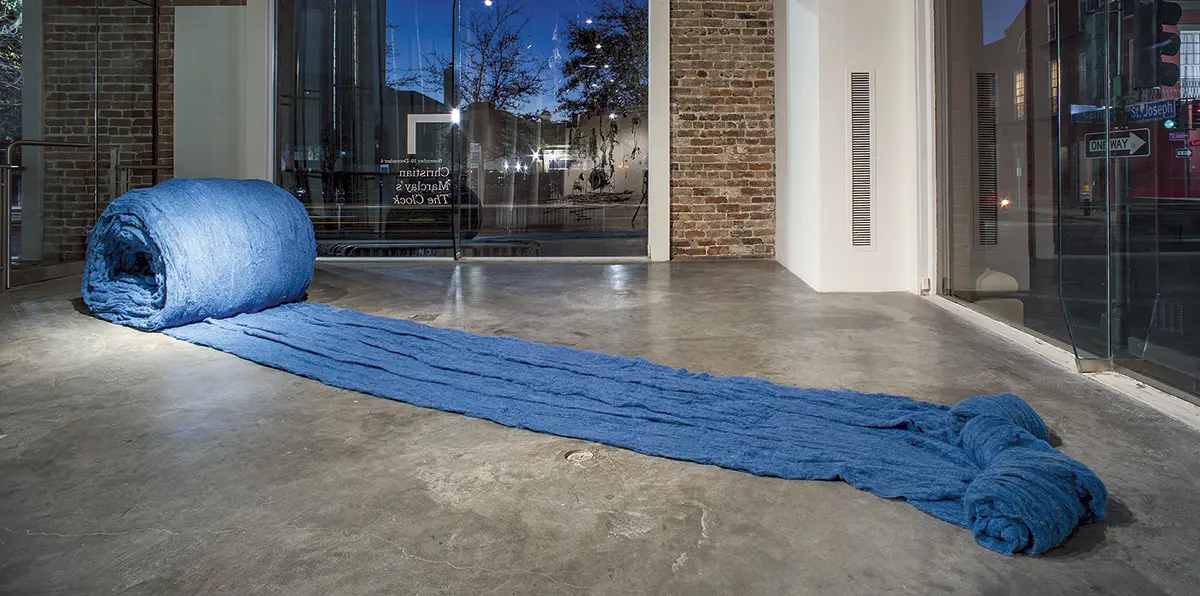
The colossal structure, built from such dissimilar materials as bird wings, maritime rope, and small detritus, as well as of empty space, is a hanging raft that floats in the air, rather a creature-effigy containing allusions to the hurricane, to the oil spills,6 to the outsize snake that in some myths brought men to the land, and which poses a looming enigma: “How will we remain afloat when the tide comes?” Perhaps part of the answer is found in the Caracol Azul (Blue Snail) that Cecilia Vicuña knitted in raw wool, invoking the snail trajectory associated with the mythical origins of writing. Its presence in About to Happen is a way of encoding the possibility of tracing a new history, the history of a human race “capable of creating a culture that treasures all forms of life.” From the darkness of the ecological disaster can also emerge such a consciousness, which Vicuña invokes with chants and rituals interwoven at the smallest scale, or forged into large, three-dimensional, poetic assemblages that call all creatures to build a luminous world before the deluge. “The discovery of paradise will coincide with the discovery of a language,” Cecilia Vicuña once wrote. She discovered it a long time ago.
NOTES
1. https://miamirail.org/visual-arts/cecilia-vicuna-with-camila-marambio/
2. Miguel A. López, “Cecilia Vicuña: A Retrospective for the Eyes That Do Not See,” in Miguel A. López (ed.), Seehearing the Enlightened Failure, Rotterdam, Witte de With, 2019, p. 23. The exhibition will travel to the Museo de Arte Contemporáneo (MUAC) of México’s Universidad Autónoma in 2020.
3. Cecilia Vicuña, www.poetryfoundation.org/harriet/2016/04/language-is-migrant
4. M. Catherine de Zegher, The Precarious, The Art and Poetry of Cecilia Vicuña, London, 1997. Cecilia Vicuña, Exhibition catalog, England & Co, London 2013.
5. Ibid
6. https://hyperallergic.com/462470/the-dazzling-and-dooming-art-of-cecilia-vicuna/
ADRIANA HERRERA PhD
Curator and writer. Co-founder of Aluna Art Foundation and the Aluna Collective