The work of Sara Ramo (Madrid, 1975), a Spanish-Brazilian artist with a growing international presence, is based on the recovery of everyday objects and materials (often discarded or forgotten) that she reconfigures, critically and poetically, in videos, photographs, collages, sculptures, and installations, capable of opening alternative pathways and extracting from the ruins the possibility of a new origin. Ramo’s evocative proposals also offer a unique approach to space, one that brings forth her interest in theater, according to the artist, the place “where we can situate every issue, simulating life,” and introducing surprising elements that can activate the viewer’s consciousness and senses.
The starting point in lindalocaviejabruja (cutiecrazyoldwitch), a project created for the Museo Reina Sofía’s Fisuras program, is a video recreating a peculiar Grand Guignol stage. In it, a curtain, made from old fabric patches, moves up and down in unsettling counterpoint to the soundtrack to reveal the bottom half of various scenes, among them a puppet that repeats the gesture of hitting a woman with a club, as often happens in “classic” Punch and Judy shows. Titled Una y otra vez (Time and Again, 2019), the video is a direct allusion to how violence against women has been naturalized throughout history, and to the urgent need for a feminism that is not only an idea but also a habit and an action.1
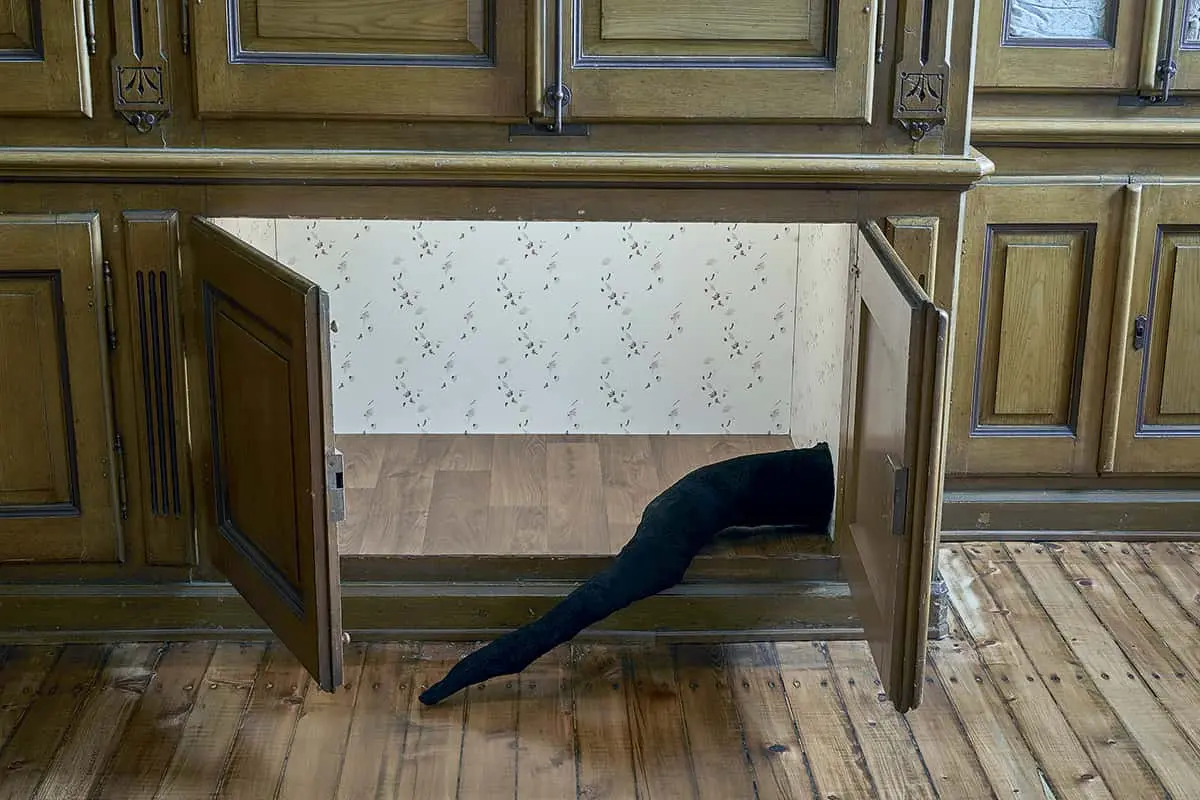
The exhibition continues in the museum’s Protocol Room, where a cleaning woman projecting a soap tongue underscores, in an ironic bent, the subversion of tasks typically assigned to women. As we move forward into a dimly lit space and probe the crannies of armoires with their doors left ajar, we discover objects and small installations intervening the furniture: a swarm of candies; clay bowls; lipstick; latex gloves; dirt; a pile of bed sheets; presences at once strange and familiar that communicate disquiet and a certain angst, as they reflect the suffocating domestic environments—and, with it, the processes of exclusion, discrimination, and social invisibilization—that continue to determine life for many women. Equally resonant here is the stigmatization of women in terms of the exhibition title: cutie, crazy, old hag, witch. In the face of all that, as Silvia Federici has noted, the figure of the witch can be seen as “as the embodiment of a world of female subjects that capitalism had to destroy: the heretic, the healer, the disobedient wife, the woman who dared to live alone, the obeah woman who poisoned the master’s food and inspired the slaves to revolt.” 2
La caída y otras formas de vida (The Fall and Other Forms of Life), the second exhibition of Sara Ramo’s work on view in Madrid, introduces us to a different, divergent, theatrical space, deployed as a form of resistance, and calls our attention to the times we live. The proposal revolves around the idea of a column as a symbolic and structural element, one whose presence marks the structure and the memory of Sala Alcalá 31, the old site of the Mercantile Industrial Bank. Ramo inverts the usual direction of traffic in the exhibition space, forcing visitors to traverse a large paneled stage or false wall containing the works on exhibit, a “story or fable about the current state of things,”3 where an evocative dialog/collage between shapes, plots, colors, textures, beings, and characters takes place.
A line of blood and a line of gold encircle this forest of false columns, and real pillars intervened by the artist until they are engulfed by a Buraco negro (Black Hole) that critically evokes political and social tensions in today’s Brazil and the rest of the world. Various connections with and nods towards earlier works and projects by Ramo are also emphasized, as a collage or “witch’s brew” that combines ideas and shapes into a kind of continuous experiment: columns covered by clips from the Financial Times in Contrato vertebra (Vertebral Contract), or by ribbons, strips of towel cloth, and intensely colored tablecloths, cut through by a line of sparkling glass beads in Hendidura (Fissure, a tribute to the Brazilian sculptor Ivens Machado), or forming a trapezoidal structure in adobe (a typical construction material in Brazil than incorporates the geometric legacy of concrete and neo-concrete art), seem to conspire and rise under the influence of the visual, rhythmic, and poetic sensations of Abre-alas o estandarte para apotheosis (Wing-opener Or Banner for Apotheosis), a series of collages located in the upper level.
These textile collages, like banners, suits, or fortune-telling cards, surround the selection of works, providing new details and perspectives. Each one corresponds to a sentence, and together as a whole, they compose a kind of poem or Marchinha de carnaval4 that expands throughout the entire space. As the Brazilian abre-alas (the troupe that leads the carnival parade) or Hélio Oiticica’s parangolés, these capes and flags to be raised or worn turn each individual into an active participant, leading a parade of entities or totems around which a heterogeneous collective takes shape, one that resists and resurfaces to generate new forms of life.
NOTES
1. Bea Espejo: “Sara Ramo: Hasta la fantasía tiene una instancia política,” El País, 10/09/2019.
2. Silvia Federici: Caliban and the Witch. Women, the Body and Primitive Accumulation. New York, Autonomedia, 2004, p. 12.
3. Claudia Rodríguez-Ponga: “Sara Ramo. La caída y otras formas de vida” (Exhibition leaflet), Sala Alcalá 31, Community of Madrid, in http://www.comunidad.madrid/sites/default/files/doc/cultura/expo.folleto_sara_ramo.pdf
4. A genre of popular music in Brazil, its first historical exemplar was composed by pianist Chiquinha Gonzaga in 1889.
WENDY NAVARRO