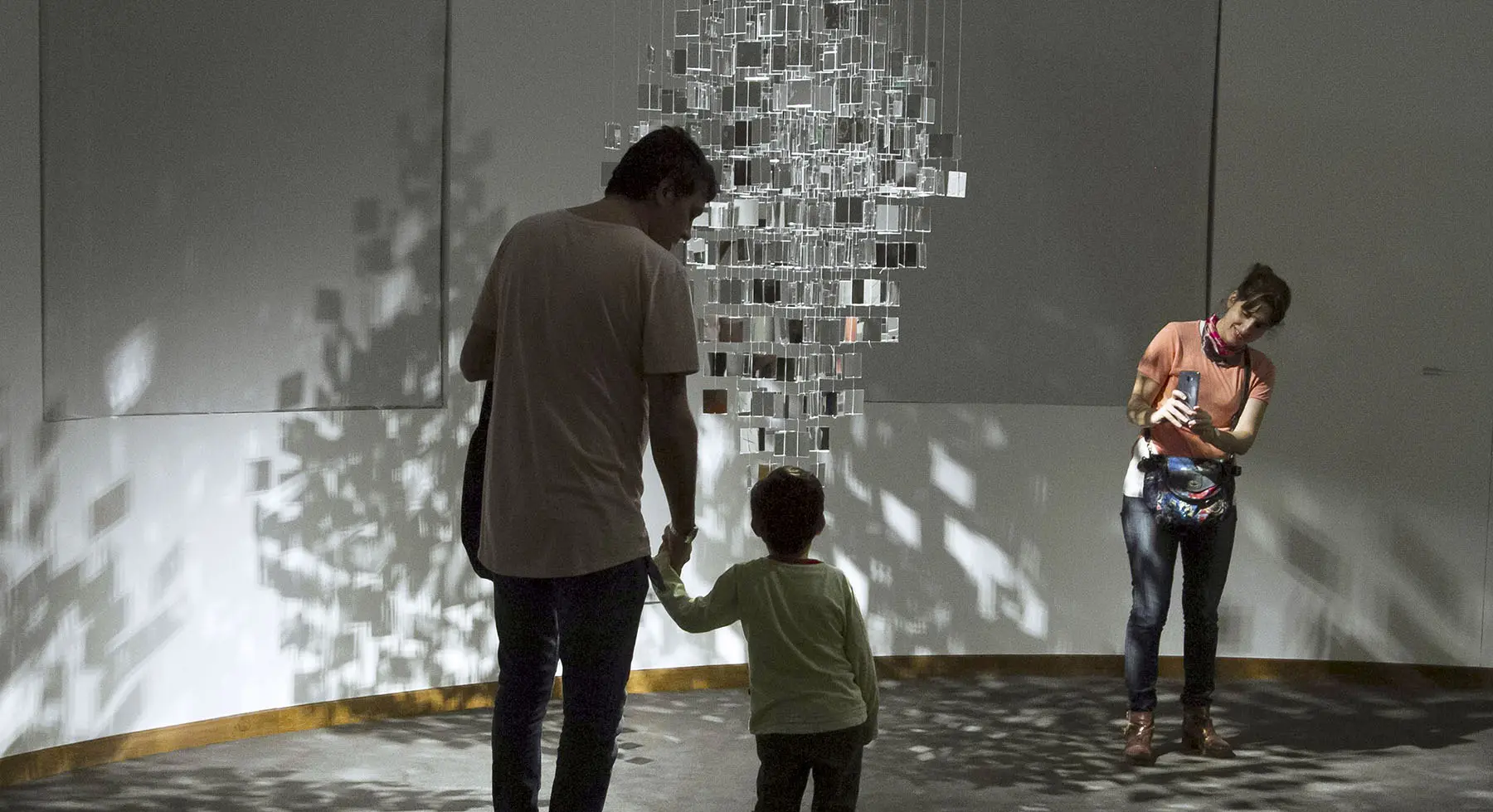
The three simultaneous shows of works by Julio Le Parc (Argentina, 1928) in Buenos Aires, along with the two volumes concurrently published, are part of a national tribute to Le Parc’s career achievement set to coincide with the acclaimed artist’s 90th birthday. Filled with joy and gratitude, Le Parc, who just turned 91, traveled several times to Buenos Aires to participate in the event, even agreeing to a live public interview at the CCK. Lucid and witty, Le Parc—a master explorer of motion, space, and light—restated his long-held belief that art must not be the preserve of “the hidden eye,” and that the audience’s point of view and participation are a determining element of his work.
The celebration began in early July and ended on November 2—during Museum Night—with the projection of a video mapping onto the city’s Obelisk. With some thirty artworks dancing to the music broadcast from speakers installed in the grand plaza, the images outshone the surrounding advertisements with their dynamism. To close the festivities, the French government gave Le Parc, at the French Embassy in Argentina, the official emblem of the National Order of the Legion of Honor.
Impeccable and abundant in their coverage of Le Parc’s oeuvre, the exhibitions invite us to experiment with our senses. Unfolding at the CCK, the Museo Nacional de Bellas Artes, and the Centro de Experimentación del Teatro Colón, the shows complement one another. They were made possible by the cooperation of the prestigious institutions involved and the perseverance of Yamil Le Parc, the artist’s son, artistic director of the general program.
Yamil Le Parc—also at the helm of Atelier Le Parc, in Paris—also promoted the publication in Spanish of two books initially written in French. Julio Le Parc. ¡Sé artista y cállate! Textos 1959-2017 (Julio Le Parc. Be an Artist and Shut Up! Writings 1959-2017), published by the MNBA, compiles Le Parc’s political writings, manifestos, and commentary on his own work. In turn, Julio Le Parc, published by the Tres Pinos foundation with support from the Buenos Aires City Government, is the first monographic volume devoted to this key figure in the history of kinetic art. With texts by Serge Lemoine, Jean de Loisy, Edgard J. Sullivan, and Rodrigo Alonso, among others, its 432 pages cover the artist’s entire career, from his early works in Argentina, in 1958, to his most recent creations.
It was precisely in 1958 that Le Parc settled in Paris, thanks to a grant from the French government. It was a return to his roots: Le Parc’s paternal grandfather had emigrated to Argentina from France in the late Nineteenth Century. His encounter with Vantongerloo, Victor Vasarely, and others reaffirmed Le Parc’s interest in optical art, already piqued in Buenos Aires. In Paris, Le Parc continued investigating perception and deepened his probe of abstraction in paintings that created optical illusions.
Thus began a coherent and transformational journey that questioned the role of art and the artist in society. Le Parc’s resolution redoubled after 1960, when, along with other Latin American expatriate artists and some French ones, he established the Groupe de Recherche d’Art Visuel (GRAV). Active through 1968, the GRAV sought to reconceptualize the work of art and to make the audience the protagonist, undermining as anachronistic “the notion of the unique and inspired artist.” The group’s experiences explored light, motion, and space in street happenings, studio shows, and some gallery exhibitions, with work in an optical and kinetic line.
Le Parc participated in the Venice Biennale on three occasions. In 1966, he won the Grand Prize for Painting with subtle creations that, with their repetitions and variations in size, shape, and background motif, reflect the fiction of motion. Soon, however, Le Parc felt the need to incorporate movement directly, beyond representation. He began using motors, manual devices, wind (in his open-air works), and optical and light suggestions to produce vibrations or oscillations.
The Exhibitions
The splendid Julio Le Parc. Un visionario (Julio Le Parc. A Visionary), curated by Gabriela Urtiaga takes over more than 3.000 m2 at the CCK. It brings together both historical and recent works into the cultural center whose central hall proudly houses the dazzling Esfera azul (Blue Sphere), with its 3.500 bluish plaques of translucent acrylic and four meters in diameter. This retrospective is a 60-year journey that includes early gouaches, monotypes, and paintings that create an illusion of movement with relationships between geometries and colors; light-based works and mobile sculptures of great complexity; participatory experiences with playful proposals, and more. The works emanate optimism and induce “the instability of vision, defying our habitual gaze.” Their radiance drapes visitors in color, and in turn, with their presence reflected and abundantly multiplied, the visitors transform the works. The exhibition includes a section with works denouncing Latin American dictatorships, featuring figurative paintings made in the 1970s alongside other artists. Here, this section serves as a reminder of Julio Le Parc’s political engagement.
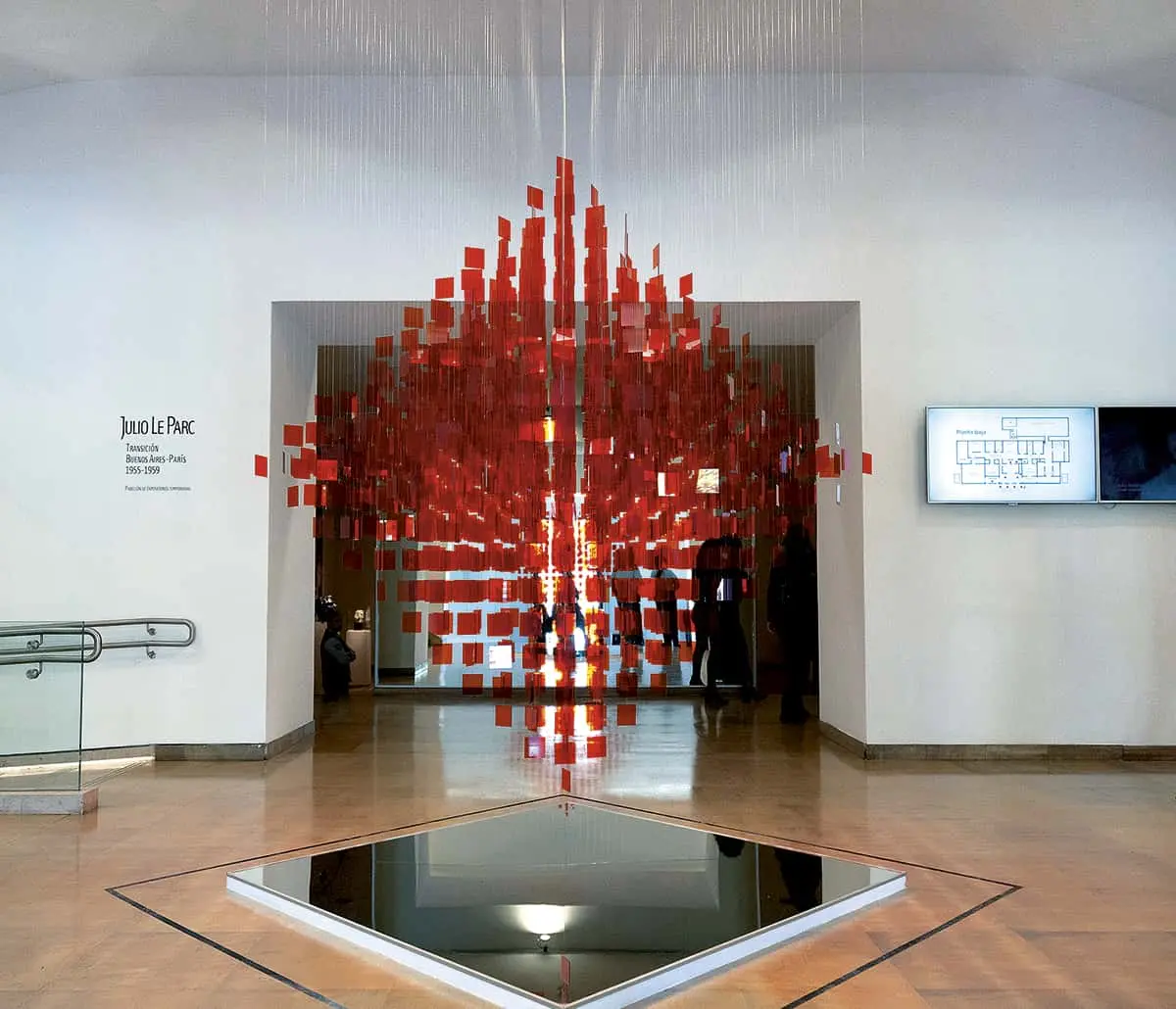
The interplay of optical provocations and combinations continues in the refined Julio Le Parc. Transición Buenos Aires-París 1954/1959 (Julio Le Parc. Buenos Aires-París Transition 1954/1959), curated by Mariana Marchesi at the Museo Nacional de Bellas Artes. It features more than one hundred works from Le Parc’s formative years, figurative portraits and academic nudes, monotypes and gouaches representative of his journey towards abstraction, and the first lightboxes from 1958-1959. These fragile boxes are immobile here, but they are shown in motion in a video by Le Parc’s son Gabriel, with commentary by the artist.
The Le Parc festival continued at the Centro de Experimentación del Teatro Colón (CETC), where oscillations and radiance came together in Proyecto Le Parc (Le Parc Project). The centerpiece, Mobile Rombo Colón (Colon Rhombus Mobile), was an installation with a fluorescent black light mobile, monumental in size (11,5 meters deep, 4.40 meters tall), and surrounded by twenty-eight mirrors. Here, the musicality of Le Parc’s work was more in evidence than ever, generating—in the artist’s own words—“a full symphony” of light in motion.
Although works by Le Parc can already be seen in public spaces throughout Buenos Aires, in cultural institutions, and in massively transited corporate buildings, these exhibitions of his work were filled with visitors, all of whom smiled.
VICTORIA VERLICHAK
Her most recent book is Mildred Burton. Atormentada y mordaz (Mildred Burton. Tormented and Scathing), from Manuela López Anaya Ediciones.