Carlos Qintana always surprises us. His solid artistic career has revealed a very particular ability to handle the sculptural object either in assemblages or—as in previous stages—by creating figures with trimmed metal, some full of wit and humor.
The materials of his new objects arguably constitute the main axis of his last solo exhibition, entitled MMXIX, curated by Patricia Morales and Verónica Liprandi, and hosted by La Caja 1 of the Chacao Cultural Center in partnership with the Museo de Arte Contemporáneo de Zulia and the Govea-Meoz Foundation.
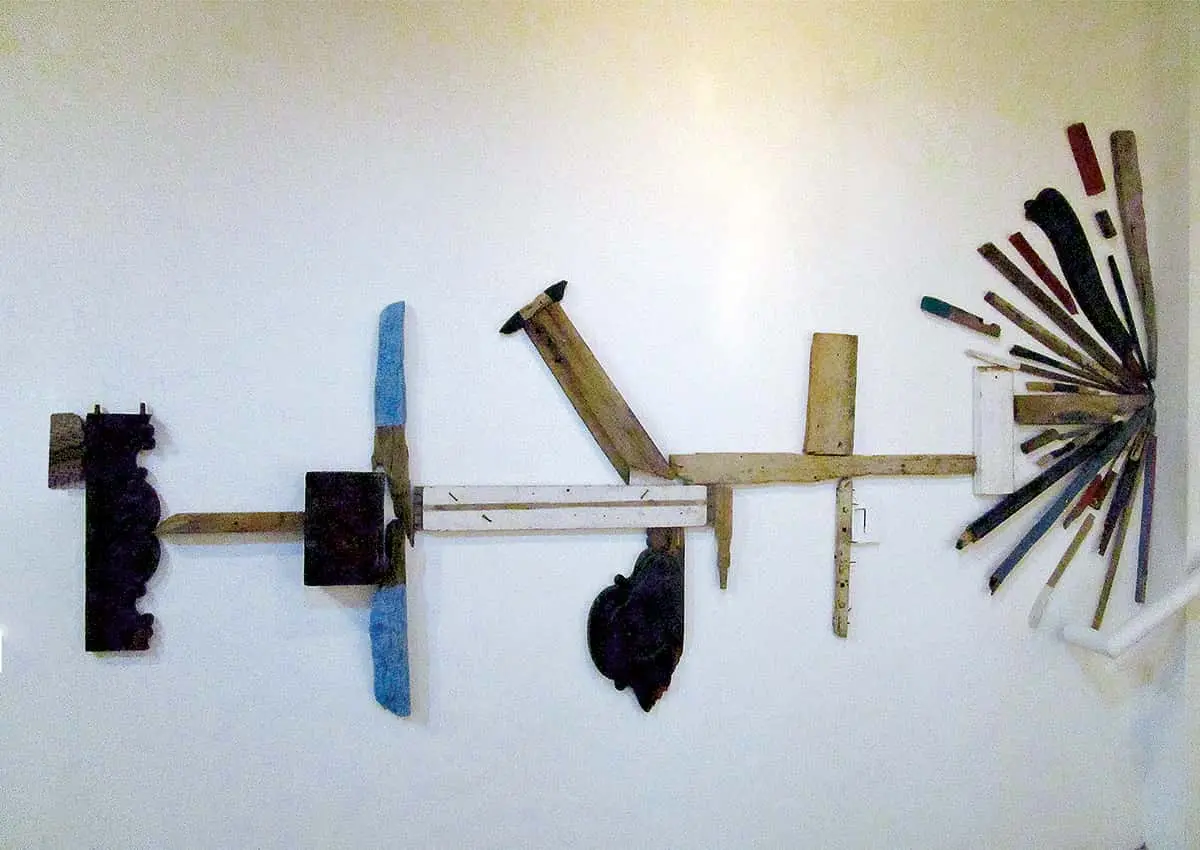
Matter, then, constitutes his primary expressive tool. His are mostly objects—or allusions to objects—made with pieces of wood or coal. Segments generate shapes that, in turn, reveal precisely how expressive these materials can be, not least in parts where the natural wood is exposed. It’s worth noting that the artist approaches these materials first, by showing them as they naturally are. Second, by using “found objects” as recipients of nostalgia and contained memories due to their worn and fragmented appearance, often with traces of the original paint. Third, by creating combinations of shapes from these fragments to suggest objects of diverse nature. And finally, by arranging them in a single line, to conceive five installations that seem to formally and semantically connect with each other. This linear composition borders the entire perimeter of the room, except for a wooden garden at the center, placed on the floor, and which, in relation to the rest, acquires a special connotation.
Each object or segment of wood or coal, viewed individually or together, can be interpreted freely because the intention is not to direct the viewer towards any particular interpretation. The curators point out that Carlos Qintana “has proposed the intervention of the space by assembling objects derived from the material culture with which we establish ambiguous relationships and to which we can grant multiple interpretations, organizing ideas and resignifying a fragmented history.”
The exhibition space becomes “a blank page” since the walls are the support for these works, which in turn act as three-dimensional “visual writings.” His “open interpretation” gives rise to feelings such as weariness and nostalgia for an “object aged by the passage of time.” Concurrently, we sense a particular beauty in the spatial impact and syntax of matter. The linear disposition of these fragments and their union have an undeniable discursive connotation since one element is linked to the following, forming a visual narrative with a specific rhythm and time: precisely the time that elapses with every interpretation. In short, these installations are “textual objects” (or, as we said before, “visual writings”) whose meaning is being “narrated” as we read the objects in a horizontal line along each wall, including the angles of the room.
A similar effect occurs with the coals. As the installation encourages complete interpretive freedom, we chose to perceive a kind of writing or (soundless) pentagram formally accomplished using glazes, chiaroscuro, and tonal games, suggesting rhythmic readings with these simple pieces of coal.
In other cases, sharp forms of “assault” and express violence. In The Cabinet of Dorángel—isolated from the rest precisely because it has a definite reference—a series of wooden fragments allude to a kitchen, many knives, and all kinds of sausages. This installation turns the occupied space into an enclosure of subversion, denouncing an abominable event that occurred during a prison riot in Venezuela. Some prisoners were victims of cannibalism at the hands of one prisoner named Dorángel. ¿Condemnation or warning? Whatever it may be, it is a reminder of an infamous crime silenced by indifference and the absence of justice.
In brief, just as all writing implies a conjoining of contents, this artist’s juxtaposed elements are perceived as sequential and time-based. As Morales and Liprandi point out, the exhibition “transcends the material condition of objects to reveal the power of the intangible, of the immaterial energy they possess. It refers us to the true and the false, to the myth that the truth is usually cruder than fiction, and how the latter tends to triumph in the history of humankind.”
Carlos Qintana’s forms and objects are, in that sense, powerful “containers of meaning.”
SUSANA BENKO