Fabulações (Fabulations), Ana Elisa Egreja’s solo exhibition at the Museu de Arte Moderna da Bahia, marks a return of the young São Paulo artist to the institution where she received her first great push forward. In 2008, Egreja participated in the 5th Bahia Salon and won a prize with Natureza morta com três patos sobre tartan verde (Still Life with Three Ducks on Green Tartan). At the time, her production focused on scenes with animals and the appropriation of printed images of various origins in somewhat surreal compositions, perhaps dominated by a universe uninhabited by humans, or one where humans, defeated by nature, had been expelled from the cities they built. In Fabulações, meanwhile, animals reappear only at specific points, at times in representations clearly derived from stylized drawings. Painting continues to be the principal terrain of Egreja’s explorations, now with decorative elements and the architecture of living spaces as newfound protagonists.
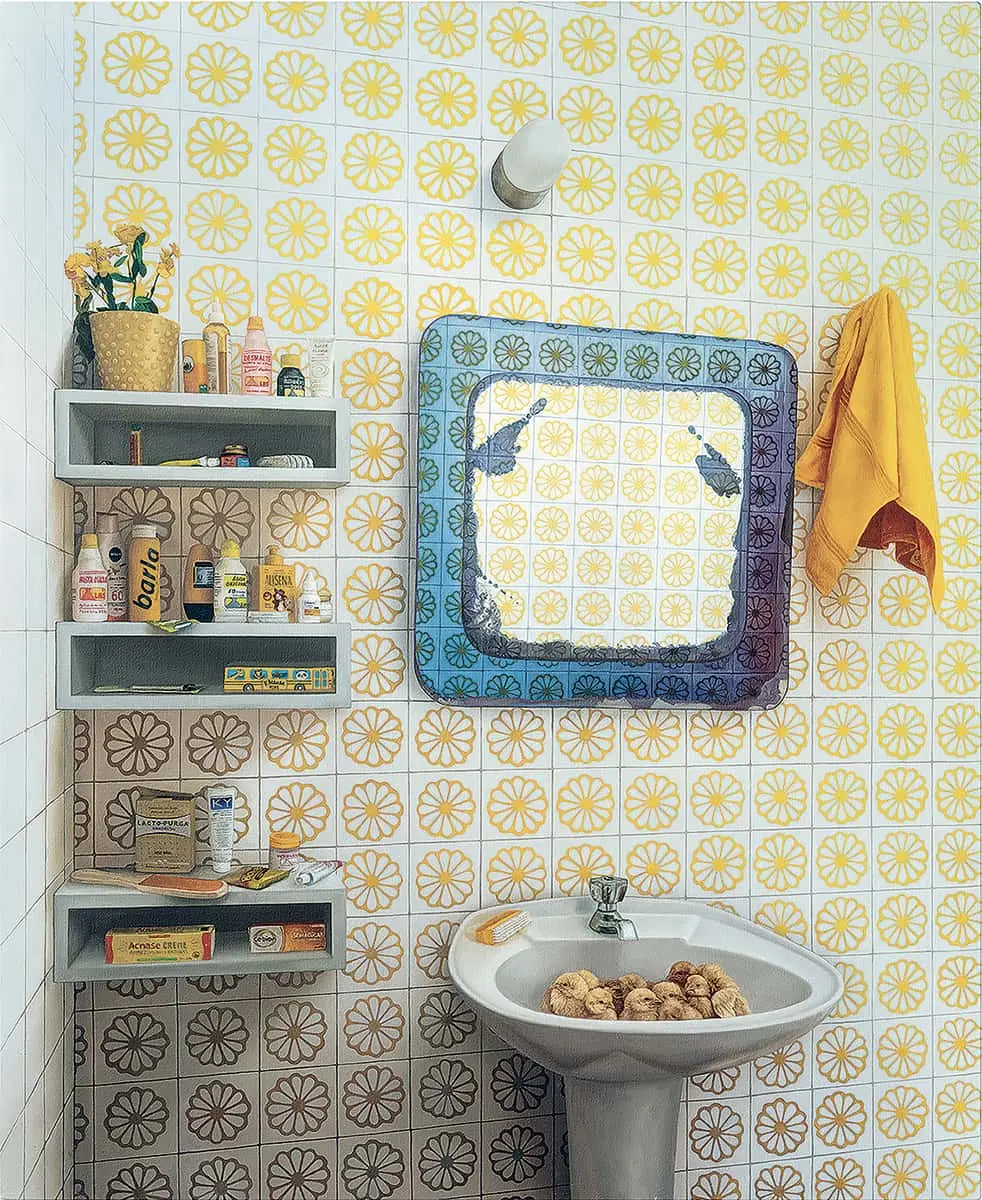
Appropriation is a rather common strategy in contemporary art, as is the reproduction of images previously reproduced on a large scale in other media. Ana Lisa Egreja’s operation, however, does not position itself as a discourse about the transposition of images or their effect. In some of her canvases, there is something of a critical narrative, for example, in Vista para o Rio Negro (View for the Negro River). Still, most of them work as a celebration of the act of seeing and its prompting by the perplexity caused by the bizarre scene. Egreja’s painterly exercise establishes a dialogue with universal references from the history of Western art, such as the painting of interior spaces and the still-life genre, canonized mainly by the European pictorial tradition. Yet, and against the grain of that tradition, what Egreja’s recent production prioritizes are not the figures, be it people, animals, or fruits. Instead, her subject is what would traditionally have functioned as a background, minimizing or even excluding the presence of animated beings. It is precisely this choice that imbues her paintings with an element of desolation, an atmosphere of abandonment, as the evidence of human absence vibrates forcefully: fruit fallen on the floor inside a room in Quarto Lívia (Casa Campo Verde/Rino Levi), (Livia Room [Campo Verde House / Rino Levi], 2018; the surface of a table in a dining room in Copa (Natureza morta) (Glass [Still life], 2017); a bathroom with various personal hygiene supplies, the sink occupied by little chickens, in Banheiro Amarelo (Casa Campo Verde/Rino Levi) [Yellow Bathroom (Campo Verde House / Rino Levi), 2018]. One is left with the impression of a recent flight, so many traces of human occupation having been left behind. On that basis, these spaces are defined by architectural elements or by objects of everyday use, household utensils seen through a closed window, or a window that is left open, or plants sitting on a ledge, or children’s toys that peek out from the shower.
Along with the vistas offered by these transparencies, it is worth noting the importance of texture and geometry in most of Egreja’s works. The patterns on the tiles, the scratches on the glass refracting the light that traverses them, and the designs of façades and floors are essential to the composition of the scenes, as was the case in Natureza morta com três patos sobre tartan verde, also included in the show. Even in canvases where these elements do not feature, as such, this kind of ornamentation, the composition itself drives attention to design patterns. The rectangle of a kitchen’s swivel windows, the paneling in a room, and the chessboard pattern in a bathroom, or the frames of windows that open to yards and gardens, all work as a kind of reticle and reproduce the separation effect provided by such open-view dividers as the lattice blinds known in Brazil as cobogós.
Precisely, central to this exhibition is the painting and installation Cobogós of 2019. This polyptych comprised of 169 canvases, 20 x 40 cm each, depicts, as though through this transparent element so common in Brazilian architecture (in truth, “intuited” on the basis of the space between each canvas), an imagined flooding of the Campo Verde House, a project of the modernist architect Rino Levi. At the museum in El Salvador, this work is installed in a structure located at the center of the space. The garden becomes a sort of portal into an invented past that dominates the exhibition and provides its connecting thread.
SYLVIA WERNECK