Taking two different concepts as his starting point, a mousetrap and the Concorde jet plane, Cadu built an expressive poetic image of the world. With dozens of previously unseen works on exhibit in his first solo show at Anita Schwartz Galeria, this São Paulo-born Río de Janeiro-based artist once again displayed his obsession with exploring multiple languages in a relentless probing of nature’s relationships, of materials and machines, and the connection between all this with humankind. With a selection of nearly thirty works that included drawings, paintings, and sculptures, all resulting from long periods of investigation, Cadu took over two floors of the gallery.
The title of the show, curated by Marcelo Campos, Fábrica de Ratoeiras Concorde (Concorde Mousetrap Factory), prompted several associations based on “the connection between two products of human ingenuity,” Cadu said. One, a simple rather rudimentary object used for pest control; the other, as the artist puts it, an airplane, representing “industrial ambition’s defiance of the gods.” While differing in their sizes and functions, these two objects nevertheless bring to the fore the idea of ingenuity, which traverses a good portion of Cadu’s oeuvre. Obsolescence, schemes for the distortion of space, close circuits and fences, all compose visual setups where mathematical compositions coexist paradoxically in a unique combination of organization and chaos, with colorful abstract brushstrokes, a variety of materials, and two- and three-dimensional planes.
The exhibition was a vibrant creative gathering of drawings, paintings, sculptures, and two interactive works titled Chinese Whispers and Pantógrafo (Pantograph), situated on the first floor of the gallery alongside the Fábrica de Ratoeiras Concorde series of nine paintings in various formats. In Chinese Whispers, Cadu mimicked the popular game of “Telephone.” The audience was invited to move a pencil connected to a system devised by the artist, which reproduced their drawings and generated enlarged, reduced, or distorted versions of the original. Yet another art gadget, Cadu’s pantograph, had visitors making a small drawing on one side of a table and enlarging it to eight times the original on the other side.
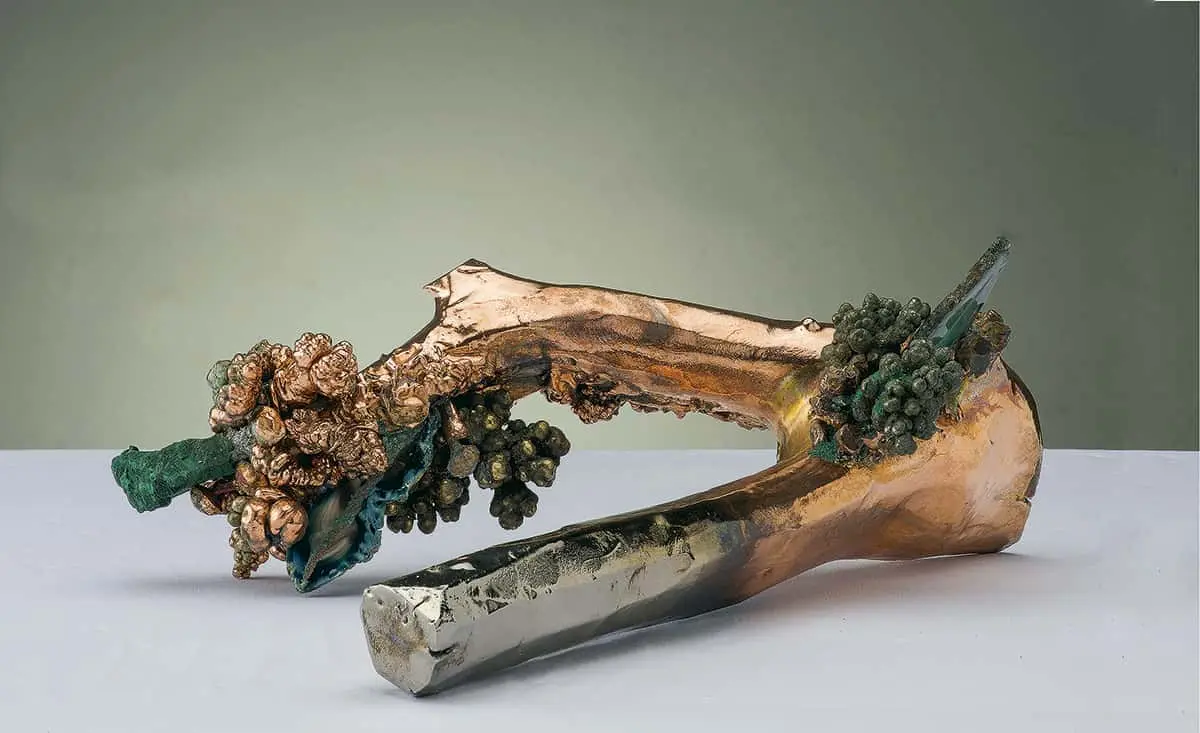
Four series occupied the second floor of the gallery: Ganga (Gangue), Craca Ganga (Barnacle Gangue), Ágata (Agate), and Walden. The Ganga series, made in collaboration with artist and jeweler Virgilio Bahde, is comprised of ten sculptures: metal hooks subjected to months-long procedures that resulted in agglutinations in their sculptures, which made them resemble coral. Craca Ganga, also a collaboration with Virgilio Bahde, includes eight sculptures in different materials, among them wood, nickel, and semi-precious stones, forming a structure with various origins, such as mineral and plant.
The Ágata series features fourteen oil paintings on aluminum plates with applications of untreated semi-precious stones, such as agate, garnet, and quartz. The works confound viewers: they appear as a collage, but one can’t tell whether the paint is on the stones, or under them. The Walden series, three raised engravings on paper, is based on pages from a book partially destroyed by termites. To ensure that the acid would create the desired pattern on the copper plates, Cadu researched the matter for two years and worked with master engraver Agustinho Coradello.
In the course of a career now spanning two decades, Cadu has participated in several biennials and exhibitions in Brazil and abroad. In 2013 he won the PIPA Prize. A transdisciplinary approach defines his practice. Each project evolves according to its conceptual characteristics, without predetermined languages or techniques. Cadu’s repertoire includes performances, installations, drawings, paintings, objects, sculptures, videos, and photographs, all touching on issues of systems, repetitions, games, time, and circularity.
Cadu’s works celebrate the relationship between man and nature, the rational and the instinctual, chaos, and rigor. They also illuminate social, economic, and environmental issues in the places where he travels, invited to live in for specific periods. And they feature an ethnographic approach as well, specifically one based on coparticipatory processes and a dissolution of authorship, as
Soy Mandala (I Am Mandala, 2014-2016), resulted from a residency at Insite/Casa Gallina, in Mexico City, an organization that promotes collaborations between artists and the local community of the Santa María La Ribera neighborhood, such as a dance troupe formed by older women and an activist group that works with tricot textiles. Cadu’s creativity recognizes no boundaries: structures that systematize readings of the behavior of the wind in the form of drawings; sheets of vegetal-fiber paper with their surfaces burned by their exposure to sunlight; white flags swaying in response to bursts of air. These are resources of a varied way of seeing that inscribes its poetic potency onto diversity itself.
ALESSANDRA SIMÕES