The Josée Bienvenu Gallery hosted Marco Maggi’s individual exhibition entitled Initialism (From Obscurantism to Enlightenment), the artist’s ninth solo show in this space. For the occasion, Maggi created a site-specific installation in the main room and a series of drawings exhibited in the smaller room at the back of the gallery.
A visit to the site-specific installation that gave its name to this exhibition was a peculiarly immersive experience. Upon entering, the room was completely dark, and all around us were visitors scrutinizing the walls while illuminating them with small flashlights. Someone gave us one of these lights, and we were ready to see what everyone was observing so attentively. Experiencing this installation was an act of “discovery.” As we advanced, a whole graphic structure of tiny paper shapes attached to the walls—creating subtle reliefs on the surface—was revealed to us. These paper particles worked almost like mosaic tesserae; they were yellow, blue, red, black, or white like the wall. Their arrangement was neither uniform nor symmetrical, and therefore unpredictable, offering “surprises” at every step of this journey of discovery. In some wall areas, the motifs agglomerated, overlapped, and created “beehives” of small shapes, while in other areas, they were more dispersed or transformed into a fine line, meticulously drawn up to or down from the ceiling. This constellation lacked a center, an entrance, or an exit. Instead, we observed a rhizomatic framework that could extend ad infinitum.
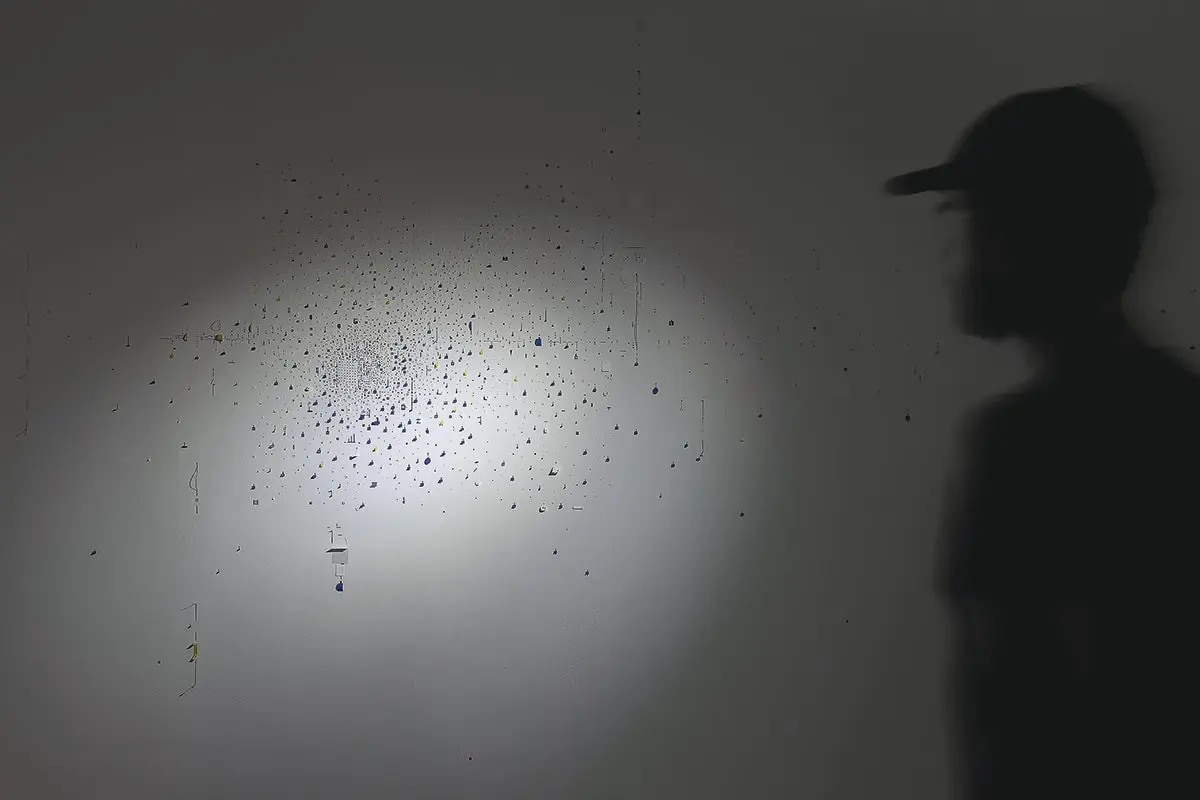
In any case, it was a fluid, coherent structure that compelled us to navigate the space as if we were trying to decipher a manifesto on its walls. We looked at these murals closely, trying to understand their messages. We observed them perhaps much the same as the paintings of the caverns were seen by those who “discovered” them centuries after they were made; trying to discern, in the shadows, aided by a faint light, the forms represented there, but without the ability to understand their real significance.
In the second room of the gallery, the space was well-lit to complete the meaning of the exhibition’s title—From Obscurantism to Enlightenment—and we were now looking at a group of works with similar symbolic systems. In those belonging to the series Waiting to Surface, particles were set on paper and framed. Small yellow lines, red and blue dots, and superimposed white paper particles created a visual dynamic whereby each element seemed to coherently mesh with the other in what appeared to be a mechanism or circuit.
In the other series exhibited in this second room and entitled Letterist, identically framed works on paper offered a different experience that perhaps generated the culmination of the enlightenment process proposed as part of the exhibition’s thesis. In this series, the surfaces were gridded, and each quadrant presented a unique motif revealing a kind of alphabet. Some of these drawings—or better, paper reliefs—highlighted a colored letter (C, E, F, L) that encompassed several symbols on the grids; hence, the title of the exhibition, “Initialism,” finally made sense. We then recalled that in our scrutiny of the four walls in the darkroom, there sometimes appeared letter-like shapes whose message was impossible to complete because we couldn’t read the subsequent symbols.
According to the exhibition’s press release, the idea for these works was also based on the current tendency to make acronyms out of complete phrases due to the celerity of contemporary life and the messages transmitted, primarily through mobile devices, social networks, and all kinds of visual platforms, leading to even further encoding and obscuring of language. Intriguingly, some creative processes occur in cycles; perhaps we are witnessing a process whereby language will again—through these abbreviated forms—establish codes that could be compared to those of ancient scriptures.
MEYKEN BARRETO