Beatriz González: A Retrospective is the first large-scale exhibition dedicated to the career of Colombian artist Beatriz González (Bucaramanga, 1938) in the United States. The show organized jointly by The Museum of Fine Arts - MFA (Houston) and the Pérez Art Museum Miami, where it was initially exhibited, offers a comprehensive look at the work of this pioneer of contemporary art in Latin America. Organized by Mari Carmen Ramírez and Tobias Ostrander, the retrospective provides the public the opportunity to take a tour through almost six decades, represented by approximately 150 works from the artist’s collection and public and private collections from Colombia, the United States, and Europe.
The exhibition begins with a series of paintings made while she was a student at the Universidad de Los Andes, in Bogotá, among which two versions of La rendición de Breda (The Surrender of Breda, 1962-1963) based on the painting of the same name executed by Diego Velázquez stand out. González, inspired by a reproduction that decorated the walls of the classroom, chose a fragment and represented it using a loose and gestural brushstroke that reveals the influence of his teacher Juan Antonio Roda. This series was fundamental in the development of her later work because when she did it, she discovered that it made more sense for her to work from a reproduction than from an original model. On the other hand, this first appropriation gave rise to a line of work that was subsequently executed, inspired by masterpieces of Western art history, as well as by the compartmentalization of areas of color that precede the use of chromatic planes. Other works from this period are the Encajeras (Lacemakers, 1963), inspired by the work of the same name by Johannes Vermeer.
In 1965, Los suicidas del Sisga (The Sisga Suicides), based on a photograph published in a local newspaper, earned the second special prize of painting at the XVII Salón de Artistas Nacionales and marked the beginning of a long-time interest in portraying the reality and politics of her country. The image showed a couple made up of a gardener and a maid who had been photographed before committing suicide to save themselves from living in a sinful world. Los suicidas del Sisga—of which there are three versions in the exhibition— is one of the first works in which González solves her search for her own language. At the stylistic level, she used colored planes that recalled the tones from her native Bucaramanga, and on a thematic level, she was inspired by popular characters.
Prints play a fundamental role in the artist’s career. Upon returning from Rotterdam, Holland, where she studied engraving at the Van Beeldende Kunsten Academy (1966), she was inspired by newspaper photographs, in particular, those found in red chronicles and social pages, to create drawings and engravings which are presented in the exhibition along with the facsimiles of the original images. These newspaper photos also inspired oil paintings such as those depicting Queen Elizabeth of England in África adiós (Africa Goodbye, 1968) and La reina Isabel se pasea por el puente de Boyacá (Queen Elizabeth Strolls on the Boyacá Bridge, 1968). In the latter’s title, one can see the artist’s keen sense of humor.
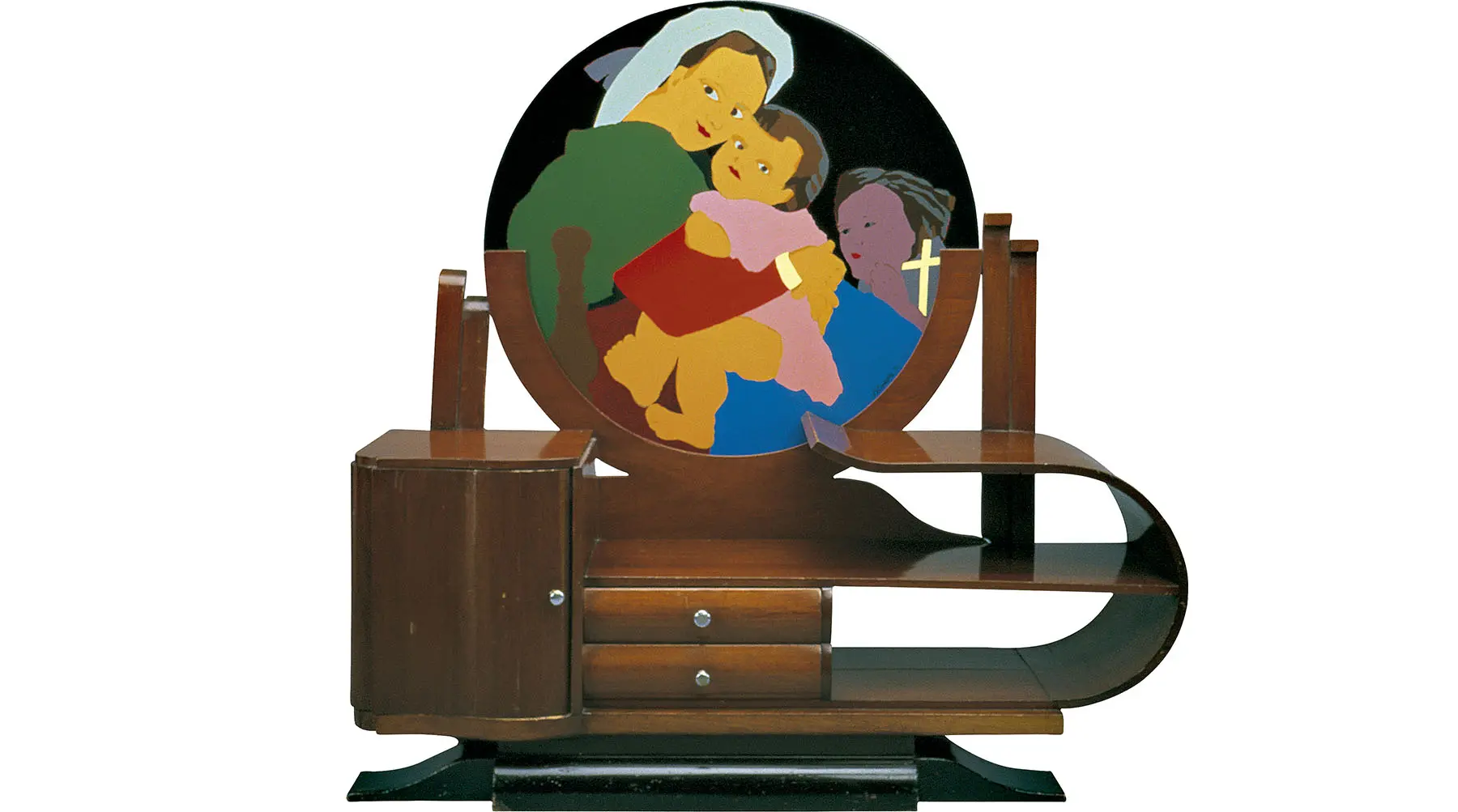
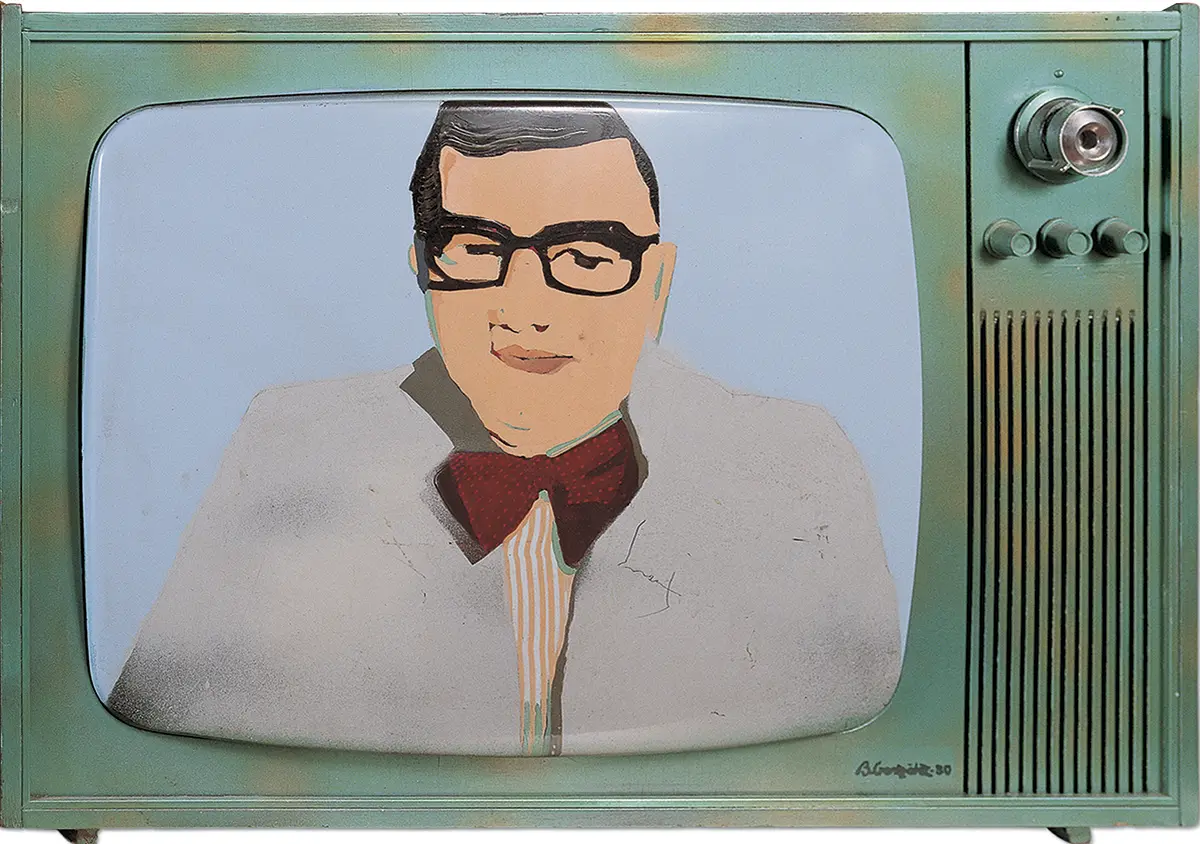
At the same time, she began to use non-traditional surfaces and materials in her paintings. The first works she carried out on metal with industrial enamel were two medallions that showed busts of Colombia’s independence heroes Simón Bolívar and Francisco de Paula Santander. Later she realized that one of her paintings fitted perfectly within the framework of a metal bed, and she made her first piece of “furniture,” Naturaleza casi muerta (Almost Still Life, 1970), in which she represented the Señor de Monserrate. This aesthetic proposal gave rise to a remarkable series of works in which she used objects—such as trays, televisions, cigar boxes, night tables, beds, cribs, cabinets, and tables—not with the idea of making three-dimensional sculptures, but rather to establish meaningful relationships using the object as a frame. Thematically, González resorted to art history, religious and political imagery, as can be seen in two of the works of the show that belong to the MFA collection, Gratia Plena (Peinador) (Full of Grace [Vanity], 1971) and Mutis por el foro (Exit Stage Rear, 1973); the beautifully decorated towel Botticelli Wash and Wear (1976), inspired by the work of Sandro Botticelli The Birth of Venus; and La última mesa (The Last Table, 1970), an appropriation of Leonardo da Vinci’s Last Supper painted on the surface of a metal table, which also shows how the selection of the support is closely related to the character or the scene represented.
Among the most impressive pieces of the show are several large curtains, including 10 metros de Renoir (10 Meters of Renoir, 1977), inspired by the work of Pierre-Auguste Renoir Bal du Moulin de la Galette, which she sold by meters—which she has done repeatedly—Telón de la móvil y cambiante naturaleza (Backdrop of the Mobile and Changing Nature, 1978), based on the painting Le déjeuner sur l’herbe by Édouard Manet, which she saw reproduced on the cover of a Salvat magazine; and Mural para fábrica socialista (Mural for Socialist Factory, 1981), an appropriation of Pablo Picasso’s Guernica. The latter serves as a transition to the political issues from the eighties on are the forefront of the artist’s work.
According to González, it was impossible not to be moved by what Colombia experienced at that time. While the population was the victim of a bloody civil war, politicians had fun in cocktails and events documented on the social pages of the capital’s newspapers. By way of criticism, González created her first openly political work entitled Decoración de interiores (Interior Decoration, 1981)—a screen-print on canvas that measured several meters long hung as if it were a large curtain—in which President Julio César Turbay appeared singing at a dinner in his honor. The retrospective includes several iconic works from that era, including the diptych Zócalo de la comedia (Foundation of Comedy, 1983) and Zócalo de la tragedia (Foundation of Tragedy, 1983), Plumario colombiano (Colombian Featherwork, 1983) and Señor Presidente, que honor estar con usted en este momento histórico (Mr. President, What an Honor to be with You in This Historical Moment, 1987).
Following the events of November 6, 1985—the storming of the Palacio de Justicia by the guerrilla group M-19 and the incursion by the National Police and the Colombian Army, which left a balance of 95 dead and several disappeared—González began to convey in her work her feelings against the irresponsibility of the rulers in power, the complicity of the representatives of the Catholic Church, and the irrationality of military actions. One of the most representative pieces of that period is Los papagayos (The Parrots, 1997). In it, President Belisario Betancur and the military leaders are represented with the colors of the birds that give the title to the painting, in explicit criticism of the resurgence of armed actions, and as a symbol of the artist’s commitment to denounce and document historical events.
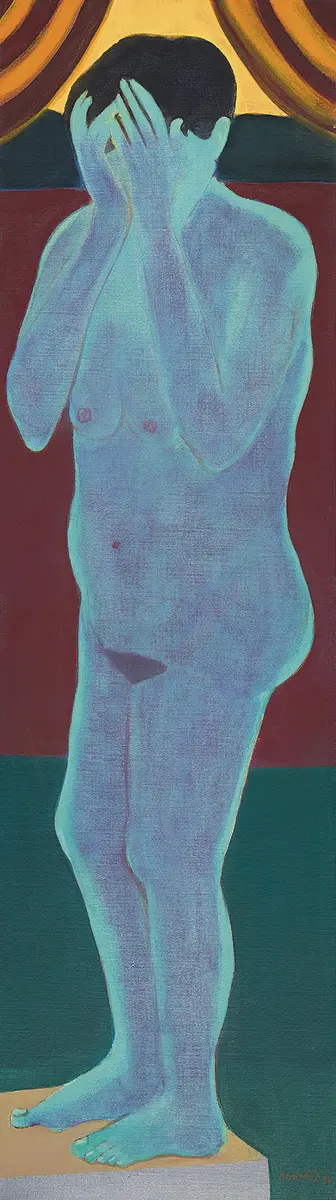
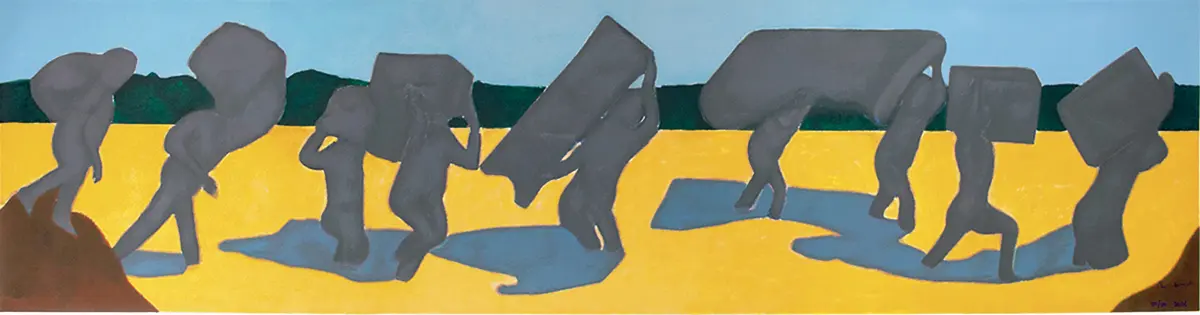
From that moment on, González became even more sensitive and began to capture in her works the stories of the displaced, those killed in mass murders, the unidentified corpses, and then disappeared, in her eagerness to claim and honor through art the victims of the armed conflict in Colombia. In 1997, she made a self-portrait in which she portrayed herself naked, crying, and covering her face with her hands as a symbol of suffering and pain. The images of women with their faces covered, crying, are recurrent in works such as Las Delicias 3 (1996) and Duelo con celular II (Mourning with Cell Phone II, 2018). The victims of the armed conflict are represented in works such as Túmulo funerario para soldados bachilleres (Funerary Mound for Student Soldiers, 1986) and Los Predicadores (The Preachers, 2000). The discovery of mass graves and the images of the cargueros (porters)—people who load the unearthed bodies in plastic bags and sacks—printed in the newspapers, became icons in paintings such as Cargueros de Bucaramanga (Bucaramanga Porters, 2006).
On the other hand, the artist identifies with the indigenous, rural, and displaced communities. In 1/500 (1992), an indigenous paddling refers to the controversial celebration of the five hundred anniversary of the arrival of Christopher Columbus to America. Yolanda Izquierdo con libreta de apuntes (Yolanda Izquierdo with Notebook, 2008) is based on the true story of a peasant leader killed for denouncing the abuse of paramilitaries. The problem of displacement, not only nationally, but also internationally, is illustrated in works such as Zulia Zulia Zulia, Cenefa (2015) and Desplazados, papel de colgadura (Displaced, Wallpaper, 2017). In all these works, González denounces and at the same time, transmits the individual and collective pain generated by each of the situations that inspire them.
Finally, the work Auras anónimas (Anonymous Auras, 2007-2009)—an installation in which the artist covered 8,957 cavities of the neoclassical buildings of Bogotá’s Cementerio Central with drawings of the cargueros, that was recently declared cultural heritage—can be seen in a video produced by the Universidad de Los Andes. This project constitutes the perfect finale for this powerful retrospective, which shows both the innovative and unpredictable character and the depth and intensity of a work that should be valued not only from the artistic point of view but, most importantly, from the deepest of human feelings.
* Catalogue Raisonnée Beatriz González. Courtesy of the artist and Banco de Archivos Digitales de Artes en Colombia of the Universidad de Los Andes.
FRANCINE BIRBRAGHER-ROZENCWAIG
Master’s in Art History and Ph.D. in Latin American History. Art historian and independent curator