Eduardo Medici presents his most recent series, Malos tiempos (Bad Times), in the gallery’s new space, which is more spacious and luminous.
Be it through drawing, photography, or painting, as in this exhibition, Medici’s world is a desperate investigation into human existence.
The depth of the issues engaged in his work has never failed to be anything but astounding.
From the start, through tortured figures that brought Giacometti to mind, Medici’s work revealed a humanistic interest. Later came an explosion of color and his investigation of the history of painting as a field of questions into which to inscribe his own language.
Medici’s work was never prey to the body/soul or spirit/flesh opposition already present in medieval “Disputations.” For Medici, the body is never separate from the spiritual aspect, a wholeness that exalts the human condition and gives sacrifice its meaning. The topics of sacrifice and ritual are connected to eroticism and death, two sustained considerations in Medici’s work.
Today, Medici has set aside the religious iconography found in so many of his prior works.
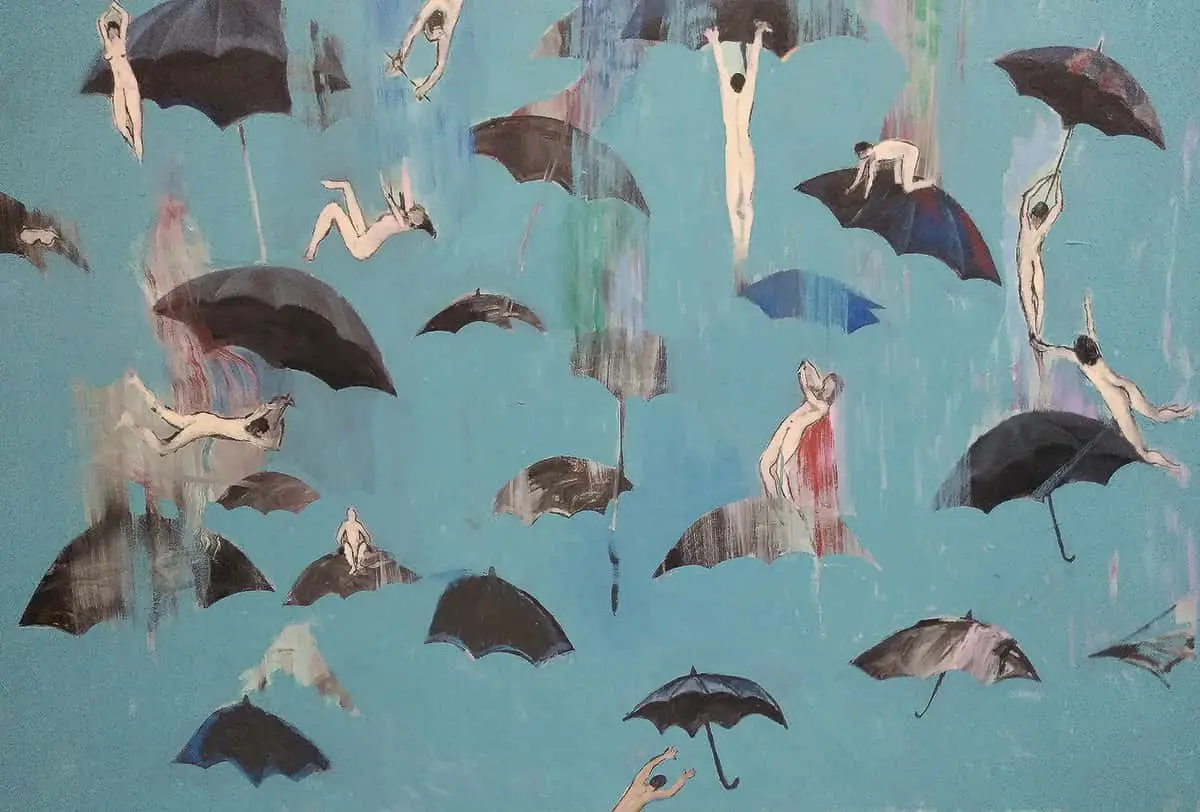
Weightless beings seem to slide or float as if playing—against a unified ground—in search of balance or rhythm, with black umbrellas of different sizes, no less oscillating and vulnerable than the figures they accompany.
In some of the works, the umbrellas float in solitude; in one, in joyful colors, the figures of Prometheus and the crow return us to the topic of existential tragedy.
The umbrellas, hypothetically an element of salvation, of refuge, allude to possible supports, more imaginary than real.
In a chaos of colors and naturalistic possibilities, a female head with a bird (Minerva and her owl, meta-modern), their gaze focused and wise, makes things emerge from chaos.
The boundless solitude represented in three of the works contrasts with those spaces filled with arresting elements. In one of them, a dark silhouetted figure, alone under an umbrella, stands clearly out. In another, the solitary figure is set against a dark ground of disturbances and alterities, not in the least homogeneous. In a third one, the fragmentary view is of a woman whose umbrella is insufficient protection against the unrelenting rain that gradually erases her image.
Are these figures an allusion to an intimate kind of loneliness, or is the issue the anomie of social media?
In this show, Medici comes at us with two quotations by Velázquez. One is an exaltation of the female form, its luminous sensuality, where the “being with” that Sloterdijk spoke of begins. The union with a female body is what makes it possible to battle against death.
The other quotation, Las meninas, prompted Foucault’s profoundly intelligent and subtle meditations on space.
In an article written in collaboration with Alejandro Schianchi, we wondered, precisely in connection with Las meninas: what happens to the traditional, monocular, and fixed perspective when we are confronted with this astonishing display of represented and virtual spaces crisscrossing and shifting like a whirlwind?
There is an exchange of roles between subjects, objects, and viewers. Is Velázquez looking at us or at the Queen and King whose image we see in the mirror on the wall? In what space are the meninas situated? What opens up with the figure all the way to the back?
As Foucault writes, profound invisibility emerges in what is seen, associated with the invisibility, the person who sees despite the mirror, the reflections, the mimicries, the depictions.
Representation acquires unfettered freedom here, one that overcomes any preceding code or norm.
As Guattari has pointed out, singular and dynamic constellations permanently generate modes of production. Thus, Eduardo Medici revisits Las meninas and transforms them into a temporal interplay between past and present. It is a double-fold diction. There is a representation of Velázquez’s representation, with Medici occupying the space of the painter and a dazzling tour of the stunning ruptures that dot the arts of the
Twentieth Century: Duchamp, Magritte, the Bechers, geometric artists. The specular vision has also been duplicated. A reflecting surface has been added to the mirror in the back, as a fulcrum for the characters.
Medici’s work is not a citation or a unidirectional reference, as is the case, for instance, of Picasso’s version of Las Meninas. Medici—following Guattari—heterogeneizes the universes of references and uses them for a dynamic investigation of the situation of the contemporary artist.
The artist counts on that move to position us amidst space’s multiplicity and leave us floating in uncertainty, insecure, filled like his characters with unanswered questions.
Yes, Medici reminds us that the conceptual misalignment that began in the Sixteenth Century still haunts us. And he refuses to heed a globalized, banal, always superficial contemporaneity.
NELLY PERAZZO