Teresita Fernández: Elemental is a retrospective spanning from the mid-1990s until today. It showcases an excellent selection of two decades of her work and brings together more than fifty pieces, including large-format installations, sculptures, mixed media, and even drawings. The latter are rarely included in her exhibitions, in spite of being a vital aspect of her creative process, allowing us to see her working methodology from the conceptual stage to its conclusion. The exhibition is a joint effort of the Pérez Art Museum Miami and the Phoenix Art Museum, and a collaboration of curators from both institutions.
Fernández, who lives and works in New York City, was born in Miami and studied at Florida International University and Virginia Commonwealth University. During her successful career, she has received numerous awards and distinctions, including the prestigious Guggenheim Fellowship for Creative Arts (2003) and the McArthur Fellows Program (2005). She is known for her on-site interactive installations, several of which are permanently exhibited in prominent public spaces.
This artist’s work is inspired by nature and based on the traditional theme of the landscape from an aesthetic outlook and her interpretations of art history. Her pieces are formally highlighted by a play of light, shadows, and textures, which visually give the illusion of a certain type of materiality; as we approach them, they are revealed to be made of something completely different and unexpected. The use of materials is key to understanding Fernández’s work, which is defined by an experimental will to seek formal solutions to express a particular idea.
The high esteem for her work is based on the intimate dialogue she builds with the public. Connections are established between each work and each spectator, based on personal experiences and interpretations. Her pieces are visually very attractive and have an evocative sensibility. In several of her installations and other works, she relies on the optical effect generated by the accumulation and repetition of their constitutive elements. A work such as Fire (2005) is an example of this type of strategy. Seen from afar, as its title indicates, it simulates a fire. Built in a circular shape, some “flames” are shorter and others longer, replicating the real effect of what could be a bonfire. As we get closer, we can verify that the piece is made of thousands of silk threads in which the color changes between the orange at the bottom (fire) and the white at the top (smoke). The delicacy of the silk thread, flowing smoothly as we approach it, perfectly represents the undulating flames of fire: a phenomenon both potentially tragic and hypnotic. Associations and interpretations of the piece can be as varied as those who see it, from total destruction to a phoenix-like rebirth.
One of the most impressive pieces in the show is Drawn Waters (Borrowdale), 2009. Made entirely of graphite, it depicts a source of water falling onto a bed of stones. Part of the title alludes to the region of Cumbria, in England, known for its historic graphite deposit. According to the artist, for her, this work is a sculpture that she made as if it were a drawing, inspired by Leonardo da Vinci’s water drawings, also made with graphite. This work is also influenced by Land Art, both on the subject and the scale.
The show features several works from that same year and the following one, which continue exploring the use of graphite to represent land-scapes, mainly nocturnal scenes. Each of these pieces is more like a “construction” of a landscape, rather than a drawing, which is the traditional medium for graphite. Fernández creates various textures with this material to reproduce landscape formations on diverse surfaces and through different layers and configurations.
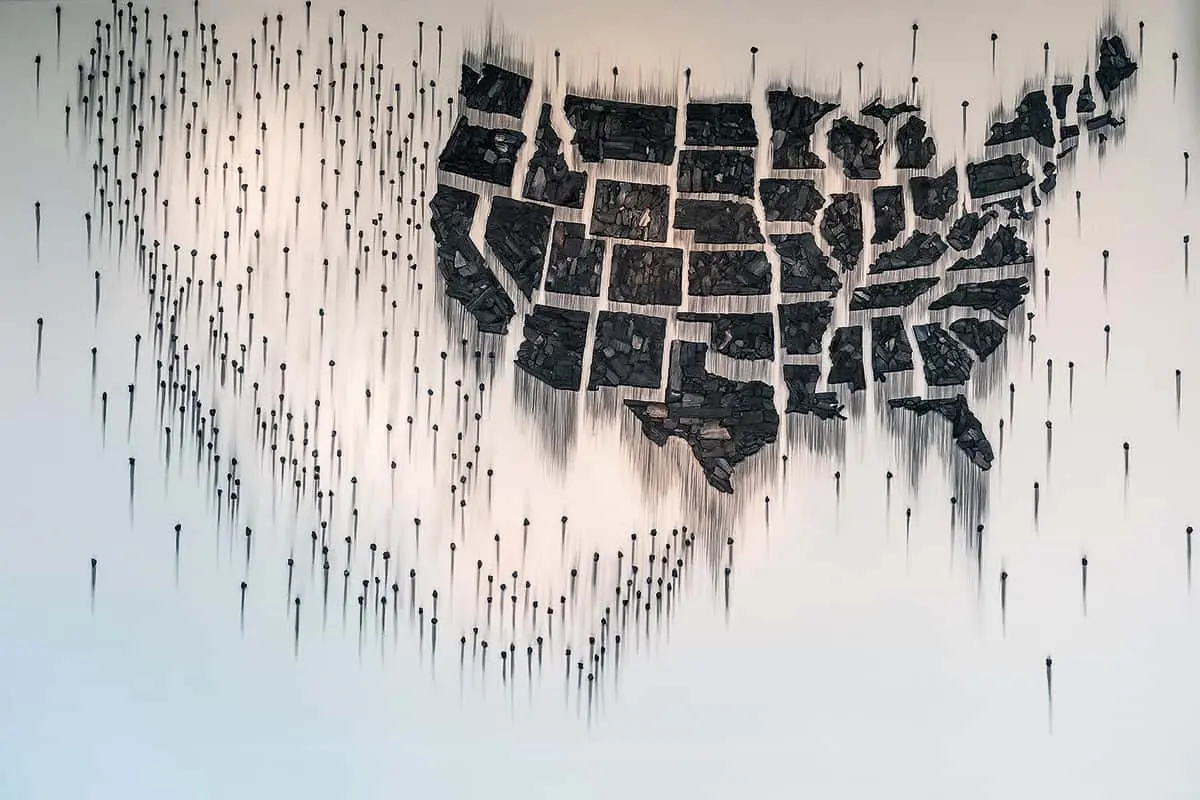
Her latest pieces move away from the interpretation of the landscape as an aesthetic and personal experience and delve more into contemporary social and political issues. In works such as Charred Landscape (America), 2017, and Fire (United States of the Americas), 2017-19, critical situ-ations such as climate change and the country’s political polarizations are embodied. In the latter, by presenting a fully charred map of the United States, she refers to the essence and the urgent nature of these problems.
IRINA LEYVA