Marta Traba’s thought, as controversial as it was, is fundamental to understanding the quest for stances of authenticity in the face of processes of cultural homogenization in Latin America. One concept Traba developed in the 1960s was that of “resistance” as a model to confronting an invasive US artistic paradigm, which she described as an “aesthetic of decline.” Two antagonistic opinions she expressed about Ecuadorean art will serve to assess the reach of Indigenism in these lands. Among local intellectuals, an aggrieved rejection of Traba, based precisely on these opinions, persists even to this day. One concerns the work of Oswaldo Guayasamín, where she finds the presence of “a premeditated and demagogical attitude” intended to render the artist “a proxy for the defeated.” The other one is about Enrique Tábara: “No other body of pictorial work in Latin America expresses an indigenous non-being as precisely as Tábara’s. It must be noted, however, that this non-being, this obstinate retreat from active life, is deeply steeped in poetry.” The artist’s discourse avoided standardization and left such a significant impression, above all, because many others were uncertain about the path to follow. What, in visual terms, did it mean not to give in to abstract expressionism (which sold itself to the world as an icon of the democratic model) without falling into the game of appearing as exotic, essentialist, or supraidentity representations?
It was not by chance that Enrique Tábara Zerna (Guayaquil, 1930) played a crucial role in the 1968 Quitio Anti-Biennial. This opposition force was forged by the tzántzico group1 based on the Cultural Front, and would, in turn, result in the formation of Grupo VAN (National Art Avant-Garde, in its Spanish acronym) and the launch of a Popular Front manifesto. In it, artists adopted a radical position against the policies of the Casa de la Cultura, an institution whose biennial proposal appeared disconnected from local realities. As Tábara put it after the establishment of VAN: “We were convinced that art concepts in the country needed to change. What we found was plenty of political art concealing artistic mediocrity, in the belief that an insistence on social realism was the only path forward”2.
In 1966, with the support of university students and workers, the Writers and Young Artists Association occupied the Casa de la Cultura Ecuatoriana. All the provinces joined in the initiative. In Guayaquil, the action Enrique Tábara, José Martínez Queirolo, and Enrique Gil Calderón were at the head of the action3. Tábara’s participation was especially significant because of his experience interacting with representatives of then-fashionable international styles during his nine years in Spain and Switzerland.
Grupo VAN was established in 1967 with León Ricaurte, Guillermo Muriel, Hugo Cifuentes, Oswaldo Moreno, Gilberto Almeida, Luis Molinari, Aníbal Villacís, and Enrique Tábara as its members. While representing different styles and languages, they shared an interest in change towards greater freedom of expression, beyond the limitations of social realism. One of the figures that most influenced the assumption of a calamitous tone and victimization was Guayasamín.
Tábara and his circle responded firmly and critically to him having been favored by the Quito Biennial, as well as to the policies he imposed after assuming the Presidency of Casa de la Cultura, in 1972, in a self-dealing attempt to establish Indigenist painting as the preeminent value in the Ecuadorean context.
When I ask for his opinion about social engagement as a creative act, Tábara notes that, in his particular case, there is a divorce of sorts between reason and how the vision he wants to show actually appears. He correctly points out that in the 1930s and 1940s, Ecuadorian artists devoted themselves to illustrating the works of Jorge Icaza and other socialist writers. “Artists said that those were the only paintings they could make, and later they became politicians.”4
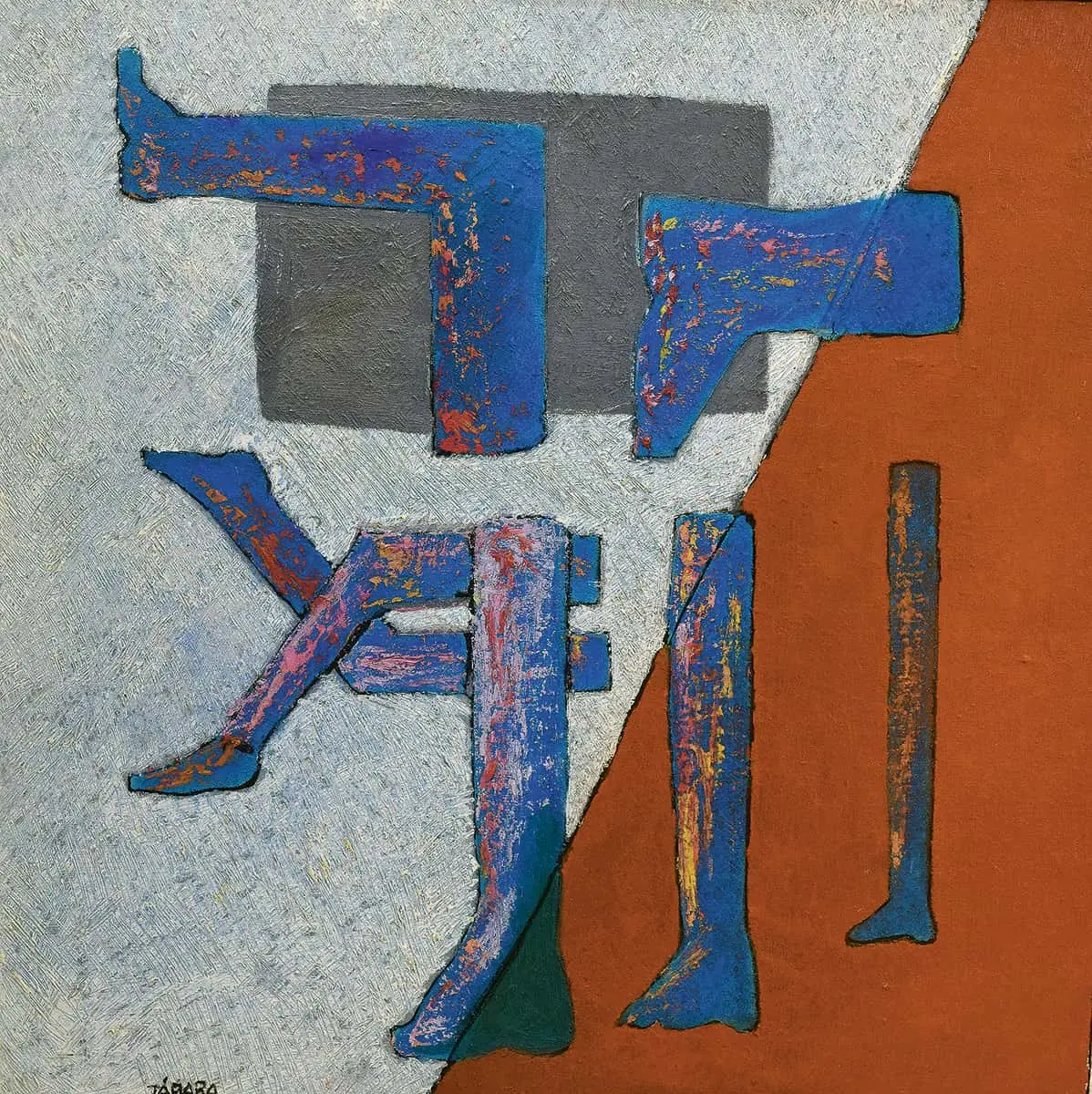
By the 1970s, Tábara was moving from abstract to pop art. Traveling from Spain to the United States, he stopped in Puerto Rico where he found himself imbued in a debate where he himself warned with curiosity that he did not want to “be on the side of abstract artists.”5 Tábara realized that abstraction, especially of the geometric kind, was the fashion of the moment in the arts, but he “felt that a return to the human was needed.” 6 Arriving in New York, he began to outline a complete human figure, head to toes. He says he tore up that drawing, and the pieces with the legs fell next to him. “I picked up the legs, and they seemed interesting for creating this new work, centered on the human.”7 Thus was born the series Pata-pata (Feet-Feet), in 1969, result of a symbiotic relationship between Tábara’s exploration of those cultural signs that would bring him closer to his own nature as a man of the people, avid to recognize himself as a creator of new, abstract, instinctual universes freed from any programmatic character and from anything even remotely redolent of aesthetic imposition.
No one is a prophet in his own land
Enrique Tábara was born on February 21, 1930, to a low-income family in the shipyard neighborhood of Guayaquil. The future artist met his father for the first time at the age of 19. The family’s scant means supported twelve siblings, a genealogy that Tábara, himself the father of eleven children, was to replicate in his own life. His mother would take him to the countryside from an early age, and as a four-year-old, he was already interested in capturing the colors of insects and butterflies. “Nature always fascinated me.”8
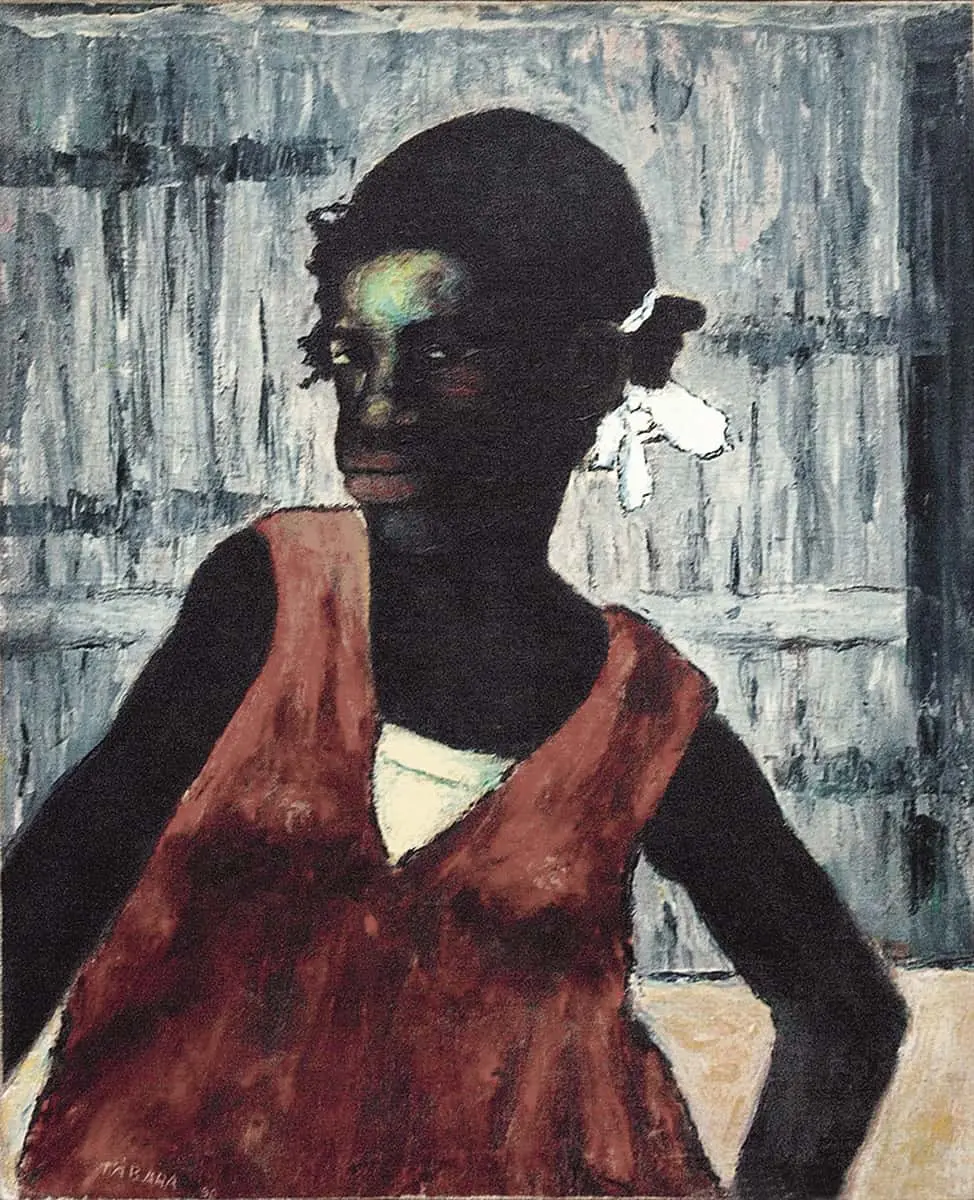
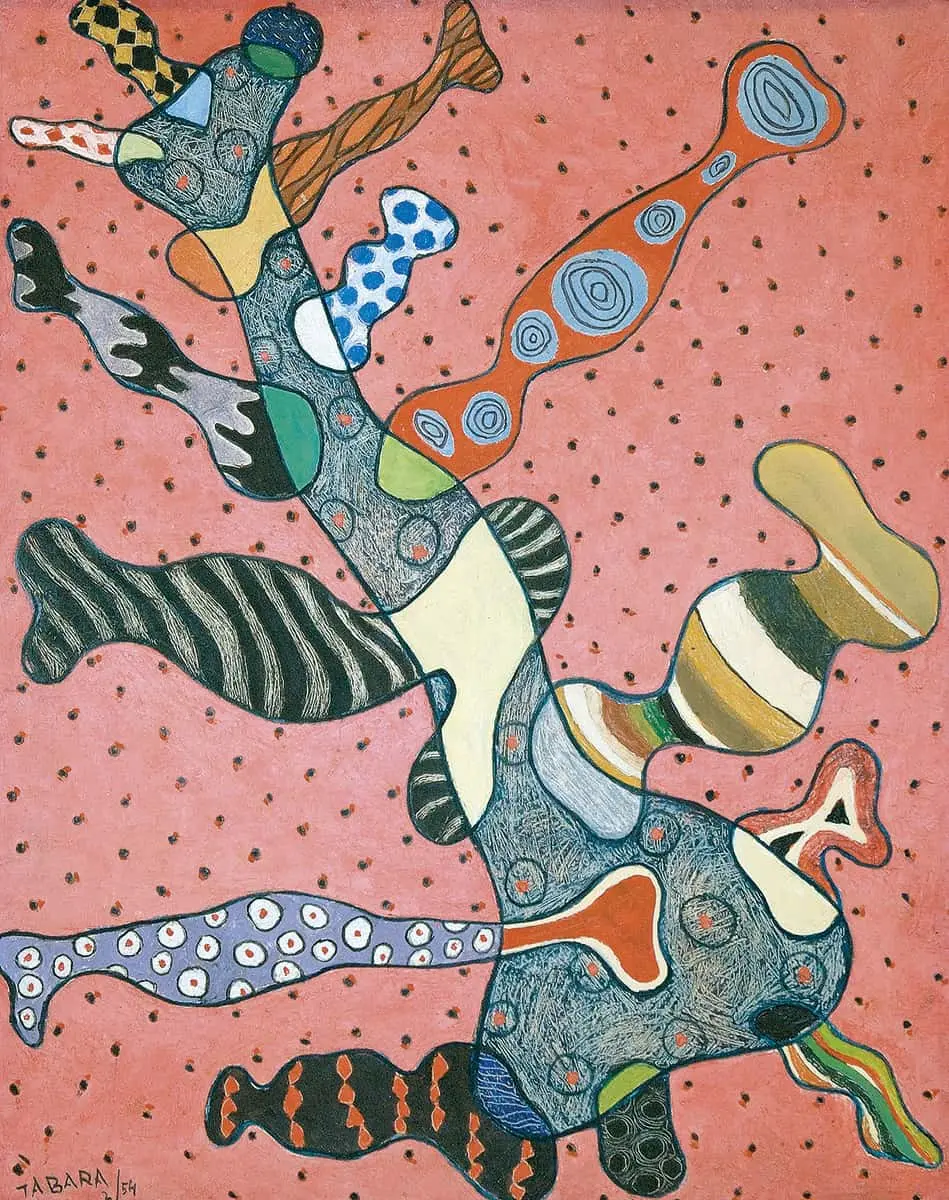
At 16, Tábara was accepted to the Escuela de Bellas Artes, where he studied under the influence of Luis Martínez Serrano and Hans Michaelson. The latter, an expressionist painter, played a particularly significant role in helping mold Tábara’s earliest productions, which already then sought to circumvent Indigenist discourse. Tábara found it dismaying that visual artists would willingly limit themselves to taking literary narratives as their sole models, emphasizing in their discourse a clichéd view of the essence of the nation. It was around that time that he painted La solterona (The Spinster) and Negrita (Little Black Girl), both dated in 1951, and Niños carboneros (Coal Mine Children), from 1952. These works came about as a result of Tábara’s interest in life in the slums. He would go to the dance halls to observe people as they danced and make sketches. The realist works of Diógenes Paredes, Eduardo Kingman, and Guayasamín had left an impression. Tábara’s move towards abstract art began only in 1953, after his study of Kandinsky. He created fictional forms and landscapes, and it was in this context that he made Atigrado en fondo rosa (Stripes on a Pink Background, 1952), which prefigured his later Pata-pata series. Thus, some of the works Tábara was to carry with him on his travels already anticipated an inclination towards the language of abstraction.
Before the idea of a European sojourn had taken shape in his mind, however, Tábara was described as a unique figure in the Latin American scene in an article about his painting La selva (The Jungle). The author of the essay introduced him to Joaquín Torres García’s work, and Tábara promptly bought his book Constructive Universalism. He carried this book under his arm during his time in Spain, where he traveled in 1955 thanks to an Ecuadorean government grant. In his baggage were paintings that already linked him to the Surrealists. In Spain, Tábara met Tàpies, Miró, and Joan Brossa, the latter an intellectual leader in Barcelona. His second exhibition in the city was held in Sarrià. Unfamiliar with the neighborhood and excited to converse with locals, he approached a man in the audience. “Only one Latin American artist has exhibited here before you,” the man told him. Intrigued, Tábara inquired about his predecessor’s name. The answer jolted him: Joaquín Torres-García.
In Tiahuanaco, from 1960, Tábara seemed to condense all the mystery and wisdom of the universe. Inspired by the ancient capital of Tiwanaku, this work pays homage to that enclave, located at the exact center of the line that represents Wiracocha’s path. Tiahuanaco speaks to us from the unfathomable knowledge of that trailblazing South American culture, while at the same time inviting us, in a decade marked by uncertainty and counterculture, to delve into our past in search of new existential possibilities. That same year, Tábara won the International Abstract Painting Prize. He continued to work on pre-Columbian themes until 1964.
Tábara’s production—if we pay heed to Traba’s description of it as “indigenous non-being”—developed a characteristic that I identify as vitalist. His own view of what constitutes painting as a life experience and the influence in it of chance; the concept of a “pictorial kitchen”9; his desire to roll along with life itself and avoid turning politics into a reiterative subject, instead relying on a lucid revolutionary vision in the political realm: all contribute to confirm this hypothesis. Existentialism exerted significant sway on Latin American intellectuals of the 1950s and 1960s, and vitalism was a part of that environment. Life was situated outside the reach of science, the media, and the culture industries. There was an urgent dive to follow instincts and the irrational, and to commune with nature. High value was placed on individuality. All of these elements can be found in Tábara’s art. Above all, a leitmotif of his work has been the profound exploration of the mysteries of existence.
In 1961, André Breton invited Tábara to participate in an exhibition in homage to Surrealism. Appearing as a Spanish representative alongside Dalí, Miró, and Eugenio Granell, Tábara contributed his work Erótico (Erotic). A year later, he participates in the New York fair. That same year, Swiss dealer Georges Kasper expressed interest in his work and proposed working together for five years. Tábara remained in Switzerland for three years before returning to Barcelona. Nevertheless, he was able to exhibit in renowned spaces in several European capitals during that period. His work was reviewed encouragingly by José María Moreno Galván, Juan Eduardo Cirlot, and Joan Teixidor. The latter presented Tábara’s solo exhibition at the Ateneo in Madrid.
Tábara had achieved what all artists aspire to: show his work to the world and receive critical approval. It was time to journey back to his origins. “I felt like Garcilaso de la Vega, the Inca, longing for home,” he says. In 1964, Enrique Tábara returned to Ecuador.
The Pata-Pata: Epitomes of life’s “natural shape”
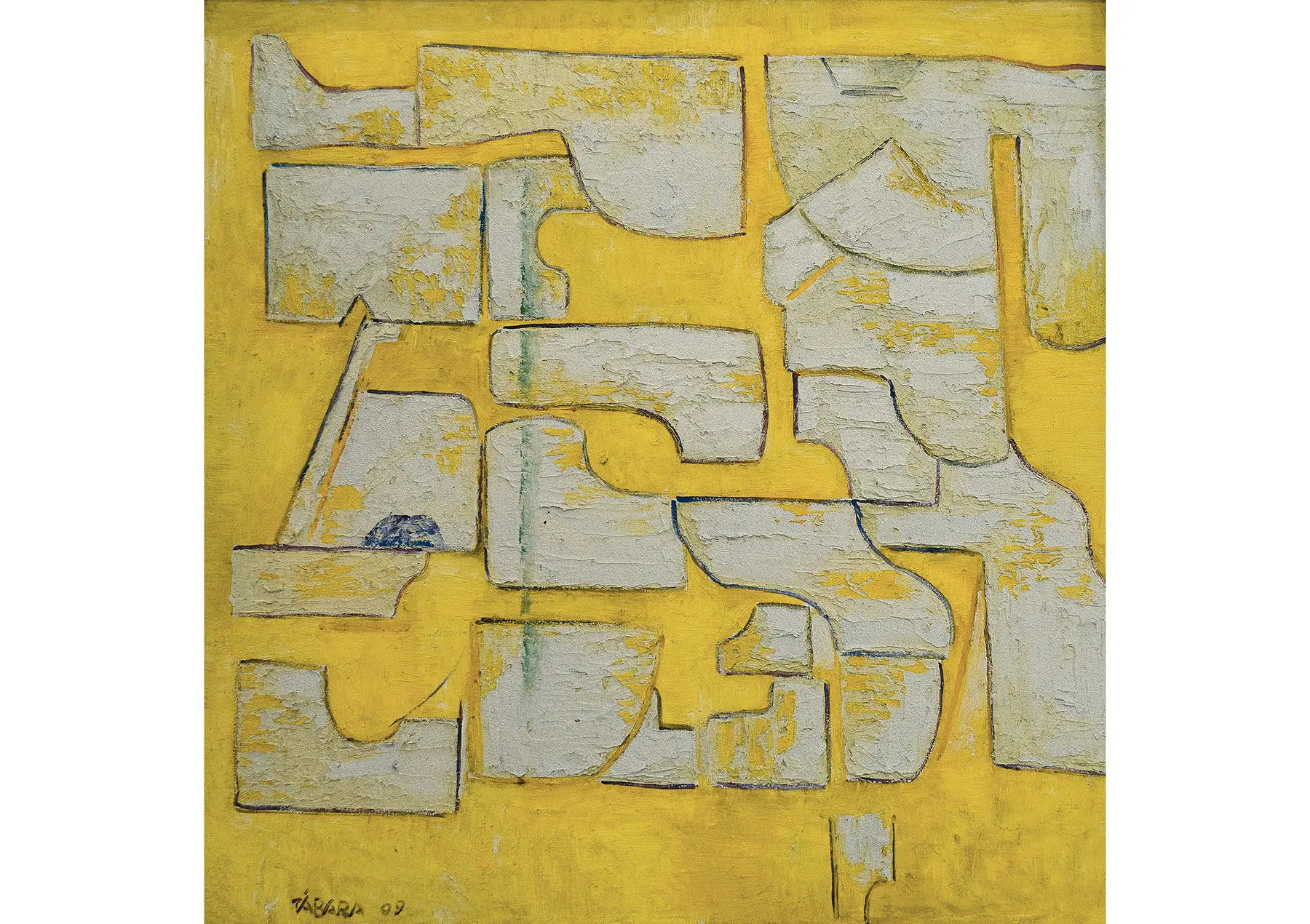
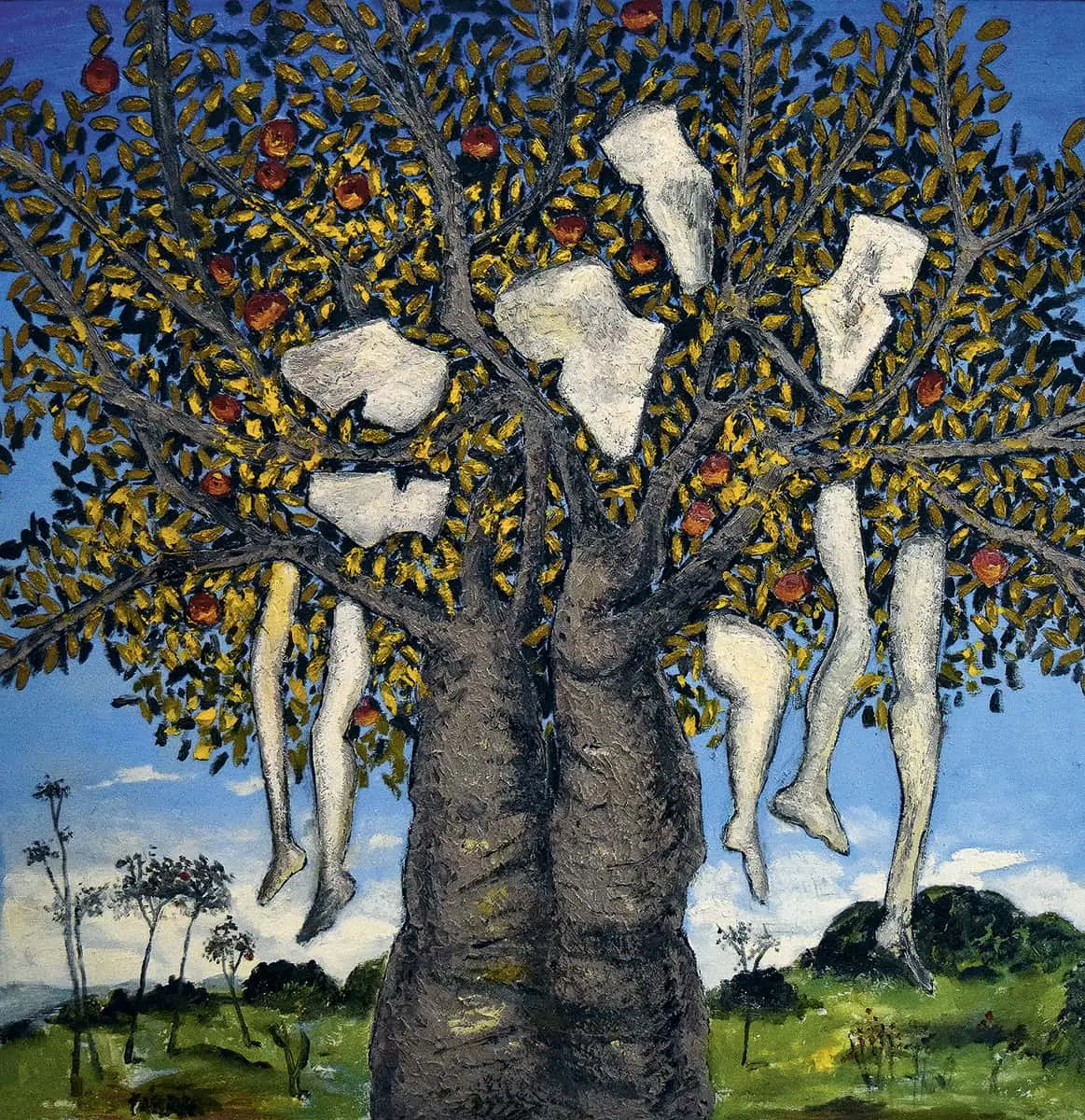
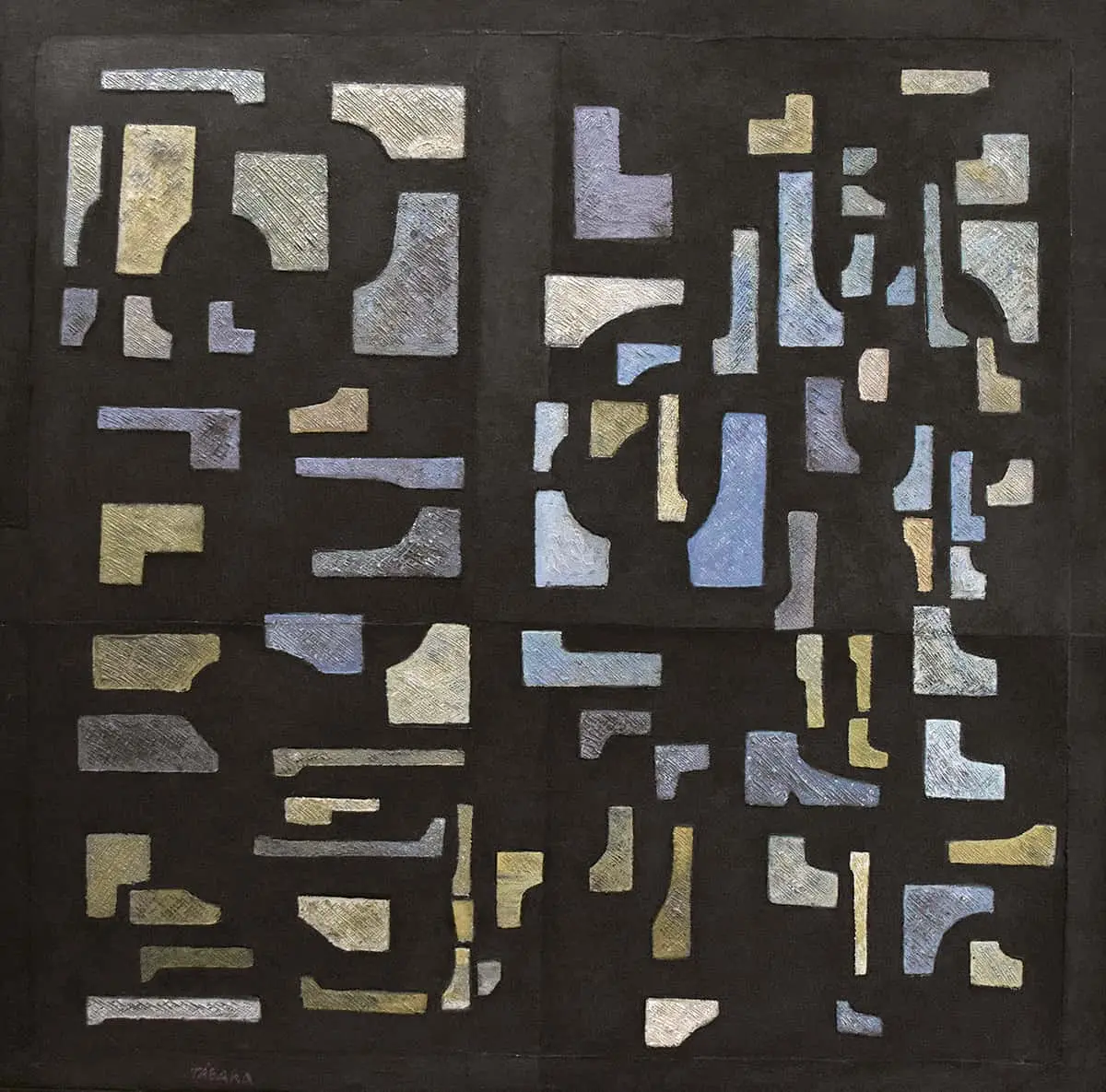
To return to the connection I am trying to establish between Tábara’s work and vitalism as a philosophical posture; I see his roots tending more towards Romantic tenets than—as is often said of Modern Latin American artists—towards a “Baroque ethos”10. Tábara has always favored succinct compositions. He has never been interested in narrative overabundance or motley plotting. Much less after he began his Pata-pata series in 1969, enthroning feet and legs as the antithetical heralds of modernity, “as it blends into the vitality of Capital”11. The Pata-pata express Tábara’s affirmation of “the natural shape of life”12. They come about in several ways: contrasting against a background that can be read as the global context of the late 1960s; hanging from the tress of the world; in oblique lines (Piernas en diagonales, Legs in Diagonals, 2014); in geometry-inflected compositions with moderate color ranges, like Ancestral en Amarillo (Ancestral in Yellow, 2009), and Comunidad en negro y gris (Community in Black and Gray, 2015); or as random occurrences immersed in warm-color palettes associated with a pop aesthetic.
Such axis Mundi, like Arbustos con imágenes blancas (Shrubs with White Images, 2016), has been gener-ally associated with natural estates of existence: “tree of life”; “tree of fertility”; “tree of the center”; “tree of ascent”; “tree of the sky”; “shamanic tree”; “mystical tree”; “tree of knowledge”13. These canvases seem to provide commentary, among other topics, on the cyclical visions of indigenous cultures. As legs and feet of different appearance frequently emerge from these axes, it may be that what we are witnessing is an art-work-manifesto. Indeed, everyday elements are hard to find in the Tábara’s oeuvre. The Pata-pata period coincides with those countercultural revolts that spoke of “power to the imagination,” and figures like Sartre—with his existentialist humanism—and Simone de Beauvoir—focused on women’s rights—were catalysts for vanguard thinking. Perhaps unconsciously, Enrique Tábara is a man who puts into practice the concept of epoché—which Sartre took from the skeptics—as the foundation of the process of achieving ataraxia (imperturbability or equanimity). Such a state of decompression and repose is present throughout his entire oeuvre.
Today, at the age of 89, this Guayaquil native continues to work on a variety of projects. One is the Enrique Tábara Museum, with holdings ranging from archeological artifacts to contemporary artworks. An exhibition of its Latin American Collection is slated for October 2020 at the Terrassa Cultural Center, in Catalonia. One of the morals Enrique Tábara leaves us with is that genuine glory is not achieved by submitting to an ideology but through permanent renewal. A statement by the members of VAN encapsulates this idea: “In the face of this present, of this lie, there are men who lose their mind, men who look to the past, and men who break into the future”14. The latter are the indispensable ones.
NOTAS
1. The tzántzico movement (in the Jivaro/Shuar language and tradition, tzantza is the art of shrinking the heads of enemies for their display as emblems of victory and power, and also the noun for the shrunken heads themselves) was launched in Quito (1962-1969). It was an insurgent reaction against the traditionalism promoted by art institutions and the outpourings of abstract language that were arriving mainly from the United States and sought the subversion of the relationship between art and politics. The movement burst into the literary field and gained cultural resonance with the magazine Pucuna. The group, along with several foreign intellectuals, met at Café 77 in Quito.
2. Enrique Tábara, VAN, 30 años después catalog, Ediciones del Banco Central del Ecuador, 1997, Quito, p. 24.
3. María José Zurita, El VAN. Memorias del arte. Catalog essay. Ministerio de Cultura y Patrimonio, Ecuador, 2018.
4. Interview with the artist at Galería Estudio Tábara, Guayaquil, Ecuador, April 30, 2019.
5. Ibid, 4.
6. Ibid.
7. Ibid.
8. Ibid.
9. He used glazes, collage, mirrors, fragments of shoes, feathers, sticks, fabrics, and chance had a fundamental role in the resources and materials that appeared in the piece.
10. Bolívar Echeverría, “El ethos barroco y los indios”, Revista de Filosofía Sophia, Quito-Ecuador. Nº 2/2008, p. 5, www.revistasophia.com
11. Ibid, 10.
12. Ibid.
13. Árbol del mundo. Diccionario de imágenes, símbolos y términos mitológicos. Criterios Collection, Casa de las Américas/UNEAC, Havana, 2002, p. 45.
4. VAN, 30 años después, Catalog, p. 3.
AMALINA BOMNIN
Curator and critic.