In Cámara traslúcida (Translucent Camera), Jorge Macchi (1963) intervened the space of Ruth Benzacar Gallery with a mysterious brick wall that blocked direct access to the main exhibition space. But the obstruction wasn’t complete; visitors could, voyeur-like, peek between the bricks into the gallery area. Positing a structural divide or a challenge to the laws of gravity, Macchi disassembled a wall into its main components, placing the brickwork grid on one side and the mortar bonds on another, thus giving the empty space an unexpected centrality. The absence of mortar seemed not to disturb the arrangement of the bricks, which remained in place despite the open spaces between them. This unsettlingly floating element allowed viewers to spy what existed beyond the wall without allowing access: an empty space delimited by a second wall, which, to complete the paradox, was actually the mortar lattice that would have otherwise supported the bricks.
Macchi intended to fracture the usual route through the gallery, and, as access to the exhibition space was denied, his show forced visitors to advance via a staircase located to the side of the wall, generally closed to unauthorized personnel. On the staircase’s landing, a minimalistic yet potent sculpture offered a surreal entry into a different dimension as it enabled the new route. The title of this sculpture is Portal, and it is a standing zipper, almost two meters tall, which, between its materiality and its title, proposes an interplay of opening and closing.
Carrying forward with its atypical trajectory (and defying the white cube), the exhibition was located in the gallery’s administrative offices. Macchi’s works revealed themselves gradually between desks, computers, file cabinets, books, and paperwork. These spaces are generally inaccessible to visitors. By placing his videos, watercolors, and object, the artist brings forth that which is usually kept out of sight; in that way, the inner spaces, the hallways, the backrooms, were presented to the visitor’s gaze. In a sense, the Ruth Benzacar people were forced to have their private spaces on display and to show more than they are accustomed to.
After almost getting lost in the labyrinth of the gallery, the route signaled by the appearance of the artworks once again descends towards the main exhibition space, but now on the other side of the wall. Hidden in the translucent camera Macchi has created, we find a large-format painting. It presents itself as a screened-off image, where an erotic Japanese print is censored by a lattice of hollow white bricks that again obstruct our view. Once again, our gaze is impeded, detoured through interstices. Macchi already has ample experience creating paradoxes that explore empty space, from his vulnerable cutout maps to his Monoblock series, where he clipped out words from death notices and left the hole in the structure of the printed paper. The way in which he has taken these explorations to space and to a different scale is, nevertheless, of great interest.
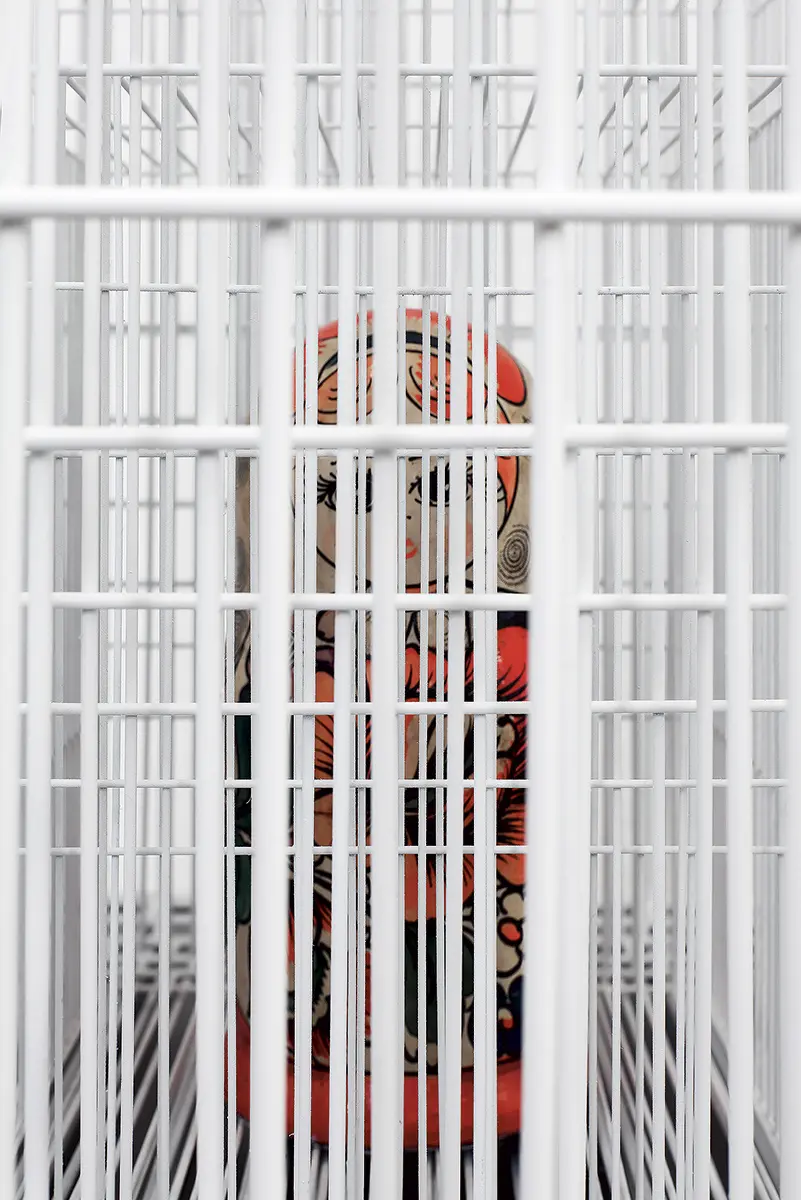
As we have noted, Cámara traslúcida is an installation of a disassembled wall that encloses another Cámara traslúcida, as this is also the title of the Japanese print. Macchi produces an inexhaustible Matryoshka play comprised of a succession of white steel cages, the bars of which block our view of the Russian doll inside. Based on a certain estrangement of the quotidian, Macchi problematizes the act of seeing, generating visual paradoxes anchored on the difference between what we know, what we see, and what we are unable to see clearly.
AYELÉN VÁZQUEZ