In the ten previously unseen works featured in O Real Intocável (The Untouchable Real), a solo exhibition at Silvia Cintra + Box 4 Gallery, the Minas Gerais-born artist Ana María Tavares once again explored the relationship between art and architecture, an indelible mark in her oeuvre. The works on exhibit were inspired by Airshaft (For Piranesi), a series in progress since 2008, which brings together digital images, video, and video installations in a dialog and in tune with Carceri d´Invenzione, by Giovanni Battista Piranesi (Eighteenth Century).
The works in the exhibition under review broadened the original series explorations, among them the relationship between draftsmanship, spatial order, and fragmented structures. In the same way that Piranesi revisited historical architectural ruins in imaginary drawings oriented towards the future, Tavares uses minerals and industrial materials as the starting point for the creation of what she imagines as “ruins of the future and contaminated cartographies, in order to create a universe that hovers between the archeological, an anti-natural and manufactured urbanism, geometry, the aseptic, and organic life.”
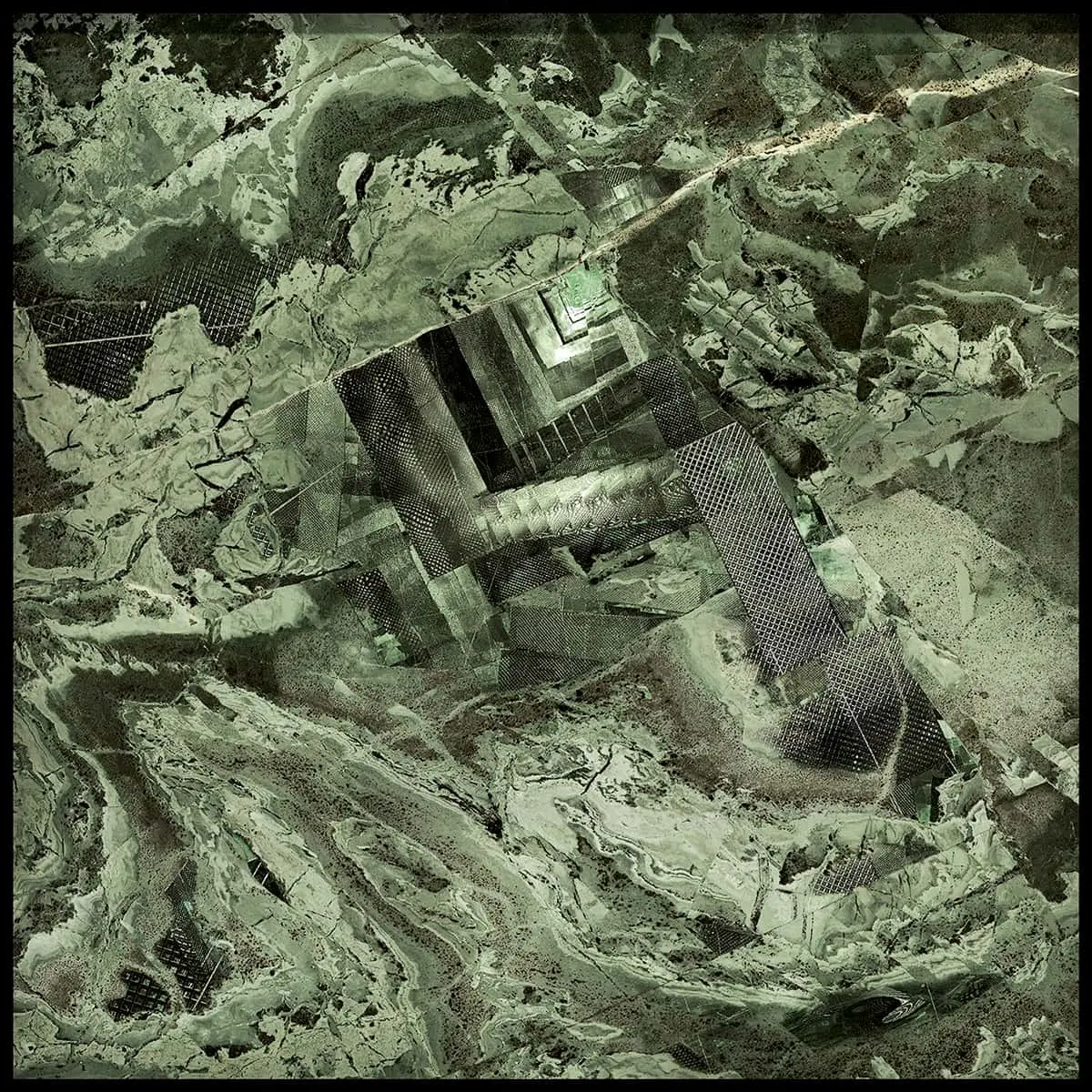
Tavares explains this in some depth: “the geological, organic, opaque formations on the surface of the green marble are like landscapes surgically sectioned by metal files that adjust a rhythmic topological definition and are juxtaposed to almost cartographical calligraphies, microphonic arabesques printed on transparent and mirror-like materials, to bring forth a kind of labyrinth in empty space.”
The first series, titled Campo Fraturado (Voo em Delírio) (Fractured Field [Flight in Delirium]), created based on photomontages, resulted from compositions formed by fragments of images present in the complexity of the air shafts’ specular spaces. These fragments fused into the marble’s topographic surface, blown up in the photographic process, resulting in a vast field of superimposed fragments of metallic mesh that suggest industrial ruins amalgamated into an arid terrain. The impossibilities of an undetermined landscape, made of ruins and the secondary setup of structures, suggest the fragmentation of the contemporary world, paradoxically composed of “ruins of the future,” in Tavares’ words.
The second series, Thirdspace (Microfonía), resulted from the digital record of reflections on a real environment covered in mirrors: the installation Exit III (Estação Luz, S.P.), from 2016. The final image, also the result of successive digital manipulations, gives origin to a mesh of arabesques and organic graphic signs that seem to relentlessly escape the imposition of an order or a discipline from the orthogonal grid of their origin.
The third series, titled Thirdspaces, from Aldeamentos, comprised diptychs and triptychs where marble appeared for the first time alongside the digital images of the series described above, to form rhythmic fields that sway between the rationality of metalized elements cutting the marble’ topographic and organic fields. “Third Space,” the word in the title, is “an intentional search for a flexible term that seeks mutations and transformations of matter and ideas,” Tavares says. Finally, X-Ray Primitivo (Primitive X-Ray) is a new version of the air shaft, where color vanishes, and the image becomes a field made from successive fragmentations that hark back to the labyrinthine perspective of Piranesi’s portals and ruins.
The works featured in this show are defined by the artist’s “meta dialog” with herself, her visual approaches, and her various conceptual choices. Tavares’ sustained exploration of visual construction in contact with the meaning of spatial structures reverberated through shifts in scale and materials.
Alongside architecture as a starting point, another key aspect of Tavares’ production is industrial culture, present in the manufacture of her works. “Industry is the realm that inspires me the most. The domains that prompt my greatest ideas are always technical domains because the more I know how to do, the more I can expand what I want to do,” the artist notes.
Ana Tavares’ initial training took place at the Universidade Federal de Minas Gerais (UFMG) Fine Arts School in Belo Horizonte, and later, already in São Paulo, she studied at the Armando Alvares Penteado Foundation (FAAP) under the guidance of Regina Silveira and Julio Plaza. In the mid-1990s, Tavares’ sculptures gained in size, always referring to everyday objects, like stairs and turnstiles, or environments, like airport lounges. During that period, Tavares’ frequent use of stainless steel placed her work at the confluence between art and design. Her most recent production also includes video images and large-format installations.
Moving between the archeological, utopian urbanism, the relationship between geometry and organic life, Tavares debates the very complexity of the contemporary world. Dealing with spatiality and surfaces, ornament and function, industry and handcraft, word and image, her works are guided by key concepts like suspension, mobility, displacement, reflection, rotation, and labyrinth. Conceived based on a critical vision of modern architecture, they also seem to weave a judgment about the impositions of contemporary rationalism, expressed in private and public spaces.
ALESSANDRA SIMÕES