Once upon a time, there was a village, an island; stories fragmented in time, a beginning, a project. Once upon a time, there was that which was, and its shadow; that which ages, that which dies. Cuba, in its past perfect tense. Oblivion.
From the wall of the gallery, it seems as if the images were narrating in a hushed voice. As if each one of them was trying to seduce the listener with stories of undefined places and references, anchored to a distant past. And it is this past, obliterated, relegated, which polarizes the works of Gruta/Pueblo modelo (Grotto/Model Village), the most recent exhibition by Alfredo Sarabia (Jr.). Two photographic series engage in dialogue; two discourses find in oblivion a disquiet and a condemnation of the impatience of our exceedingly self-absorbed times. But this is not an impetuous accusation; it is not even evident. The works rather offer a nostalgic gaze at the way we were, pointing at what we lost or forgot, and at what gave us awareness.
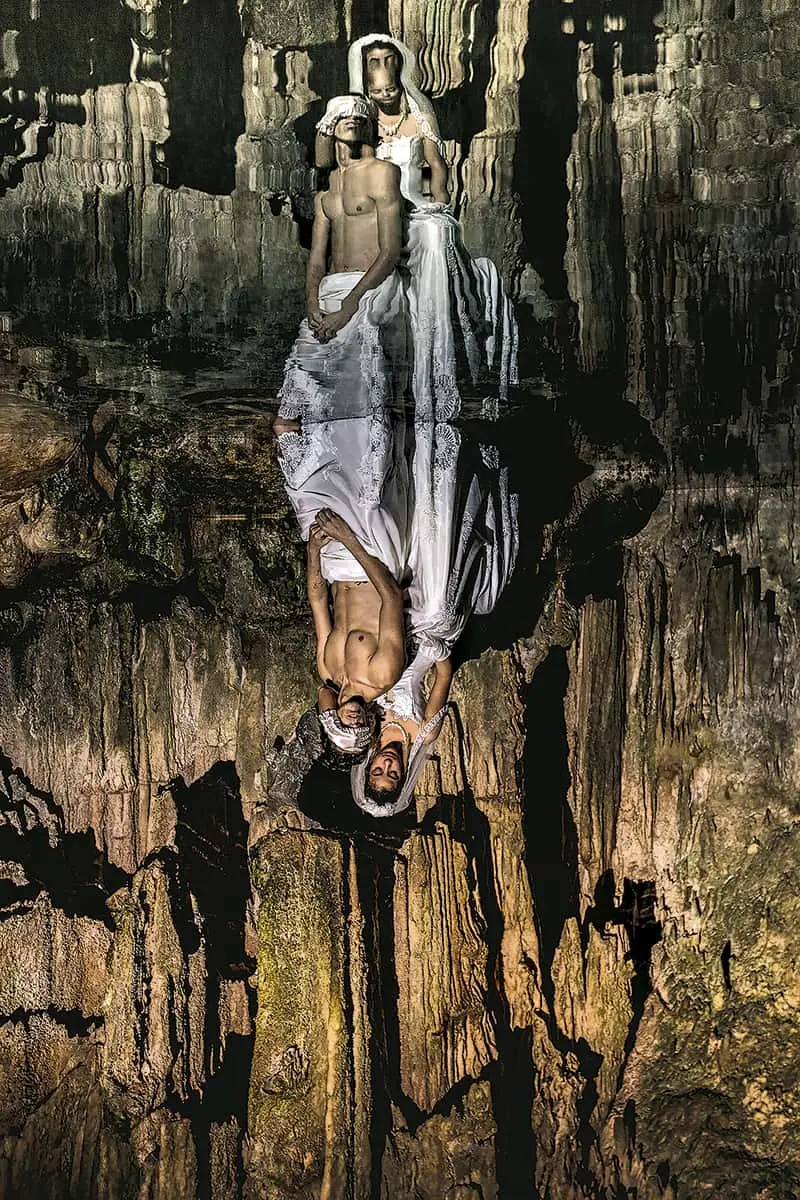
We start to get intoxicated with a feeling of nostalgia, subtly and gradually overwhelming us as we contemplate the works of the Gruta series, where the same scenario transports us to primeval moments of formation, of life, to the foundations of Cuba and its most hidden, most intimate hideouts.
The subterranean beauty of the caves, their enigmas, and ancient immutability are seen as a parallel world to our own. An existence that, because of its very nature, we leave confined in its own solitude, in its very origin. Hence, the tremendous halo that has conventionally stigmatized these caves and which Sarabia clings to intensifies the dramatic impact of his preconceived staging of their interior.
A bride and groom strangely positioned in situations where, at times, a femme fatale seems to be in control; that same bride who, in other scenes, covers her face with a veil, like a Stephen King character or a drowned Ophelia. All are immersed in surrealist, phlegmatically disturbing atmospheres where color reaches unusual fluorescent levels in certain areas.
The truth is that aside from their gloom, these photographs display an inventory of artistic-religious references that today seem obsolete and emptied of meaning. Perhaps, even without the artist’s intention, this overlapping of culturally distant elements alludes to Creole synchronism, to the symbiotic essence of Cuba. These references are indissoluble from Cuba’s identity, but at the same time, they have been disintegrating in the course of history, losing battles against globalization, darkening.
Grotto becomes a scrutinizing metaphor for the recesses of a sorrowful nation that has magnetized in time and paradoxically forgotten about herself. It later resurfaces in Model Town, but this time through one single, tangible reference: the town of Hershey.
From splendor to desolation. This was the tragic fate of the legendary town of Hershey, in Matanzas (Cuba). Its history dates back to 1918 when the American magnate Milton S. Hershey decided to start a colossal sugar factory on the island to ensure the supply of sugar for his chocolate fac-tory in Pennsylvania. As a result, a prosperous settlement grew around it, benefited by the growing success of the sugarcane economy, and where workers lived an almost chimerical, exemplary reality. A reality that began to fall through after the sale in 1946 of the sugarcane fields and their productive infrastructure; then came to the nationalization imposed by the Revolution, and finally, the closure of the plant at the beginning of the 21st century.
Only people and memories have remained trapped in a two-dimensional existence that feeds a yearning while caught in the solid present; or perhaps in a sort of trigonometric relationship between what was, what could have been, and what is. Thousands of miles away, its twin—Hershey, Pennsylvania—overflows with opulence and progress; they call it “The Sweetest Place on Earth.”
Photographs that record the dilapidated sites of this Mantanzas community—renamed Camilo Cienfuegos—are disguised as spectral illusions. Fragmented spaces, elements unrelated and odd, fluorescent lights that return to disturb us, the silence, the penumbra: all recreate surrealist moments in clear harmony with the unstable and the truncated. Once again, the forgotten, nostalgic Cuba.
No doubt, a visceral awareness underlies the work of Alfredo Sarabia. A latent, sincere restlessness. A resistance to the lousy passing of time, to unwarranted amnesia. The photographic singularity through which he materializes a vision so personal, and at the same time so mature and firm, transports spectators to wherever they desire to go. He makes art.
MÓNICA LLORENTE