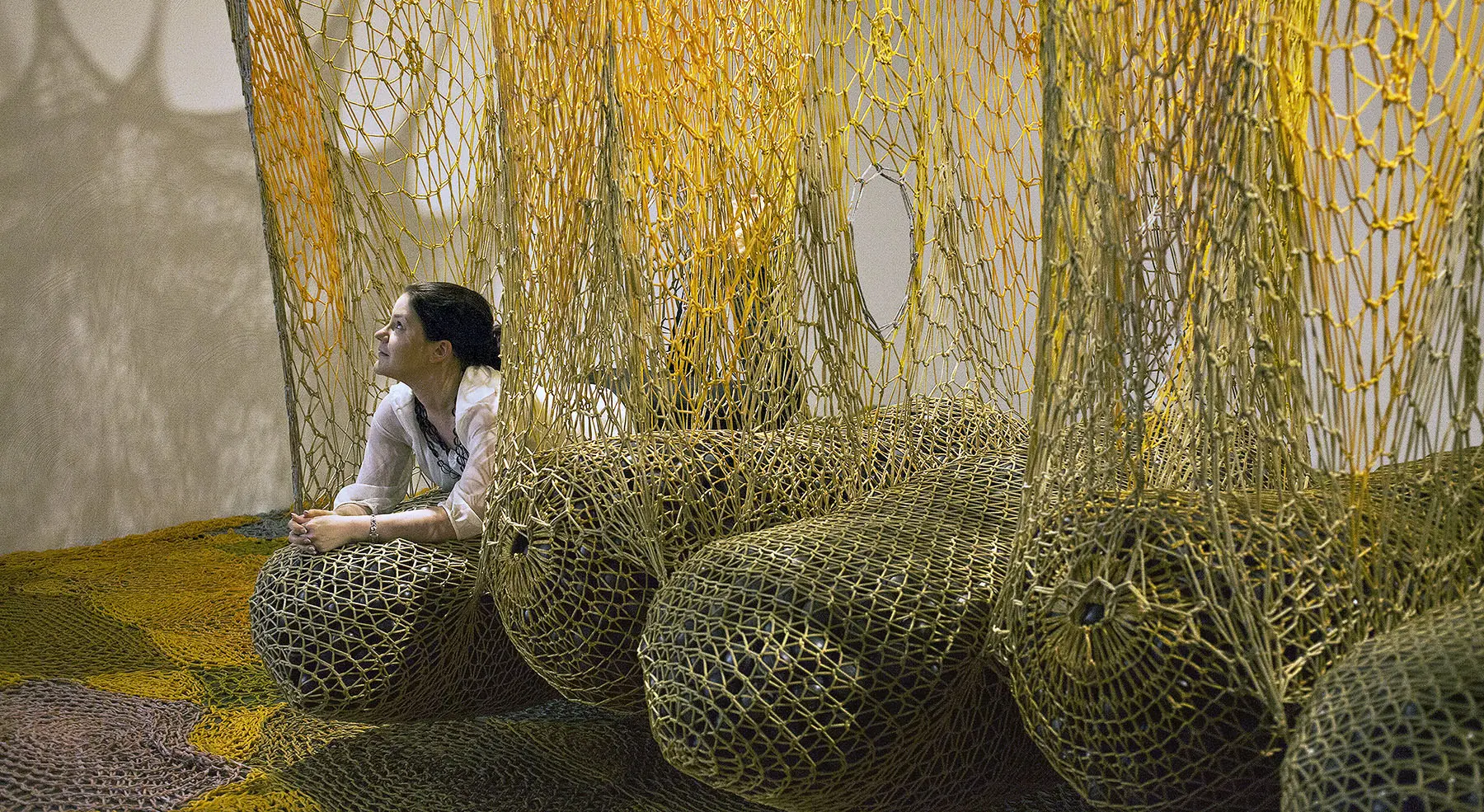
While not an anthology, the Sopro (Blow) exhibition does present a synthetic overview of the work of one of the most prominent contemporary artists. The exhibition space itself, with its Nineteenth Century high-school architecture, its bare-brick walls, its abundance of light (thanks to a large skylight overhead), is the first to conspire with Neto’s structures-membranes. Awed by this gravitational play, viewers are overtaken by a forceful aesthetic experience that soon turns, in a second instance, ethical.
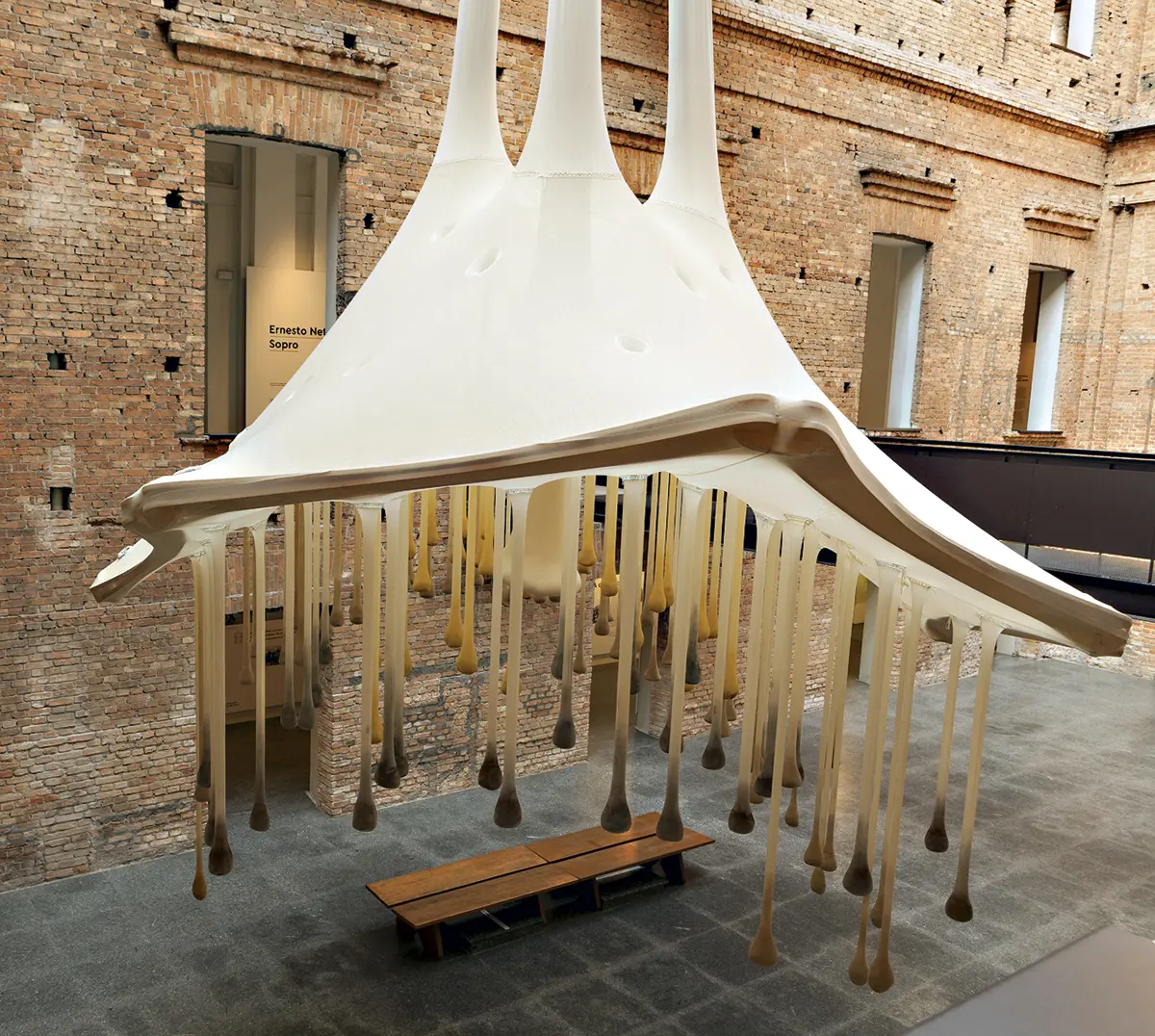
One of the first works to strike us in this way is En cuanto nada acontece (While Nothing Happens, 2008), installed between the first floor and the lower level. Indeed, its large format is an attempt to engulf not only an entire exhibition gallery (one of the most vibrant challenges posed by Neto’s work in the 2000s) but an even larger environment, with sumptuous support. Conceived as embodied color —in this case, orange, tangible, and irradiating in many hues over the polyamide—this work is also a symphony of globules. I use the word advisedly: it comes from Neto’s relentless quest to personify bodily organs through his symbiosis of forms and attitudes. On the one hand, the epidermal quality of the polyamide gives support to his tubes and globules; on the other, an effect of contained or expelled air becomes an attitude: blowing. Of course, the materials and techniques have incidence in this game of cause and effect. Hence the artist’s decision to never use stitching to join the sections of the large polyamide cave together, but to crochet junctions that resemble a woven zipper. Similarly, Neto’s combinations of solids to fill those globules (sand, wood, and ground spices such as turmeric, clove, cumin, black pepper, and ginger) activate at once the warm colors’ inherent luminosity and prod our sense of smell. More than just tactile, these components are intended to be participatory, a first step in the direction of ethics. But above all, they conjugate one of the legacies of Brazil’s 1960s Neo-Concrete movement and its representative artists Lygia Clark, Lygia Pape, and Hélio Oiticica. The title of the exhibition already points towards Clark and her maxim, “I am the mold, blowing is up to you,” which Neto has taken to dazzling heights.
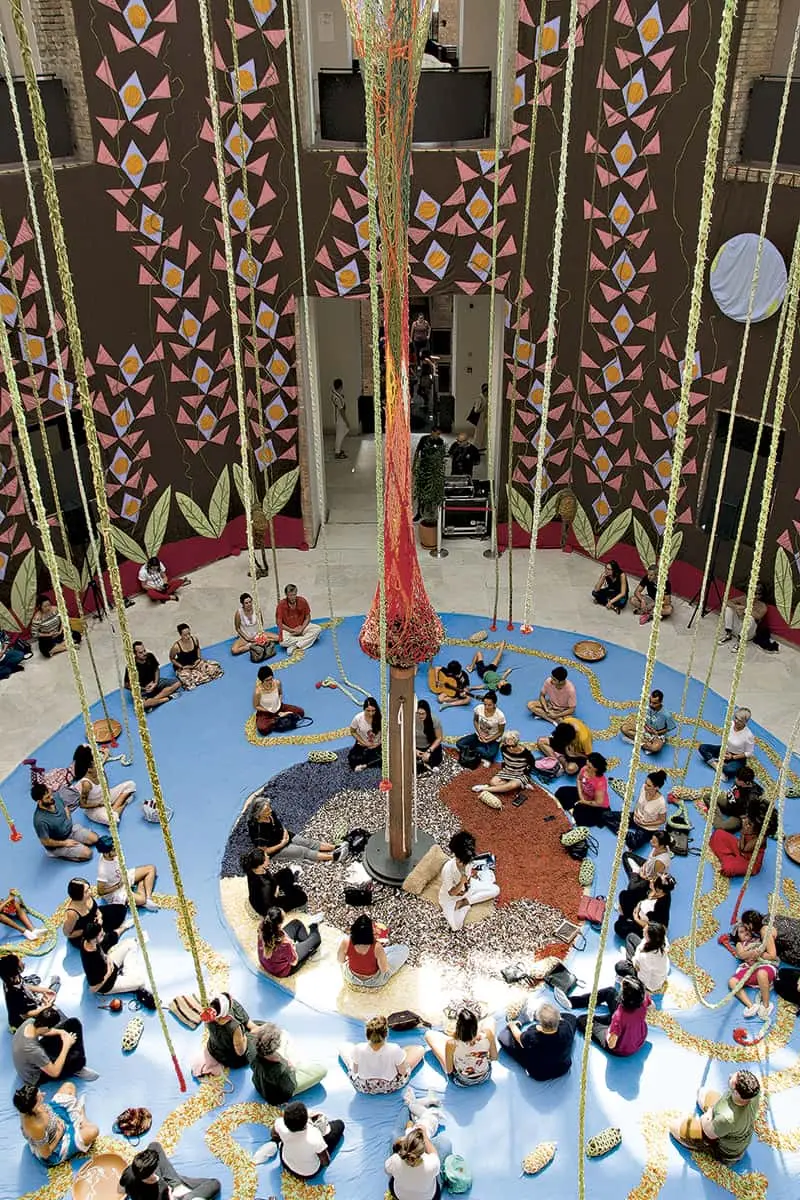
Impeccably curated by Jochen Volz and Valéria Piccoli, the exhibition celebrates Neto’s three decades of artistic activity (1989-2019). It is divided into a section with more significant works and a section with works in smaller sizes. The former are arranged in the museum’s high-traffic areas, while the latter occupy the building’s north wing. At the Octagon, the installation Cura Bra Cura Té (2019) asserts itself as an eloquent protagonist. In it, the idea of a “membrane” has been replaced with the concept of “vegetation,” invoked by the crochet weaving. It is not difficult to find a connection to Neto’s successful Gaia Mother Tree (2018), which occupied a train station in Zurich last year. However, while both works allude to the biology and climate of Brazil’s great landscapes—including the Amazon basin, the Atlantic forest, the Caatinga region, and the Cerrado—Cura Bra..., unlike its predecessor, discusses these landscapes crisis and the predations visited on their systems by human action and technology. To that end, Neto conceived his “activations,” performance events presented at the show’s inauguration and on specific days after that. The ritual begins with the artist repeating the title like a mantra, followed by speeches by leaders of indigenous and Afro-Brazilian movements, which provoke debates, emotions, and silences broken by chants or physical exercises. The intended perception of this work as a mise-en-scène helps bring forth new flavors of Gaia. Firstly, the large tulle curtain with geometric motifs, suggested by a free interpretation of the diamond and the circle of the Brazilian national flag. Also, a large light-blue tapestry invites us to sit down or lean back inside the work. A high point in the activations comes when the large crochet structure is dislodged and unravels, sliding down to have its netting penetrated by a trunk that stands in the middle of a map of Brazilian cultures. As Neto observes, the trunk is synonymous with masculinity and with the oppression put in motion from the start by the cycle of colonial exploitation in the country; thus, it contains coffee, soy, sugar, and cacao, all export products that cause great ecological devastation. Its resignification of ethnic groupings, or the role played by marginalized cultures in centuries of “civilizing” processes, renders this an emphatically ethics-focused work of art.
Another high point in the exhibition is the works on display in four contiguous galleries, a synthesis of the palimpsests in Neto’s most contemporary production. There we once again encounter his famous Copulônia (1989-2009), a portmanteau title combining the words copula (copulation) and colônia (colony). Copulônia is made up of dozens of niches in a polyamide medium filled with tiny lead spheres, which present vertical tensions and rest positions at floor level. To guide the viewer’s experience, Neto designed a glossary for this work, positing an equilibrium needed for Cupid’s goals: “walking,” “falling in love,” “family,” and “plumb line.” Also on display in this group is Flying Gloup Nave (1999), from the series Naves (Ships). It is the first in Neto’s sequence of penetrables, works that invite viewers to enter, explore, and traverse their noticeably uterus-like structure.
Another key work from Neto’s early period, set up anew for this exhibition, is Venus Quak Paff (1997), a sculpture of overstretched polyamide bodies that expands on the artist’s investigations in Copulônia, now with a single, vertical gesture echoing from an onomatopoeic title. The journey continues with A B A (iron, latex, iron), an early work with minimalist accents where Neto was already exploring principles that were to become central to his later soft-fabric sculptures, such as tension, resistance, elasticity, and support. Continuing with the logic of the palimpsest, the exhibition also includes drawings from the 1990s. In Desejo adeusas (1997), the straight lines pursue a clear denotation of spatiality. Any rationality is counterbalanced by wordplay, as in the neologism adeusas, which combines adeus (goodbye) and deusa (goddess).
These drawings showcase the DNA of Neto’s three-dimensional work in the most synthetic way possible: “Drawing is a graphic manifestation of sculpture. (…) I think of them as contours of a body: the paper is the skin, the border between what is inside and what’s outside. In a drawing, the body is implicit, like our feelings (…), this is why they can’t be controlled.” 1
Other previously unseen works with high participatory power take us to the show’s eloquent closing. Trasveste (2019), a kind of crochet shawl, must be worn by three participants at the same time, and to me, it seems an homage to Max Bill, who stipulated tripartite tensions as a universal law. Finally, we arrive at Alegría dos seres da Tierra (Joy of the Children of the Earth, 2016) and Silêncio é uma forma de oração (Silence Is a Form of Praying, 2017), both tributes to the color red and Eros. The former, paraphrasing one of Hieronymus Bosch’s edible raspberries in The Garden of Earthly Delights, invites viewers to hit a drum, as in some sort of primitive festivity. The latter, with its dimly lit, friendly environment, reinforces the emanation of turmeric and cinnamon aromas. Both negate the “hyper-mentalization” of the art universe.
NOTE
1. Folha de São Paulo, February 11, 1995.
XENIA BERMANG
Art critic.