The retrospective Otros cuerpos detrás (Other Bodies Behind) spans thirty years of the career of artist Adriana Varejão (Rio de Janeiro, 1964), whose central theme has been to reflect on Brazilian identity in relation to Portuguese colonialism and its aftermath in the contemporary context.
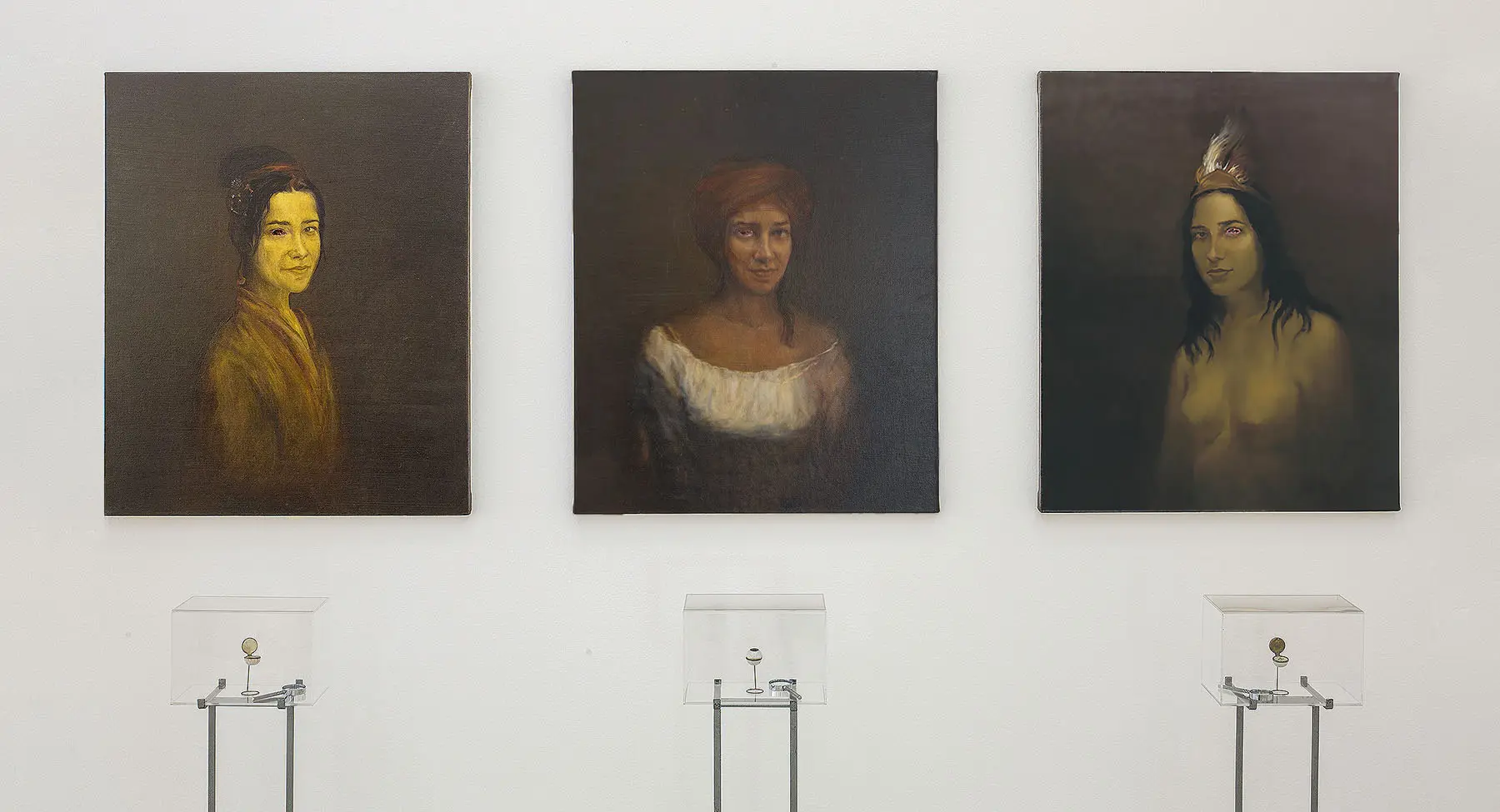
Aside from having adhered to Latin American artists’ constant exploration of identity in the 1990s, Varejão tackles her practice in diverse ways; transversally, she explores the concept of the body as a political and aesthetic subject and links it to traditional elements of the Portuguese legacy in Brazil, such as the tile. An example of this group of works is Rome Meat Ruin, which juxtaposes ceramics and the explicit corporeality of the exposed flesh. The result of this interplay of elements is defiant and crude. The viscera suggest a decomposition behind colonial buildings and palaces: the construction of an empire over the sacrifice and remains of previous cultures.
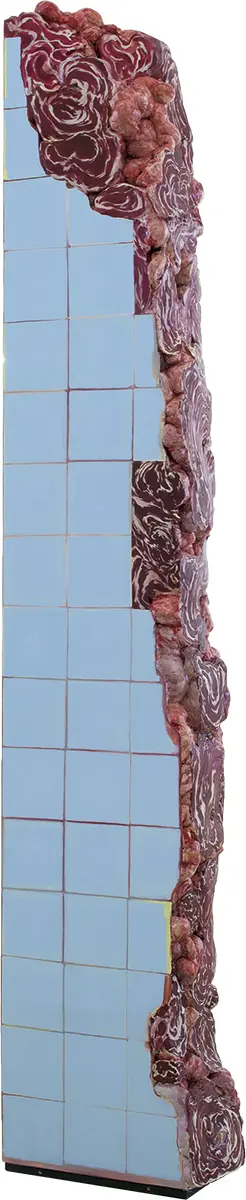
Along the same lines, the installation Eye Witnesses, X, Y, Z speaks of the cultural imposition of ritual practices such as eye reading to try to capture the dying person’s last vision. In this work, Varejão asked the artist Ana Moura to paint her with diverse ethnic features in the manner of colonial “caste” portraits. In each painting, an eye is missing and has been replaced by oil paint resembling mucous membranes and blood. Porcelain jewelry boxes with prosthetic eyes were aseptically and meticulously displayed in a glass bell in front of these paintings. The boxes were accompanied by a magnifying glass, as if to look at the last image, the eye kept within. These images may be brutal, but also symbolic; they address miscegenation, a particularly recurrent theme in Varejão’s work.
Her most recent series includes the Polvo Portraits (polvo means octopus in Portuguese). The melanin in the octopus’s ink is a metaphor for the melanin that pigments the skin. The artist drew on the answers of a census taken in 1976 in Brazil—a country with a vast racial diversity—, which asked people to name the color of their skin. There are usually only five categories to choose from: white, black, red, brown, or yellow. In this census, the question was left open, and 136 answers were received. Adriana Varejão selected 33 of these names—often poetic, such as “kissed by the sun” or “faded fawn”—and created pigments and palettes for them.
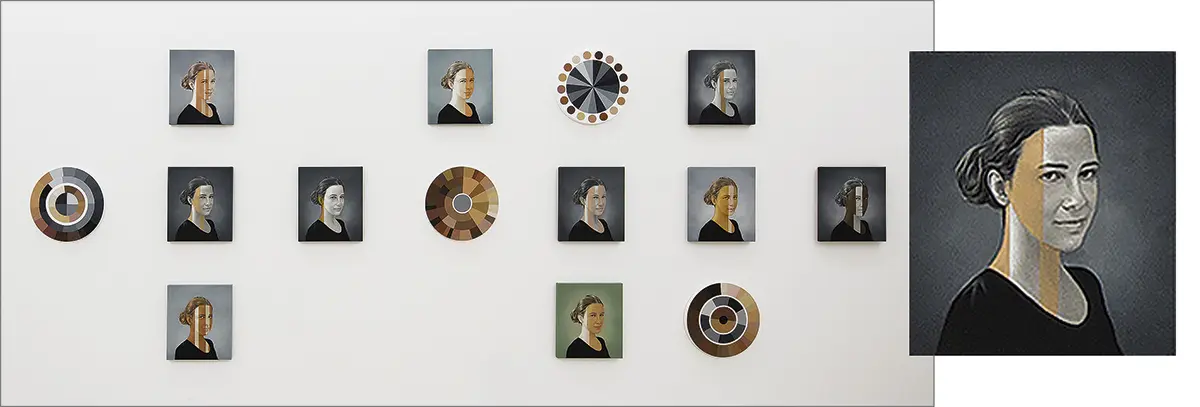
With these pigments, the artist produced self-portraits that experiment with various tones. This places each painting in a different racial category, illustrating how race and skin tone have social and cultural implications.
This work is a sort of a contemporary equivalent of caste painting, a genre of the seventeenth and eighteenth centuries characteristic of New Spain, and particularly colonial Mexico, which, by seeking to classify racial diversity, established a hierarchy related to purity and the superiority of white complexion.
At present, the relation of identity and miscegenation is still an ongoing debate, so this work provides a reflection on this subject, seen from her self-representation, as well as from the self-perception of others.
Adriana Varejão is one of the most internationally recognized Brazilian artists, and her work belongs to the collections of important museums in Europe, Asia, and America. Yet, it is her first solo show in Mexico. As part of the activities surrounding the exhibition, the curator of the show, Adriano Pedrosa, held a public conversation with the artist.
Sharing a mixed-race past with Mexico, the mid-career retrospective Other Bodies Behind is not only an incisive critique of colonialism and the cultural impositions of history. It is also the starting point for the analysis of cultural representation and identity, not only in Brazil but throughout Latin America.
ISAURA RUIZ
Master's in Cultural Management with a degree in Art Research. Manager and administrator of cultural and social projects