The intervention Síntomas de la historia, presented in December at the National Library, had a thematic pretext: Chile’s return to Peru, in 2007, of four thousand books captured after the fall of Lima in the War of the Pacific (1879-1881). The show was part of a series financed in the context of the Bicentennial, and corresponds to the celebration’s middle phase; the first, Plaga: la histeria y los bordes de la histeria, was presented in 2008 at Sala Gasco; this second show was a diptych and continued in January in Peru’s National Library (Síntomas de la historia: una construcción imaginaria; meanwhile, Salpêtrière opened in February at the Museo de Arte Contemporáneo in Valdivia).
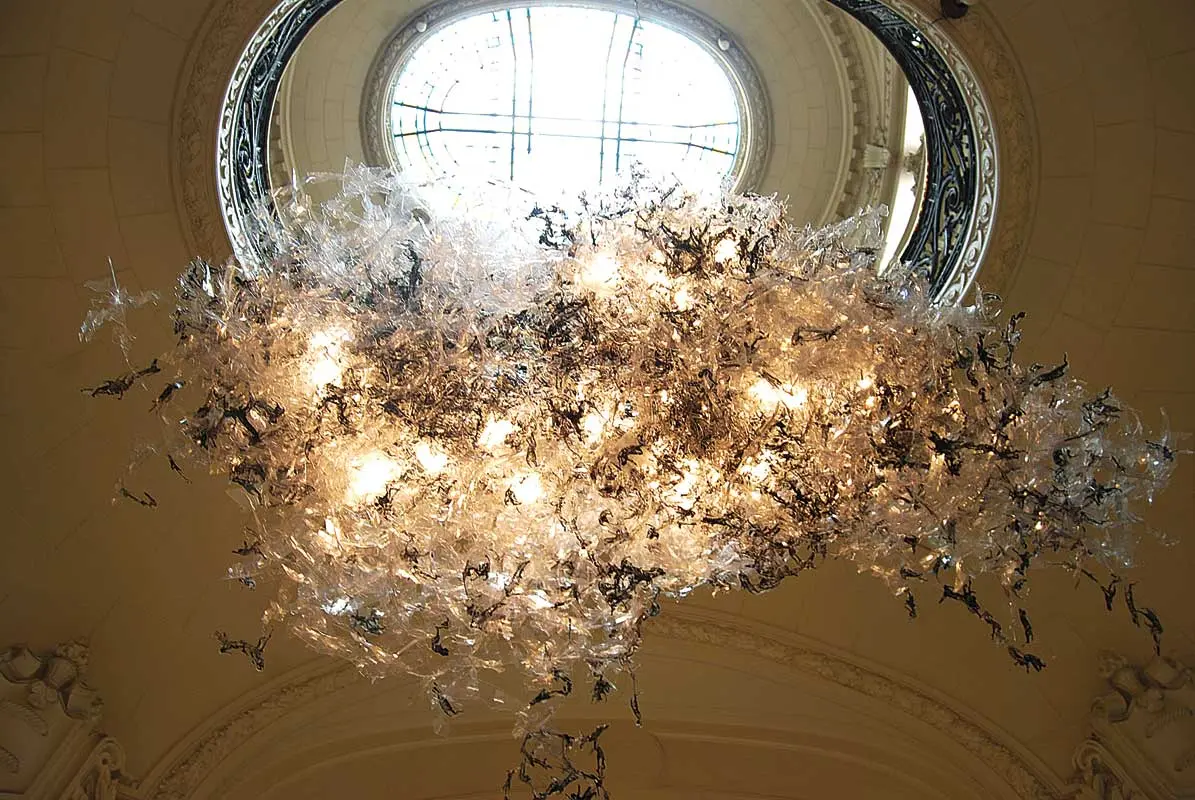
Yet, this proposal can be read in isolation, taking into account certain coincidences between the four situations. Firstly, the surprise of finding an installation by an artist who for twenty years has gained recognition with paintings that “tense” the support and the limits of “the paintable,” always on the basis of the tradition. Secondly, her work with small mica pieces printed with the same black figures, suspended by the hundreds, piled up, or invading the space like a swarm in geometric formation. These are the contorted shapes of women in the midst of hysteria attacks, postage stamps made from photographs taken in the late Nineteenth Century by neurologist Jean-Martin Charcot in the course of his research in the Salpêtrière hospital, in France. Thus, the third coincidence: her work with hysteria, which is not unusual for Voluspa Jarpa, who since the late 1990s has explored parallelisms between the control mechanisms in hysteria and in history. The next coincidence is also befuddling for those who have seen the artist’s previous work: the influx of beauty.
It is not that her works on canvas weren’t “beautiful.” It is just that in them what dominated was her critical analysis. Now, the experience was one of entering, seeking the intervention in the monumental building, and being fascinated in the first room by the delicateness of the small, translucent shapes, held by invisible threads, that fell in large amounts from the ceiling—dimly lit through the high windows—towards a glass case underneath that exhibited a couple of patrimonial books. In the next gallery, a large hanging lamp, covered by another swarm that seems to hover around between tangled membranes, shining like chrysalis open to the light. A large doorway and the entrance to a central reading room led us to an exhibition of paintings on the wall with austere images of old publications, opened, piled up, or placed in shelves, moving between realism, subtle gestures, and blurrings.
A mandatory exercise was to discover what was pictorial in this work: there were the compulsory graphic elements on the plastic material; brightness, opacities, transparencies; the work with light and shadows; the chiaroscuro and the atmospherics; and a gaze game, characteristic of work with blotches: from a distance, the shapes resembled insects, but up close we found them to be contorted bodies.
The complete tour was one of the contrasts, divided into two parts with a common element: the presence of books. The small floating, dazzling figures tensed the experience of the publications on exhibit as museum pieces or as pictorial representation. Several painted texts corresponded to the treasures returned to Peru, and they could hardly be read. Only those in the glass case: it was the Official Newspaper from 1881, listing the volumes brought to Chile as war booty, and a publication where Ignacio Domeyko (1802-1889), a scientist and president of the Universidad de Chile, writes uncomfortably about the books he was charged with cataloging and classifying. On these volumes falls the “ornament,” a virulent and phantasmagoric intervention of small hysteric women.
Just as the War of the Pacific was taking place and this episode of contradictory versions unfolded, Charcot was carrying out his study of those “sick women” Salpêtrière Hysteria was attributed to essentially female symptoms, closely connected to moral repression. Freud attended those lectures where women, with their delirium and contorted bodies, represented trauma, suffering, the visceral, that which couldn’t be said.
Síntomas de la historia was being put together, then, as a narrative of contrasts, erasures, and artifice, staging the unsayable under the grid of appearances. Through the pictorial element, the artist cogitated about what to narrate and what not to. The blotch and the erasure, as well as the swarm of little bodies shining in the illuminated space, covered the evidence. The aura of the building—erected in 1914 as the new site for the national Library—hid the upheaval of war. From a distance, the ornament, the representation, a disingenuous reading; up close, history as a hysteric construction, where the desire for objectivity is unsustainable under the drive of subjective experience.
CAROLINA LARA