Mar 2010 - May 2010
artnexus #76
Arte in Colombia #122
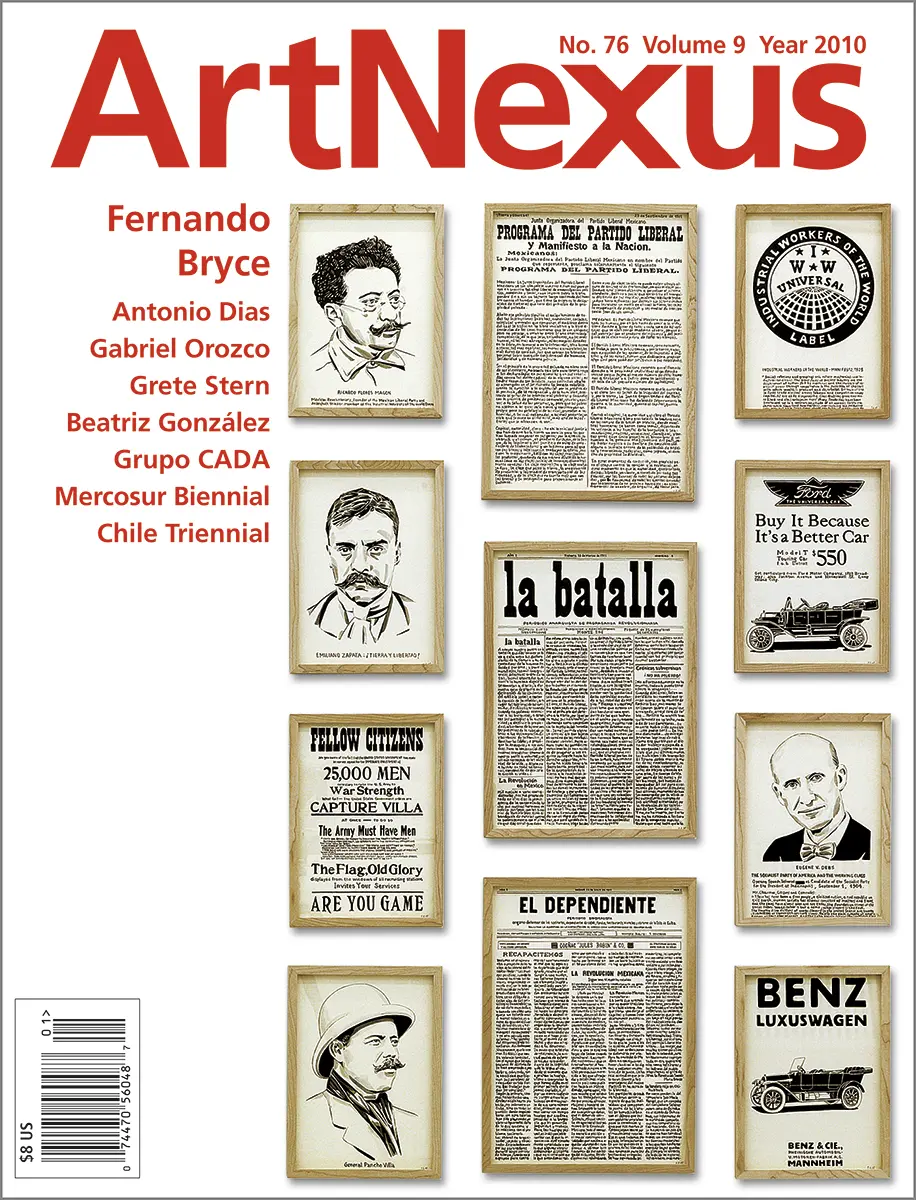
Fernando Bryce (Lima, 1965; lives in Berlin) calls his work strategy the “mimetic-analysis method,” an activity focused on digging out documents and images from a variety of spaces and periods and, like a copyist, constructing them anew with ink on paper. These are colorless drawings, presented as ideological constructs corresponding to a given moment in time, and their significance resides on the artist’s ability to unveil that which we can’t or won’t remember.
Exploring the archives of different libraries, Bryce salvages visual materials he will use as the raw components in his revision of history, documented from the standpoint of a unique aesthetic and intentionality. His rigorous research shows a strong bias towards political themes, thus the many articles alluding, for instance, to colonialism and anti-colonialism, to rich countries’ patronizing attitude towards poorer ones when it comes to aid, to the Spanish Civil War, to leftist position in the context of the Cuban revolution, or to conflicts in Africa and the Middle East. The underlying intention in these documentary crossings are connected to Bryce’s interest in looking again, from today’s vantage, at histories that seem past but remain alive in that many of the instances chosen refer to the way in which power is administered.
Obviously, however, Bryce’s work is not limited to the reiteration of a pre-existing illustration; rather, it seeks to promote, from the particular visuality and crossings proposed, a vision of the process of production and circulation of those images, in a reading that prioritizes the influence the image had—and has. The debates that come to the fore as these images are reordered tend to break with the tendency towards forgetting that often surrounds them, in this way linking those images to the present and proposing new chains of meaning. And the images install new ways of representing and interpreting events, forming a kind of visual history.
IVONNE PINI
IVONNE PINI
Issue Number: 76
Arte in Colombia: #122
Period: Mar 2010 - May 2010
You have 4 free articles remaining. Sign up for unlimited access.