The exhibition titled Intermission by Venezuelan artist María Teresa González (1972) is the result of an artistic residency offered by the Halka Art Residency in Istanbul (Turkey) and completed between January and April of 2014. It consisted of a video installation of four projections that occupied the four walls of the exhibition room plus a light intervention. The four projections occurred in succession at specific times determined by sound patterns that guided the attention of viewers from one video to the next. At certain moments all projections appeared simultaneously just before space would unexpectedly turn dark. Immediately after this, a melody interpreted with a glockenspiel would begin playing as an overhead light was turned on. This event was precisely the “intermission:” the time between two acts in a play, opera, or concert. In this case, it represented the time that established a pattern for the gradual resumption of the video projections. According to González, it is not rare that a person appears before an audience to play a melody with a glockenspiel during the intermissions of operas or some symphony concerts.
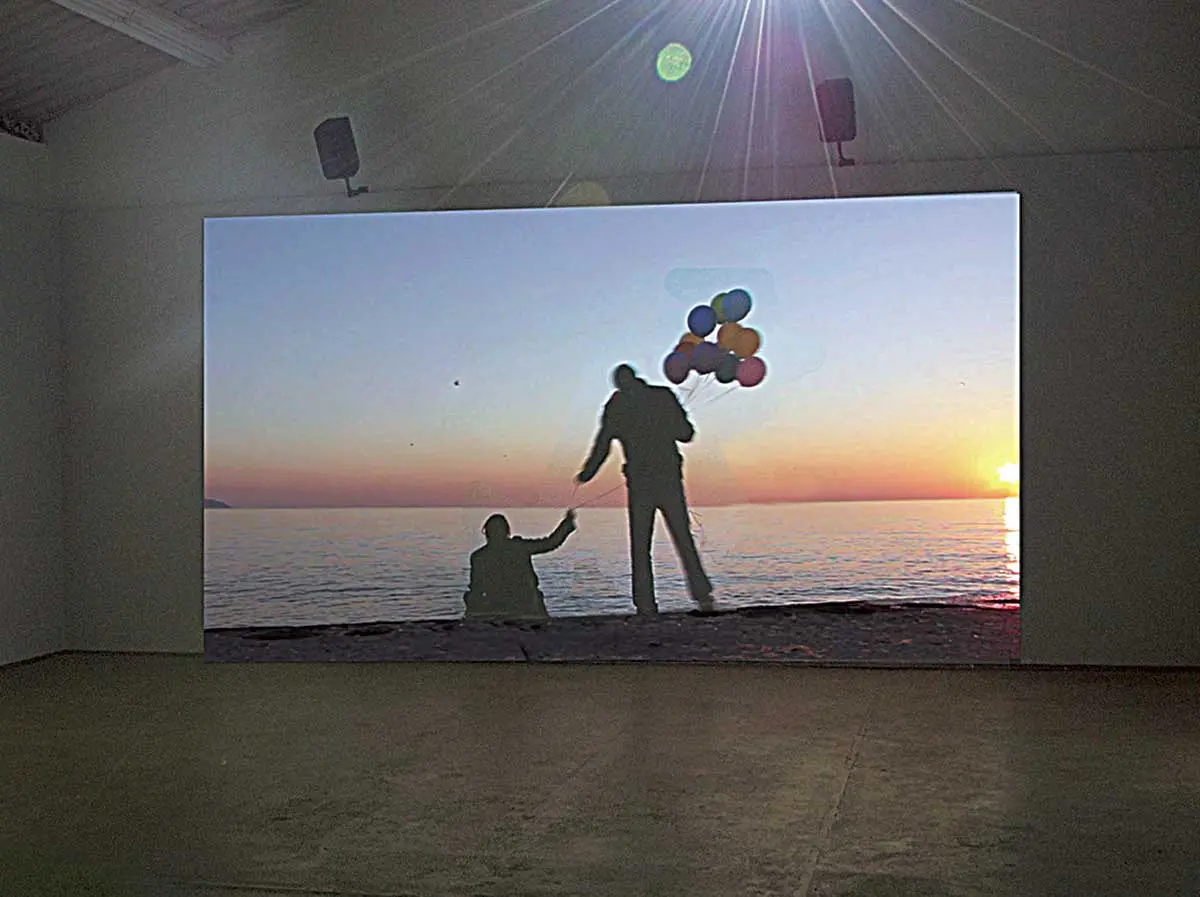
Maria Teresa Gonzalez. General view of the exhibition: Extract video: Party. Rituals of Lost Generations, 2014. Video installation. Variable dimensions.
The videos allude to dramatic situations that occur in real life. They address feelings about uncertainty and death and refer to the condition of people who have been displaced or have lost all hope. González’s way of dealing with these issues is sensorial and evocative, through images that are full of poetry and subtlety; qualities that are also present in her earlier work. In 2013, when she introduced delicate drawings and collages in the exhibition Nowhere, also presented at Oficina No. 1, she conveyed the same feelings while exploring the theme of loss through the defragmentation or dismemberment of birds and butterflies whose parts “floated” in the space. The subtle illustrated the terrible.
Through such subtlety González avoids the weight of a narrative, preferring instead to rely on the conceptual expression of fragility. Intermission focuses on very specific human situations: It pertains to people who have been uprooted and live in exile after fleeing their homelands to escape totalitarian regimes; displaced individuals who have been waiting forever to regularize their situations so they can rebuild and resume their lives; those who have not left but expect their government to change, but to no avail; or those who are marked by witnessing violence and counting the dead. Although González does not point to any country, in particular, the videos implicitly allude to the tumultuous Venezuelan political and social situation during the first months of 2014—in Turkey, coincidentally, the situation was also unstable.
The video titled Fiesta/Rituales de las Generaciones Perdidas (Party/Rituals of the Lost Generations, 2014) centers on the theme of the passage of time without hope. With their backs to the camera, a couple looks into the distance of the Bosphorus. It is a beautiful sunset. The video begins with the main theme—performed by the Prague Philharmonic Orchestra, conducted by Carl Davis—of Charlie Chaplin’s film The Great Dictator (1940) that satirized the dictators of the time. While music and balloons convey a festive atmosphere, the attitude of the couple is hoverer not cheerful but resigned. The man, who stands holding the balloons, gives these to the woman, who is sitting. As soon as she takes them one of the balloons explodes, in an action that is repeated until the intermission. Fiesta… reinterprets the hopelessness and discouragement felt by many young people in countries where they are deprived of freedom and hope as they wait for a change that never comes.
Status Limbo (2014) shows the drama of those in exile who find themselves in an interminable wait. A printer is shown generating 122 refugee application forms from around the world that fall into the ocean. In the meantime, those who continue in limbo keep waiting for a nationality, uprooted and without any legal protections.
In El Jardín de las Rosas—del Latín Rosarium (The Rose Garden—from the Latin Rosarium, 2014) a long string of red beads is thrown on an area of green grass. In religions, the beads are used to pray or to repeat mantras. Generally, the number of beads varies according to the religion. In this case, the number of beads, a total of 24,763 red beads, refers to the 24,763 deaths that occurred in Venezuela in 2013, one of the most violent years in that country.
There are also the sounds of Canción de Cuna para los Pueblos que Duermen (Lullaby for the People Who Sleep, 2014), a video that references the title of the novel by Dulce Chacón titled La Voz Dormida (The Sleeping Voice). This is one of the most daunting videos of the exhibition. The hanging figures depicted are not naive: they are the shadows of dead fish, the Trigla hirundo, or flying gurnard fish, a common fish in Turkey.
This exhibition included the participation of Daniel Espinoza, who collaborated with his music, and of Lars Goldschlager who, along with Espinoza, worked on the synchronization of the images and sound. The exhibition stood out for its sensitivity, accuracy, conceptual foundation, and strong suggestive ability.
SUSANA BENKO