Within the framework of the Meeting of the Ibero-American Presidents, the Patricios Foundation recently inaugurated an exhibition of paintings by the Brazilian artist Iberê Camargo.
The show included some thirty paintings and drawings which illustrated the relevance of Iberê Camargo (1914-1994), not only in the art of the neighboring country but in Latin America as a whole. The exhibition confirmed how little we really know about the continental artistic movements, and raised the question of why an exhibition of this kind has not been presented in some official setting.
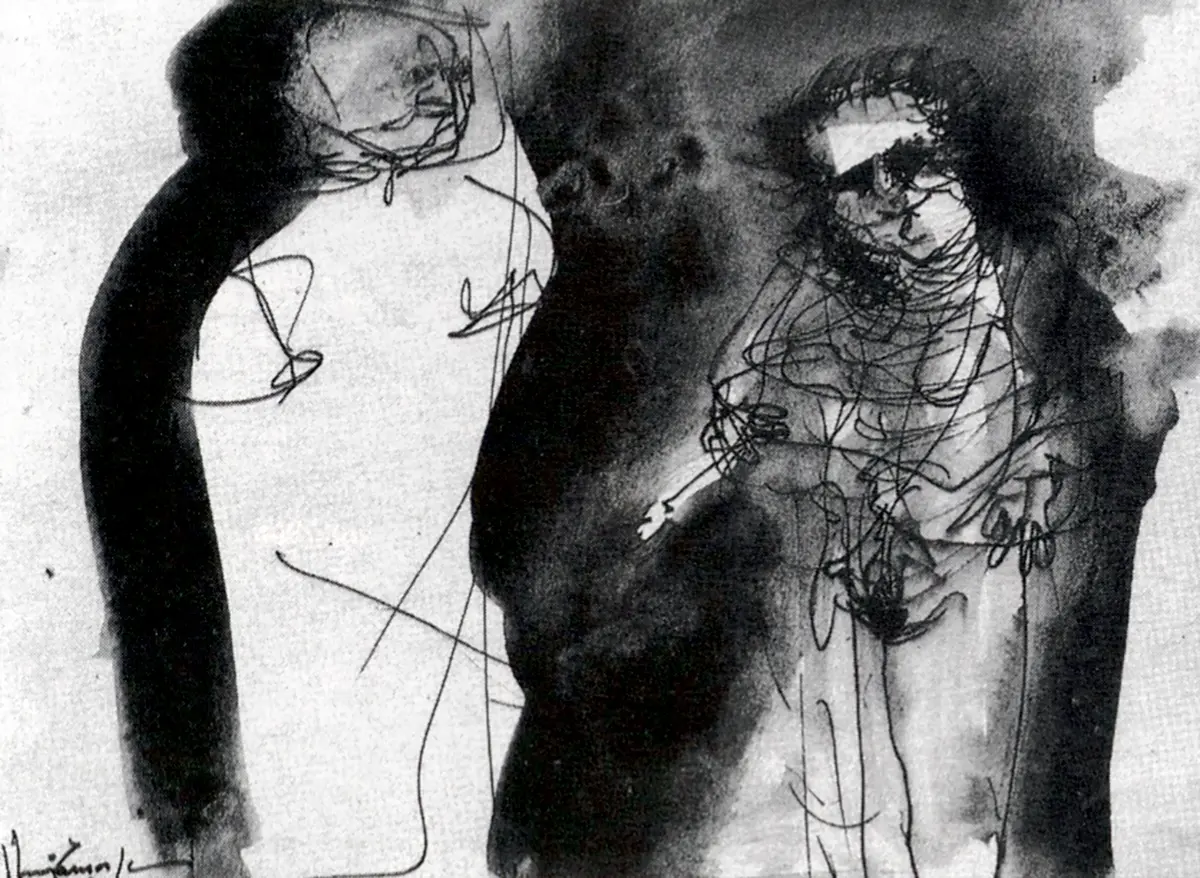
Iberê Camargo. Untitled, 1993. Drawing. 10 x 14 inches. Collection: María Camargo.
A large number of the works were done between 1992 and 1993, and several were exhibited at the last São Paulo Biennial. The works show the artist (born in the city of Porto Alegre) at the height of his creative and poetic force, with the synthesis of his Language in the service of a tempered sense of drama in which man is the protagonist.
Iberê Camargo, who was from the state of Rio Grande do Sul, was considered a disciple of the Brazilian master Guignard and studied in Europe with de Chirico and André Lothe. In the 1940s, his work was characterized by its figurative images, although he was subsequently influenced by informalism and abstraction, so that his pictures from the 1960s and 1970s bordered on being abstract. In all cases, however, the brush strokes were vigorous, with rich color impasto.
Good examples of the quality of his work include the three large oilworks entitled Tudo te e Falso é Inutil III, Tudo te é Falso e Inutil V, and Crepúsculo da Boca do Monte, all from 1993. The palette is almost monochromatic and low-toned, with a great economy of materials—a feature which gives special emphasis to his use of impasto. The linework is another aspect that gives subtlety to the overall composition.
The drawings in Indian ink and gouaches show another facet of his creative capacity, and are striking in their free handling of linework, the subtlety of color, and freshness.
ALBERTO COLLAZO