
The ideal city is a utopian image not at all alien to the authorities in Valencia, who do anything within their reach to convince everyone who needs convincing that theirs is, indeed, an “ideal city.” And they might be onto something: Valencia is Spain’s number three city from a demographic and economic point of view, and it does not lack the qualifications inherent in that label. The third axis point of a triangle that includes Barcelona and Madrid, Valencia is a port town that benefits from a benevolent climate and avoids the extremes of summer and winter weather thanks to its proximity to the Mediterranean Sea. Valencia also boasts a feast of fire and gunpowder that invigorates communal life in the city’s barrios throughout the year and sustains the legions of craftsmen who conceive, design, and build its famous fallas, groups of ninots made of papier mâché and wood that some consider marvelous displays of popular inventiveness, and others regard as pure kitsch. In fact, Valencia’s people are often seen as horteras (ostentatious) in other parts of Spain, and many give credence to the legend that Walt Disney’s father, or perhaps his mother was from Valencia. What better source of inspiration for the imaginative excess of Disneyland, that idyllic citadel where, for the first time, the modern world would capture and cloister its own childhood?
Hortera is a term exclusively used in Spain (although equivalents are found in Mexico, Argentina, and Colombia) and its meaning is close to the German kitsch. This is to say, it defines the “bad” taste characteristic of the nouveau riche who, without possessing any real distinction of blood or breeding, were the ostensible and ostentatious beneficiaries of capitalism’s cold, hard, impersonal laws. Hortera derives from hortulus, which is related to orchard; to this day orchards are a distinctive presence in Valencia’s agriculture and for centuries functioned as small family enterprises that were linked by their mutual dependence on a complex irrigation system comprised of canals and ditches. An hortera is an orchard keeper who, having come into sudden money, makes irreverent displays of his tastes and does not care whether he is labeled as lacking in what Winckelmann called noble countenance and serene greatness. But independent of the consistency of these philological considerations, let us simply state that a hortera, and by extension the horterada (the act that reveals one as a hortera,) carry two inescapable characteristics: excess and ostentation. And it is true that neither is lacking in Valencia, nor in the ephemeral architectures of the fallas themselves. They are especially evident in the city’s more monumental, architectural projects, among which the obvious excess of those by Santiago Calatrava, the favorite architect of Valencia’s institutional committees, are paramount. Indeed, the fallas that each neighborhood finances with the efforts of a whole year are burned in a single night of happy profligacy. And it was to Santiago Calatrava that the authorities gave the lion’s share of the contract to design a very large architectural complex called “Arts and Sciences City.” There, in an area of hundreds of thousands of square kilometers, Calatrava has designed nothing less than a large bridge, a huge opera house, a cyclopean planetarium, as well as an equally gargantuan science palace and parking area. All of these are linked by means of plazas, gardens, ponds, and walking paths. And on all of them, he has impressed the megalomaniac mixture of futuristic dreams and gothic fantasy that characterize his work. Given these antecedents, it is clear why the city’s authorities—led in the cultural field by Consuelo Císcar—did not hesitate to accept Calatrava’s proposal two years ago, of an international art biennial that aspired to become the most important event in the Mediterranean region. Nor did they hesitate to accept that the event’s second edition, held between June and September of this year, would adopt the “Ideal City” as its theme or leitmotif. For those authorities, as I have said, there is no doubt that Valencia is precisely that.
II
It fell to Luigi Settembrini—director of this and of the previous biennial—to transform the city authorities’ naive passion for Valencia into a reasoned, or at least reasonable, exhibition project. In order to achieve this and from the outset he adopted an ambivalent attitude that in one sense interprets the term “ideal” not as the qualifier of a concrete city, but rather as yet another name for utopia; in fact, it has been interpreted in this way by a long line of urban planners that extends from the Renaissance to the modern world and has been influenced by the ideas of Plato, St. Augustine, Campanella, and Fourier. In another sense, it questions whether that idealism of a perfect form, whether political, architectural, or urban, has any meaning for these times, which are dominated by irredeemably heterogeneous and antagonistic megalopolises. Thus he makes the surprising catalog statement that the theme for this biennial was not the “Ideal City,” but “the art of being a city, "1 and adds in the next line that such an art is above all the art of communicating differences and of communication among differences—the many differences that characterize those megalopolises.
After establishing a distance from other committee members (and even from himself), Settembrini structured the biennial2 around three exhibitions—each with its own curator—that openly intervened with Valencia’s urban life. The first exhibition was titled Solares and comprised installations by thirty-seven contemporary artists in various empty lots located in the Ciutat Vella, Valencia’s Old Town. The second exhibition, Sociopolis, presented proposals by a number of significant contemporary architects for “the development of a housing complex” to be located “at the border between the urban space and the orchard.” And the third exhibition, El rostro, espejo de la sociedad, included approximately fifty photographs of Valencia’s citizens taken by Brazilian photographer Sebastião Salgado. These depicted the social, cultural, and even ethnic diversity of Valencia’s population and included representatives from the arts, crafts, and professions.
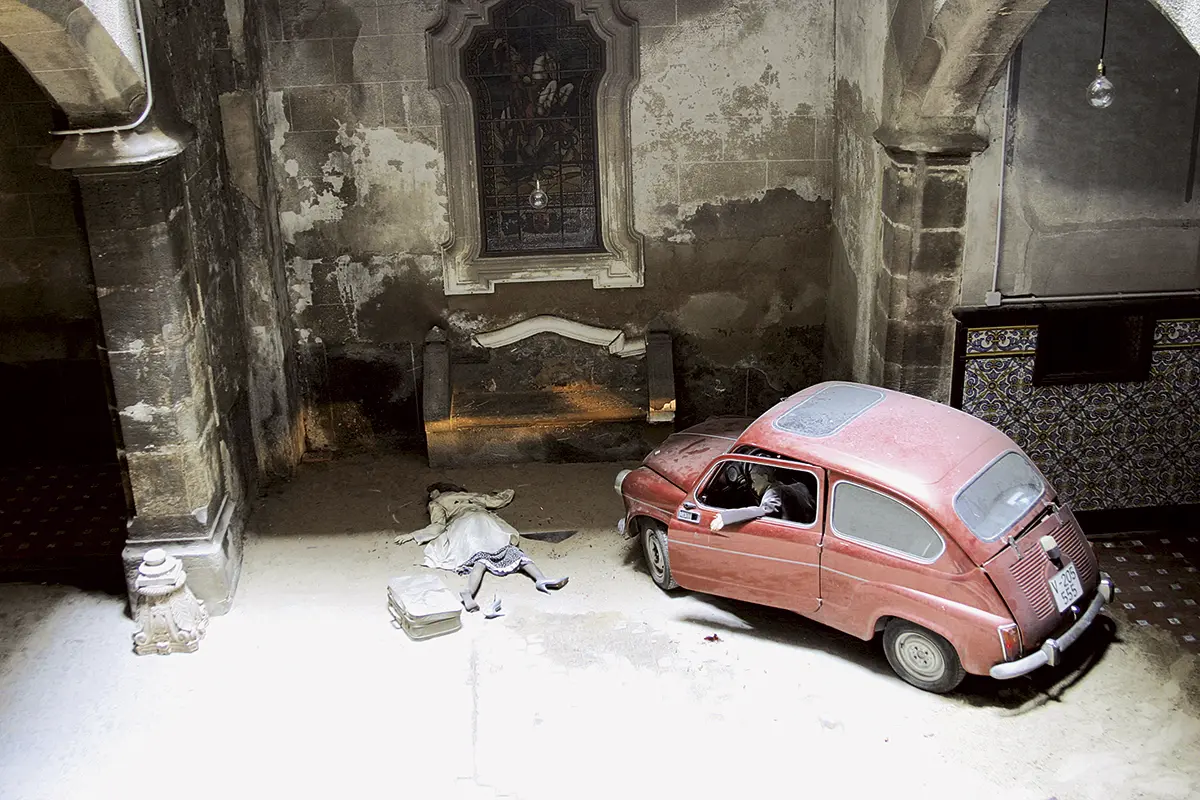
Regarding this group, we must also mention a fourth project, symptomatically titled El museo imperfecto (The imperfect museum). Its author is British filmmaker Mike Figgis—the director of Leaving Las Vegas, among other films—who took over an abandoned palace on Erxach Street and, exploiting the locale’s fantastic decorations, transformed it into the best possible stage for the display of his photographs, videos, and projections. Figgis gathered images of actors, friends, and strangers, as well as landscapes, city corners, and banal objects, and interwove them with minimalist film narratives that evoked the repressed desires, obsessions, and ghosts that haunt him.
The rest of the biennial comprised exhibitions that, while they displayed a similarly urban dimension, were even more utopian, if we understand utopia in the strictest sense as that which has no place, that which awaits discovering its own topoi. MicroUtopías, an exhibition curated by Francisco Jarauta and Jean-Louis Maubant with José Lebreros’ decisive support, was one of these exhibitions, and it gathered in the splendid Atarazanas building, works by forty-three artists and architects active in the last half-century. The contributors are authors of works and projects that investigated the problems of art, architecture, and urban planning with the intention of conceiving “ways of living” radically different from those that exist or providing forms of comfort and representation for those that are emerging or still in their formative stages. The atarazanas, which were shipyards in the middle ages, are now among Valencia’s most beautiful exhibition spaces. They are no longer next to the sea since the sea has receded and marooned them inland, like the old boats chosen by Japanese artist Tadashi Kawamata for Barquitos, whose installation was in the atarazanas atrium. This work functioned as an announcement and prologue for microUtopías.
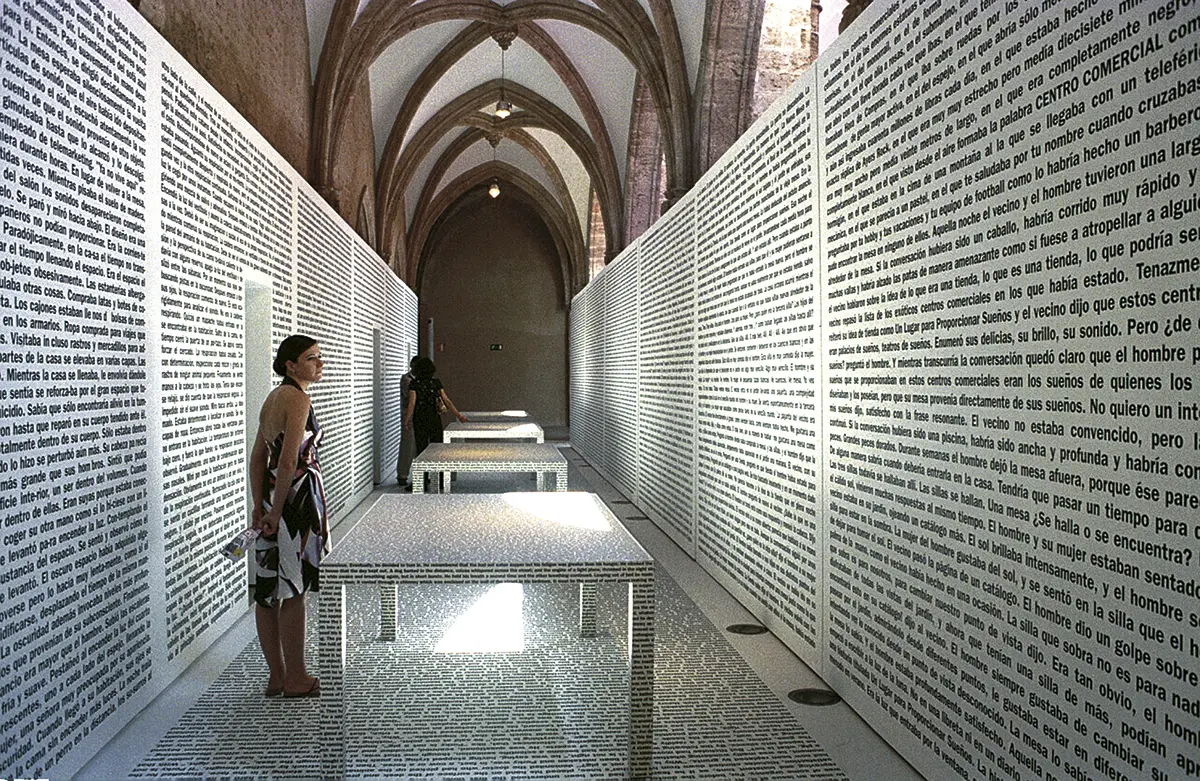
The other show in this group, A & M almacenes, was a project by Will Alsop and artist Bruce McLean—both British—that was devoted to exploring the potential of shopping centers, by redesigning them so that they play an important role in the promotion of models of social interaction that are less narrow, pragmatic, or utilitarian than those currently found there. In fact, in the Convento del Carmen (one of the biennial’s sites) Aslop and Mclean built a model for the typical store they had in mind, incorporating departments such as reading, humor, dance, and eroticism in addition to the more traditional departments of travel and beauty.
III
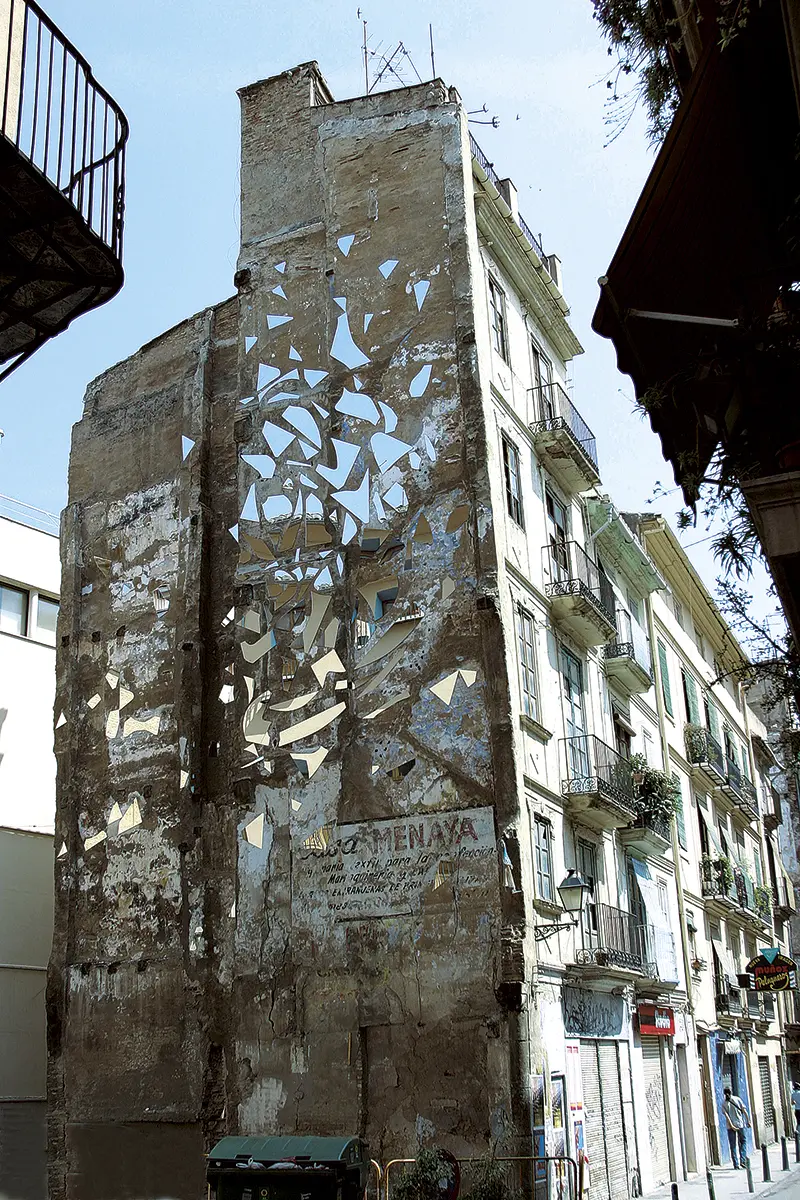
If anything distinguishes Valencia’s historic center from those found in other Spanish and European cities, it is the existence of many empty lots interrupting, with their enigmatic void, the continuity of its compact urban grid. The most frequent explanation offered is that most of these lots were the result of aerial bombardment during the Spanish Civil War. There are some who add that if the lots have remained empty it is because construction companies do not want to invest in them because of both their resistance to the rules that govern development in the Old Town area, and because the neighborhood, despite its privileged location, is inhabited mostly by seniors, immigrants, and the poor. Whatever the reason, curator Loran Hegyl discovered in these spaces the possibility of creating, however briefly, a series of dialogues and confrontations between past and present; between contemporary art and old architecture; between fullness and emptiness; and between life-long neighbors and a number of artists newly arrived from many corners of the world. Few among the latter, however, were able to establish an authentic dialogue between their works and the lots on which they were placed. Among the successful I count Michelangelo Pistoletto, whose work, L'esplosione dello specchio displayed a group of broken mirrors attached directly to the back wall of a building adjacent to his lot. The mirrors not only reflected the changing sky and light conditions but also drained weight and density from the wall on which they rested, transforming it by their reflections into a sort of stage curtain. It was pure magic. Another achievement was by U.S. artist Clay Ketter, who created his Lux in Tenebris in Valencia by painting squares and rectangles so that the viewer was encouraged to attribute an artistic character to the debris and marks left on staircases, bathrooms, and pillars in that same building or in adjacent ones. This was a new variation of appropriation or of the aesthetic appropriation of a previously existing environment. Relief-Peintre by Bertrand Lavier achieved a similar effect albeit not through painting. Lavier fixed a pre-fabricated aluminum partition with glass windows to the center of another back wall, suddenly turning it into a singular façade.
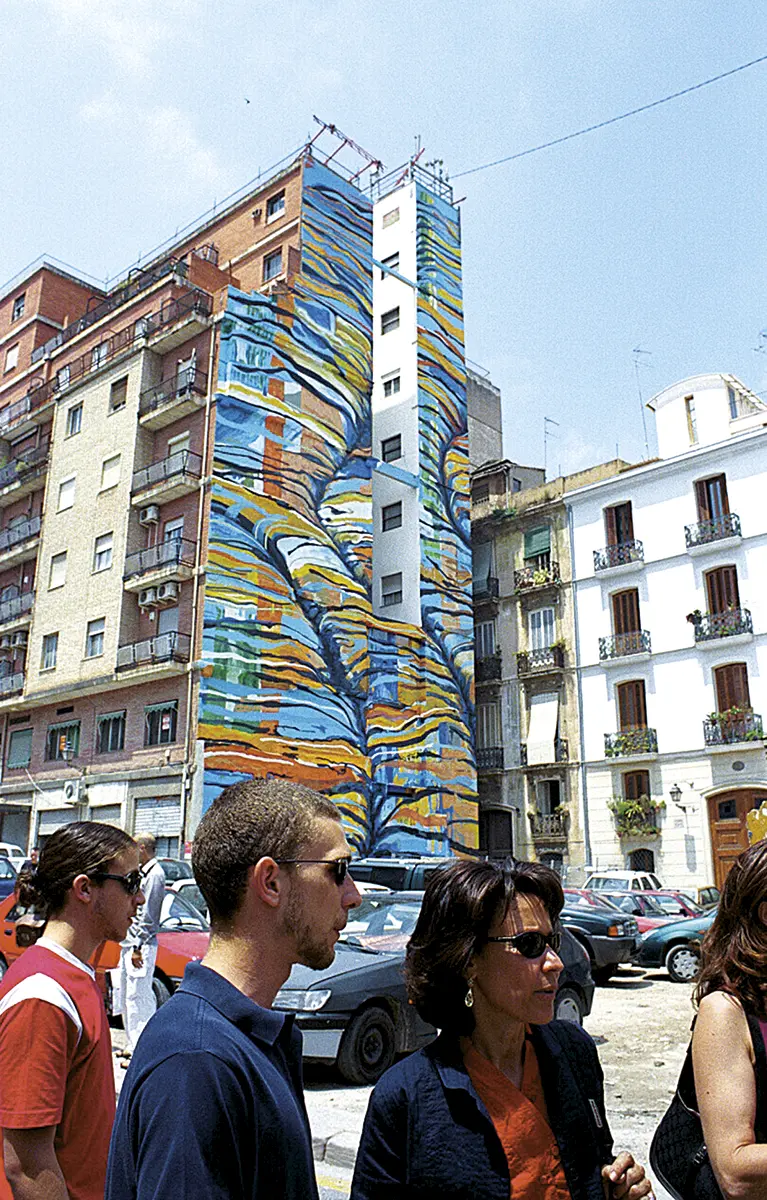
Argentinean artist Fernando Cánovas took the opposite approach and completely covered the back of a relatively modern building of ten or more stories under an enormous and striking mural. Titled Movimientos ocultos, the mural was filled with vivid colors that, according to the artist, were intended to evoke the geologic fault lines under the surface of the earth.s
Finally, I must name Mauricio Nannucci and Pascal Pinaud, who did not alter any walls. The former arranged a sign written in large neon letters on a beautiful circular-plan nineteenth-century marketplace façade that read: Qué ver Qué no ver Qué decir Qué no decir Qué oir Qué no oir (What to see What not to see What to say What not to say What to hear What not to hear). Pinaud surrounded a small plaza in the Old Town area with a forged-iron fence carved with traditional designs in a polygonal plan. Both works were admirably constrained and effective.
IV
Forty-three artists and architects of many ages and from many countries were gathered in the atarazanas. Although their proposals were different from one another, it was possible to discern in this fertile diversity some lines of connection and demarcation. Perhaps the most evident separated the apocalyptic utopians from the integrated ones, to put it in the terms popularized by Umberto Eco in his very influential book of the 1960s. Artists like Daniel Buren or Gordon Matta Clark, who exhibited a version of his cart designed to offer oxygen to New Yorkers, clearly belong to the first group. The same goes for architects like Peter Cook, from the Archigram collective, or Constant, author of New Babylon, another project from the 1960s and 1970s, who tried to bring the ideas of Guy Debord and the Situationist International to the field of urban planning in terms of what could be the “first global city on a planetary scale.” In the second group, we find some of the brightest stars in today’s mass-media firmament, such as architects Frank Gehry, Rem Koolhaas, Asymptote, or Coop Himmelb(l)au, and artists Mike Kelley, Jason Rhoades, or Leonel Moura. Wedged between these two categories are the differences that infiltrated the 1960s and 1970s—when revolution returned to the West from the no man’s land to which it had been confined by fascism, Stalinism, and World War II—and the 1990s, when revolution was again exorcised, this time by rampant and triumphant neo-liberalism on a planetary scale.
To put it in different words, although for Archigram or New Babylon, as well as for Matta Clark and the early Buren, formal and sensory experimentation could not be dissociated from a revolutionary change in the world, for Rem Koolhaas or Asymptote that experimentation and that change can be carried out without the necessity of waiting for the revolution. Moreover, for this new generation of artists and architects waiting for the revolution is not needed because the only possible revolution is already underway: it is not social or political, but economic and technological, and it is represented by the Internet, the mass media, virtual reality, and globalization as a whole. It is to the consequences of this ongoing revolution that they are attempting to respond with utopian projects. What is surprising, perhaps perverse is that as a result of the exhibition, or, if you will, the “museumification” of this history, the differences between its periods are blurred, neutralized, or involuntarily repressed. Instead of unveiling and underscoring those differences, micro Utopías contributed to their dissolution, setting up as equivalent the results of attitudes and positions that continue to be very different from each other.
V
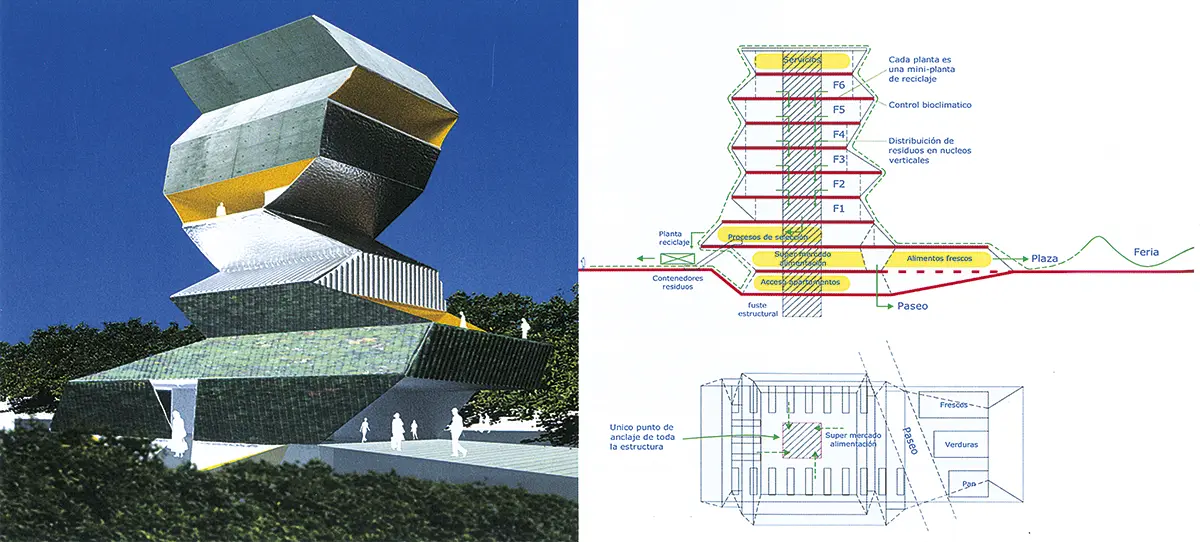
This reconciliation of utopia with current reality and with its own history had its highest achievement within the Valencia biennial in the Sociopolis exhibition, primarily because the intention of its curator, Catalan architect Vicente Guallart, was to turn the show into a medium for twelve architects—among them stars such as Greg Lynn, MVRDV, and Toyo Ito—to design projects that could be executed immediately in Valencia’s current political, economic, and social environment. The exhibition’s entire concept rested on the notion that these proposals should allow the recuperation of the orchard and its economic and symbolic integration with the city’s new urban developments, and they should also stimulate new forms of social interaction between Valencia’s inhabitants that would be characterized by greater solidarity and less hostility towards nature than is currently the case. With the help of computers and the Internet and by taking these concepts and purposes into account the participating architects elaborated the projects. They are divided into the categories of social and urban equipment; urban services; work; infrastructure networks; and housing. In my view, the most interesting and exciting were Greg Lynn’s Flor de la cebolla; Alejandro Zaera and Farshid Moussavi’s Hidráulica de habitación; Willy Müller’s proposed tower; and François Roche and Stéphane Lavaux’s Tejido social. With these works, utopia seems firmly and permanently positioned in reality.
NOTES
1. Luigi Settembrini, “El arte de ser ciudad,” La ciudad Ideal, 2nd Valencia Biennial exhibition catalogue (Valencia: Charta, 2003).
2. This information and all the data used in this article about works and artists included in the various exhibitions of the 2nd Valencia Biennial, is taken from the event’s catalog, cited in the previous note.
CARLOS JIMÉNEZ
Writer and art critic. Professor at Universidad del Valle, Colombia.