Tony Bechara’s recent paintings explore the opposition between controlled propositions and accidental effects. As a strategy, Bechara’s formal and conceptual approach sets up an interesting opposition between the mathematical rigidity of the modernist grid and the incorporation of chance elements on the canvas.
Of the eleven new paintings exhibited, six incorporate the terms “stratagem” and “random” in their titles. Stratagem is defined as an operation —usually an artifice or trick— designed to outwit or surprise the enemy. Paintings such as Strategem in Grey, 2003, pay a debt to Op-art creating a three-dimensional design that both recedes and advances in space. In this case, the trick is played upon the human eye, which perceives a star-shaped motif superimposed upon similar three-dimensional patterns. This type of meticulously-controlled imagery can be contrasted with paintings like Random: 125 Colors, 2003 where Bechara integrates coincidence and chance in his application of repetitive geometric forms and colors. The end result is an intricate and dazzling matrix of contrasting color and chromatic vibration.
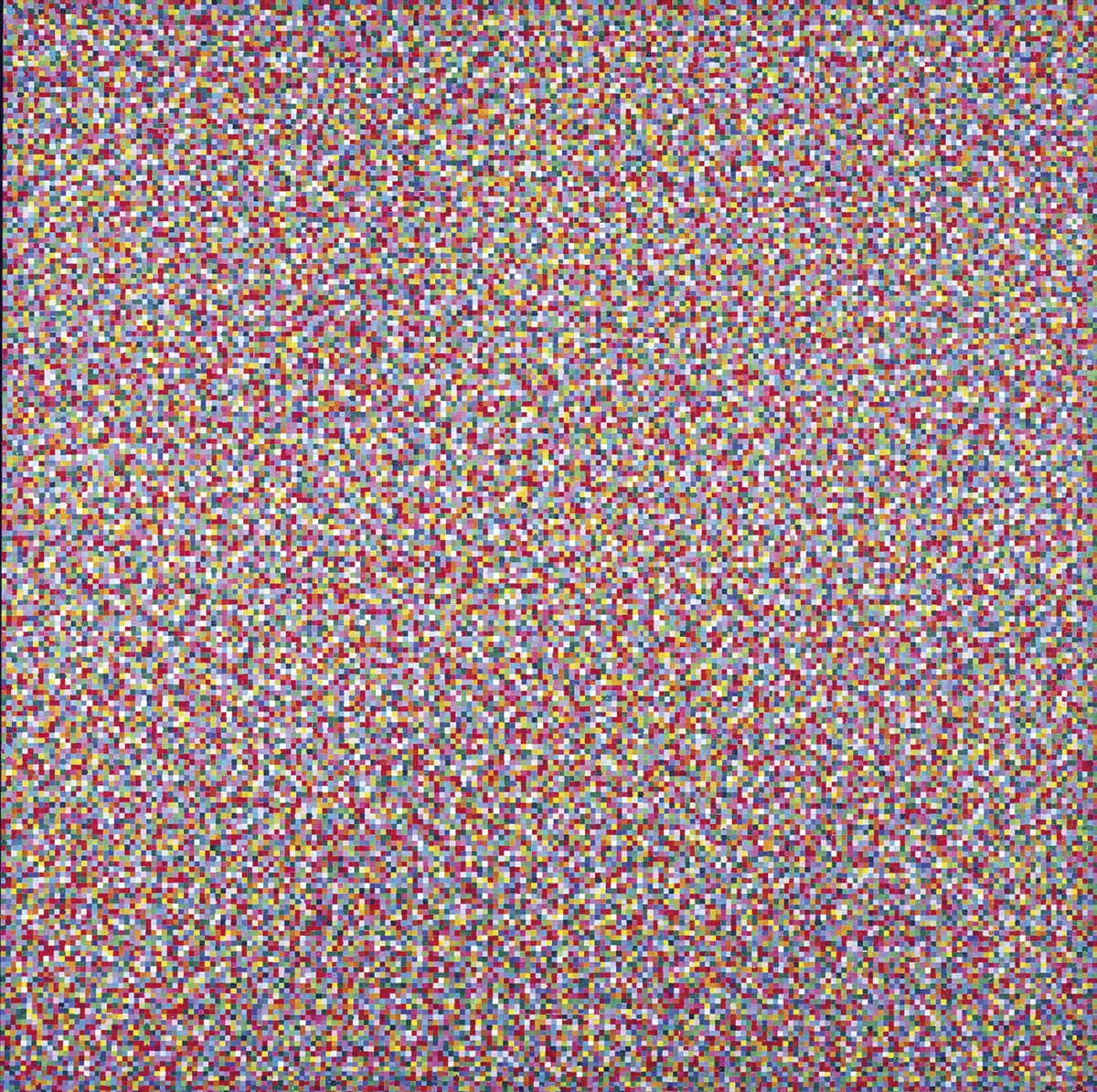
Bechara’s work does not signify; instead, the artist is interested in the way the viewer interacts and responds to the painting. How we distinguish between randomness and controlled proposals, and how pure light and color are perceived by the brain are fundamental aspects of the work. Bechara plays with our visual perception: some works are concerned with color theory and the eye’s response to it; others investigate the psychophysiology of pattern discrimination and how the mind creates meaning from visual fragmentation and abstraction. Less concerned with figuration and narrative than with gestalt effects —Bechara is fascinated by the viewer’s desire to attribute meaning by translating his abstractions into recognizable patterns and shapes.
Works such as Yaller and White Out, both from 2002, introduce a more monochromatic palette into the mix. The subtle gradations of modulated color create a moiréd effect generating the illusion of a three-dimensional space rich in texture and recessional depth. Bechara’s geometric patterns incorporate the human touch into the equation lending a painterly and expressive gesture to the systematic severity of the underlying framework. The result is a sensual and often decorative effect that integrates subtle imperfections and random surprises.
Among the many art historical influences he cites, Bechara includes the Pattern and Decoration movement of the mid-1970s. Artists associated with the group, working mainly in Southern California, challenged the taboo against decorative arts and drew inspiration from a range of sources including Islamic, Celtic, Byzantine, and Navajo arts. Bechara, himself, was influenced by the fifth and sixth-century mosaics at Ravenna and this association becomes clear when you compare his intricate geometric patterns of small repetitive squares of paint to the elegant pieces of tesserae used to create pictorial elements in the Churches of San Vitale and Saint Apollinare. To the contemporary viewer, Bechara’s monumental grids of color and light appear like a matrix of computer-generated pixels, and it is precisely our desire to see meaning and to create analogies that most intrigue the artist. The influence of high modernism by artists such as Piet Mondrian, Joseph Albers, and Jesús Rafael Soto, among others, is also discernable in Bechara’s canvases, which rely heavily on formalist assumptions regarding the autonomous nature of the painting and the disinterested contemplation of the viewer.
Bechara’s painstaking process and systematic application of paint offer insight into the artist’s analytical mind. His rigorous exploration of perspectival illusion and chromatic tension emphasizes movement and dynamism while investigating psychological effects on visual perception. By mixing the precision of science with the expressive potential of decorative art, Bechara creates a complementary amalgam that appeals both to the intellect and to human emotion.
CHARMAINE PICARD