A product of globalization? A disciple of post-structuralism? An heir to Kosuth? Yes, yes, and yes: All of the above is what Stefan Brüggemann shows himself to be in his exhibition at the Mexico City Galería de Arte Mexicano. But where the conceptual artists of the Vienna Circle generated complex theories to define their work, Brüggemann says that “all his explanations are garbage.” Indeed, one of the show’s centerpieces is a vinyl sign against the white wall that reads (in English): "ALL MY IDEAS ARE IMPORTED ALL MY PRODUCTS ARE EXPORTED ALL MY EXPLANATIONS ARE RUBBISH." In the vestibule that gives access to the show, there is a lone cardboard box with the word "NOTHING" printed on it with a black marker. It is part of an elaborate installation in which several boxes printed with the same word create a kind of barricade, plus there is also a photograph of the boxes and Kosuth’s One and Three Chairs comes immediately to mind. On another wall, the artist has written, graffiti style and in three spray-painted hues, the word "RUBBISH." In yet another one we read: "THERE IS A THING ON THE BACK OF MY HEAD (PILLOW)." Such is the exhibition’s tone; its meaning is much deeper.
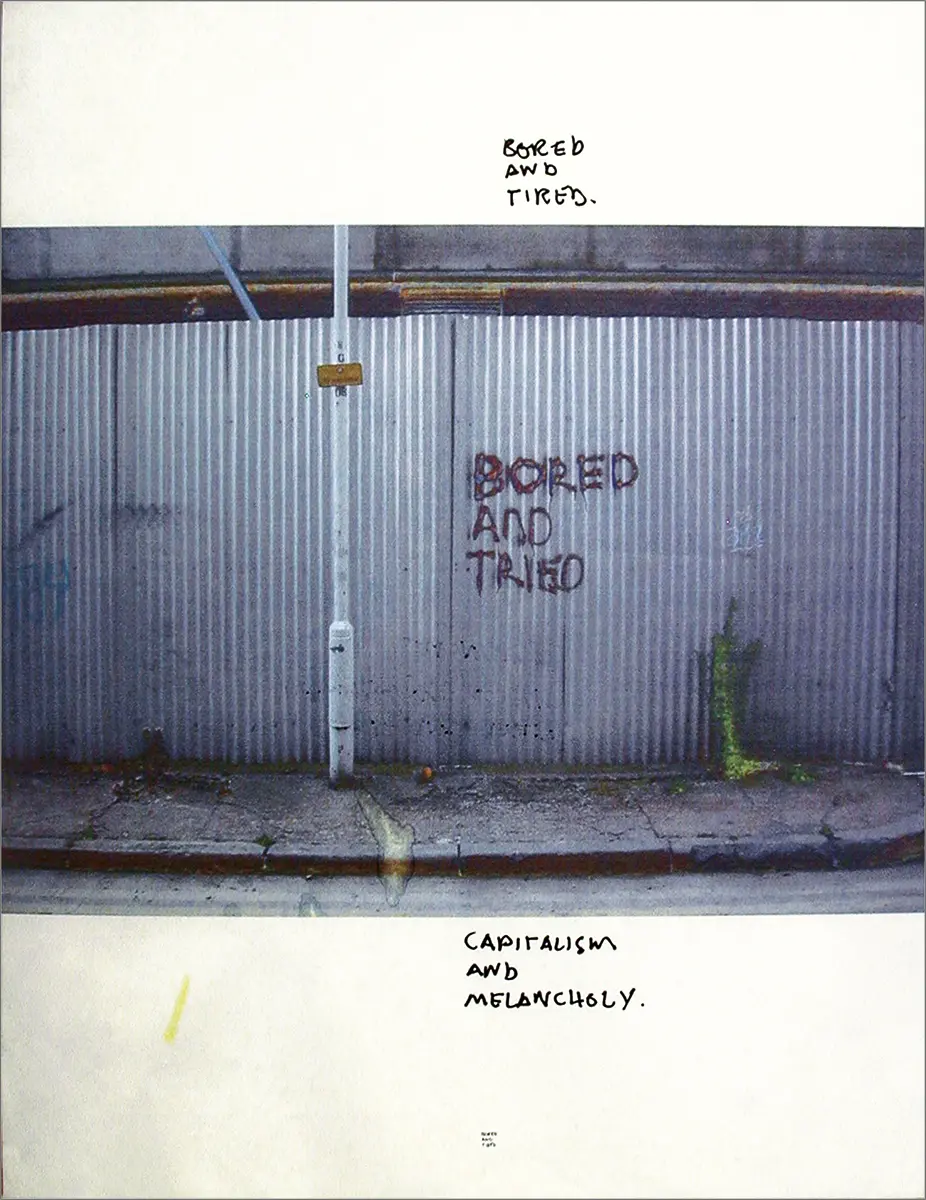
Saussure, Baudrillard, Derrida? Yes, but from a frankly cynical point of view. In a framed notebook page Brüggemann notes: "IN PARIS PEOPLE THINK IN FRENCH." Not only clever, he is graced with a splendid sense of humor. Other pieces that include pages from magazines display sentences from Wittgenstein, Dan Graham, Robert Barry, or Stefan Brüggemann. These are generally thoughts about art, which bring Kosuth to mind once again, and his statement that “Art and the definition of Art are one and the same thing.”
The remainder of the show has pictures from magazines, scanned and printed on canvas, often with something added by Brüggemann, like "I DON´T NEED A GALLERY I NEED A SHOW AND A MAGAZINE; GOOD IDEAS STEALING IDEAS; TO BE POLITICAL IT HAS TO LOOK NICE; YOU SAY IT BEST WHEN YOU SAY NOTHING AT ALL" (this came already printed in the original magazine); printed upside down: "THINGS UPSIDE DOWN JUST A ODD THING," and so on. These are reflections, ideas, and sentences that occur to the artist and he jots down wherever he can. Later he prints them on paper or on a clipped page from a magazine just like he scribbled them down originally, with typos or dyslexia-induced errors, which gives greater form to the letter but leaves language, his raw matter, unaltered.
Since conceptual and post-conceptual artists already exist, Brüggemann pigeonholes himself into a self-created style, Twisted Conceptual Pop. The Pop element comes from his use of items and images taken from the mass media as artistic material. The conceptual element is evident in his 1960s-inspired work with language as material and support, signs and signifieds as ideas or proposals, Kosuth’s tautologies as formulas and reflections, and the notion that anything can be art. The twisted element derives from the constant exercise of parodying what is evident, established, and possible. Stefan Brüggemann thinks and loves Mexico City (Stefan dixit.)
LUZ MARÍA SEPÚLVEDA