Francine Birbragher: It is a pleasure to meet you and to interview you on the occasion of your exhibit at the Miami Art Museum. The show includes most of your video environments along with some photographs that are very passionate and very poetic and presents a clear evolution of your work. Can you please tell us how your career began and how it progressed?
Shirin Neshat: I started to make art seriously in 1993. I had studied art before then but when I graduated I basically abandoned making art for about ten years. I began working in 1993 and in the relatively short period of time since then there have been a lot of changes and developments both in terms of the concept and in terms of the visual form, the medium. I studied painting in school but I really lost interest in that medium altogether. I thought I was a really bad painter and as an Iranian artist attending a Western school, I felt I had nothing to contribute. I would have done mediocre work half-Iranian, half-Western—very typical of artists from another culture living in the United States who feel the pressure to create a middle space. So I decided to leave art and I did other things. The return to the making of art was very personal and very much related to my return to my country. My personal desire to create a link with my country and the discovery of the kind of transformation the country had undergone after the revolution, inspired me to create a group of works that somehow could convey my emotions, my responses, and my understanding of the profound changes that were taking place. It is very important in looking at my work that people are aware of the context in which it was made. I had no audience, I had no professional art activity, and therefore, this work was made for purely personal objectives.
Through this work, through this research, I was trying to find answers for myself and one question, one issue led to another, and to another, and to another. I have been very lucky because the work has taken a very natural, spontaneous course in the way that it has evolved. I always trusted myself, and my intuition, both in terms of the visual aspect of the work and in terms of the content. I began working with photography because I was making the work called The Women of Allah, 1993–1997, which was about women in relation to the revolution. I felt the urgency of using photography not only because of the photojournalistic images that I have been surrounded by and impressed by but also because of its realism.
FB: You definitively have the eye for it!
SN: Thank you. Then I went on to video, then film and performance, and now I am working with film and photography.
FB: I would like you to talk about your first series of photographs. You mentioned that one of your first interests was to find yourself and explore women’s issues. You experienced a tremendous impact when you went back to Iran and found women in very specific situations that inspired that series of images, first of women and then women with objects such as rifles and guns. You also included children.
SN: Women have become the main characters in my work for many reasons. Since I am a woman, I find it easier to approach the emotional and psychological state of other women. I also believe that in Islamic countries, whenever there is a major change through revolution, women are the first to be affected. In fact, you can study the culture by studying the women: the way they dress, the way their own society changes, the way they have to wear the chador. Unlike men who create the rules, women wear the rules. And so for me, there has always been a fascination with discovering how these women are feeling, how they are coping. In The Women of Allah there is a particular irony in what I see. In some ways, we have the idea that all these women are very much behind, or very much the victims of men, and yet throughout history in Islamic tradition there is evidence of women being active in the military during the revolution and after the revolution. So I find it ironic that when it comes to the moment of war, women are equal to men.
Beyond that, I wanted to fully comprehend the ideologies and philosophies of individuals, particularly of women, because they give life, and give birth. They place themselves in a position where they are so willing to let go of their lives, of the material world, of their children, and the whole question is one of faith. It became a fascinating project because what we have is a strong concept of martyrdom, which is related to terrorism. The "Women of Allah" were martyrs who were armed and willing to die. The other layer of the work is trying to understand the conflict from the Western point of view, and that is so difficult and impossible to comprehend within the rationale of the West. In a way, they are good people because they are so willing to sacrifice themselves in the name of the community and their faith. Whether or not you agree that it is right or wrong to believe in and to love God with such a great sense of devotion, it is this same devotion and spirituality and everything about it that is good that is also so close to cruelty, violence, and death.
Am I saying it is good or bad? Am I saying it is good to be a martyr? Am I criticizing it? No. I am saying it is very complex; good and bad coexist all over the world and you cannot make a judgment about these people. That is really what “Women of Allah” is saying.
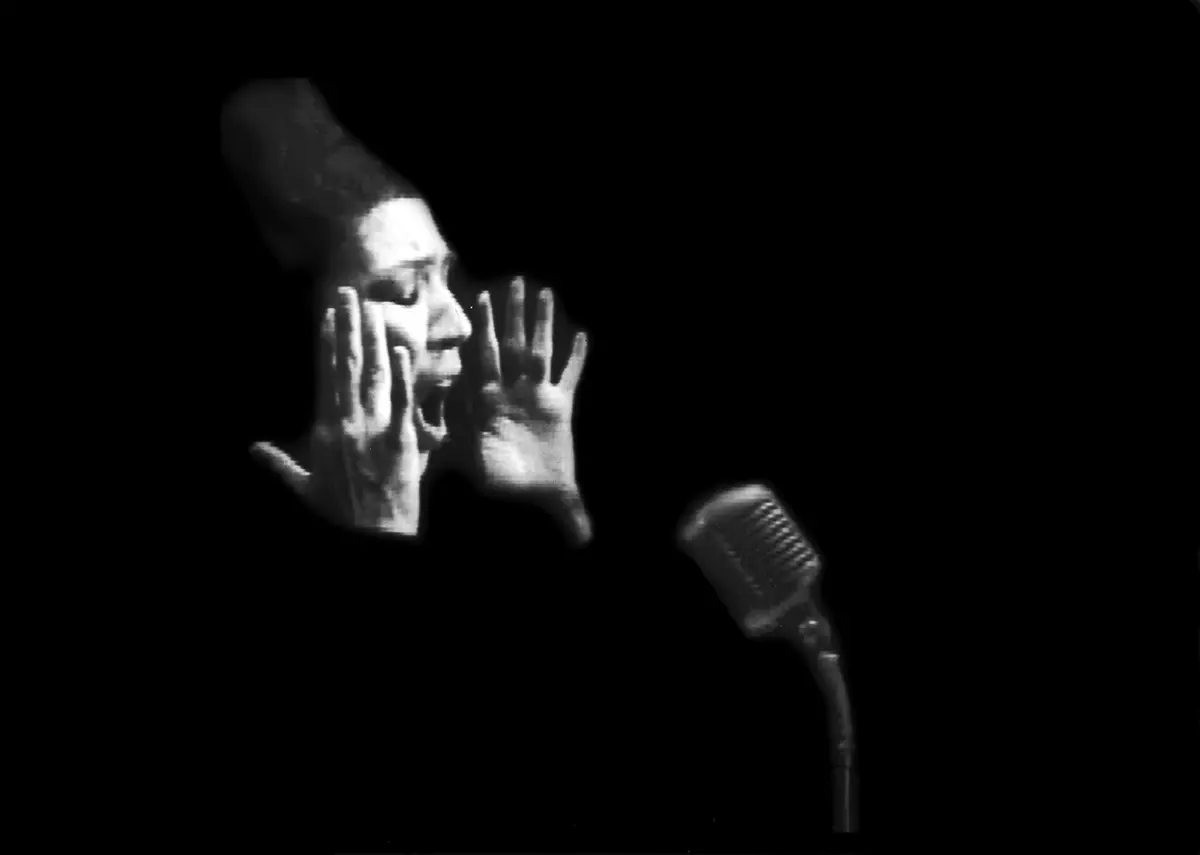
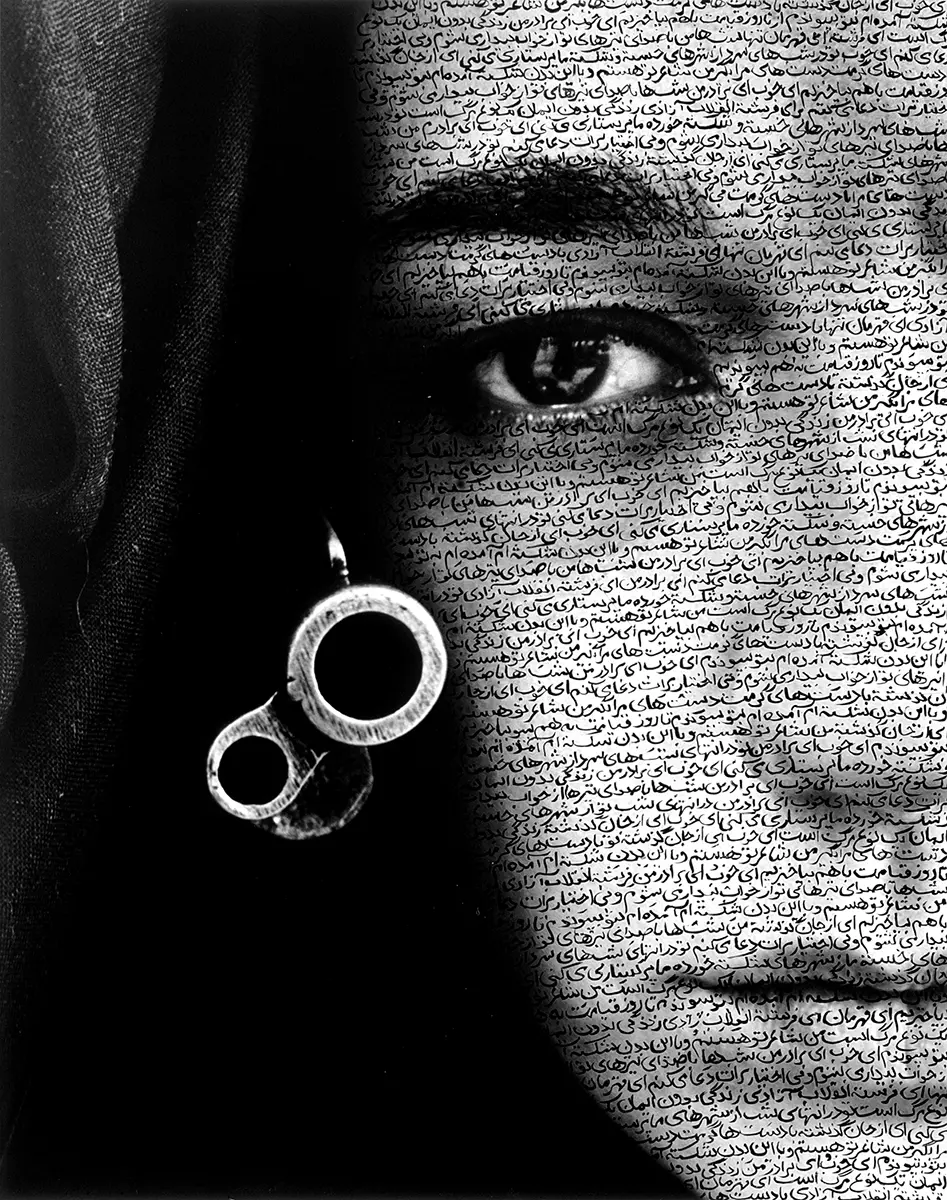
FB: In the photographs you took at the time, you went beyond portraits; you also worked on hands, and something that made your work unique was the fact that you used Farsi writings as part of your aesthetic language.
SN: Well, the reason I did that is because when women are covered, the only parts of the body that can be seen are the hands, the feet, and the face. And I was interested in how, with these very few body parts, you could project so much through subtle movement. I have a picture of a woman [covering her mouth], you know? Is she being quieted? Is she trying to say something? What can be read in an image depicting the contact between a woman and a man, or a woman simply looking at the audience? I love that minimalism; in fact, all of my films are minimal in that way: reduced to very few things, but those few things say a lot.
FB: I think that video and film give you tremendous freedom as well as the power to express those complexities and dualities, and to make the viewers much more aware of what you are trying to explain or project. I do not think you are providing an explanation as much as you are trying to present the reality in all its complexity.
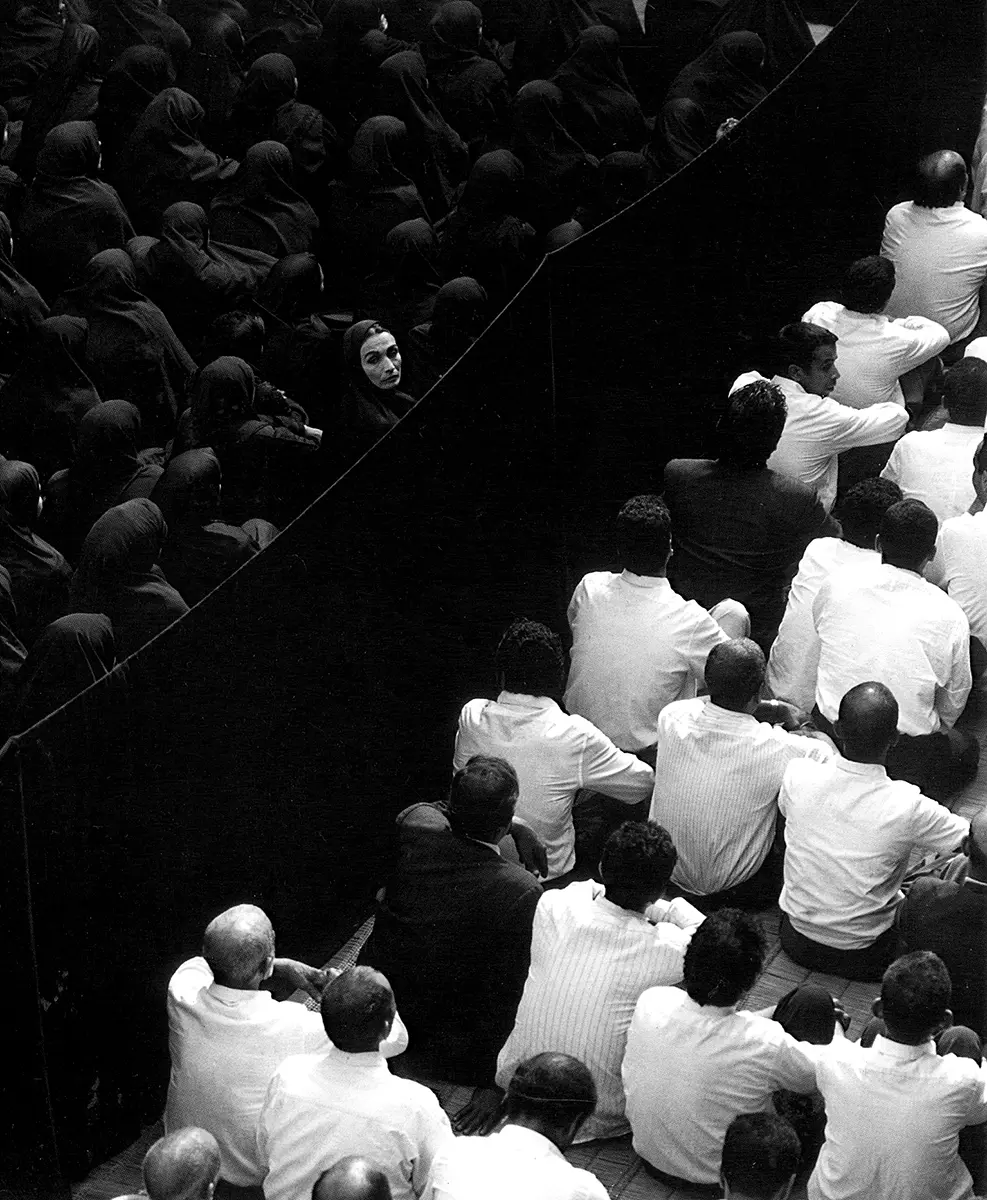
SN: The films are separate from the photographs. The photographs catch a single moment. The films tell stories. I like the idea of stories. I like photography, painting, sculpture, and cinema, and I love the idea of mixing many mediums together and offering the viewer an experience for ten minutes or so that is unlike either seeing a commercial film or seeing an art object hanging on a wall. The fact that there are two opposite projections creates a very tense moment for the audience, who becomes physically and psychologically engaged. They can’t be as passive as they are in the theater. In fact, they have to choose what side they are going to look at and what side they are going to miss, and for me that creates a very interesting experience.
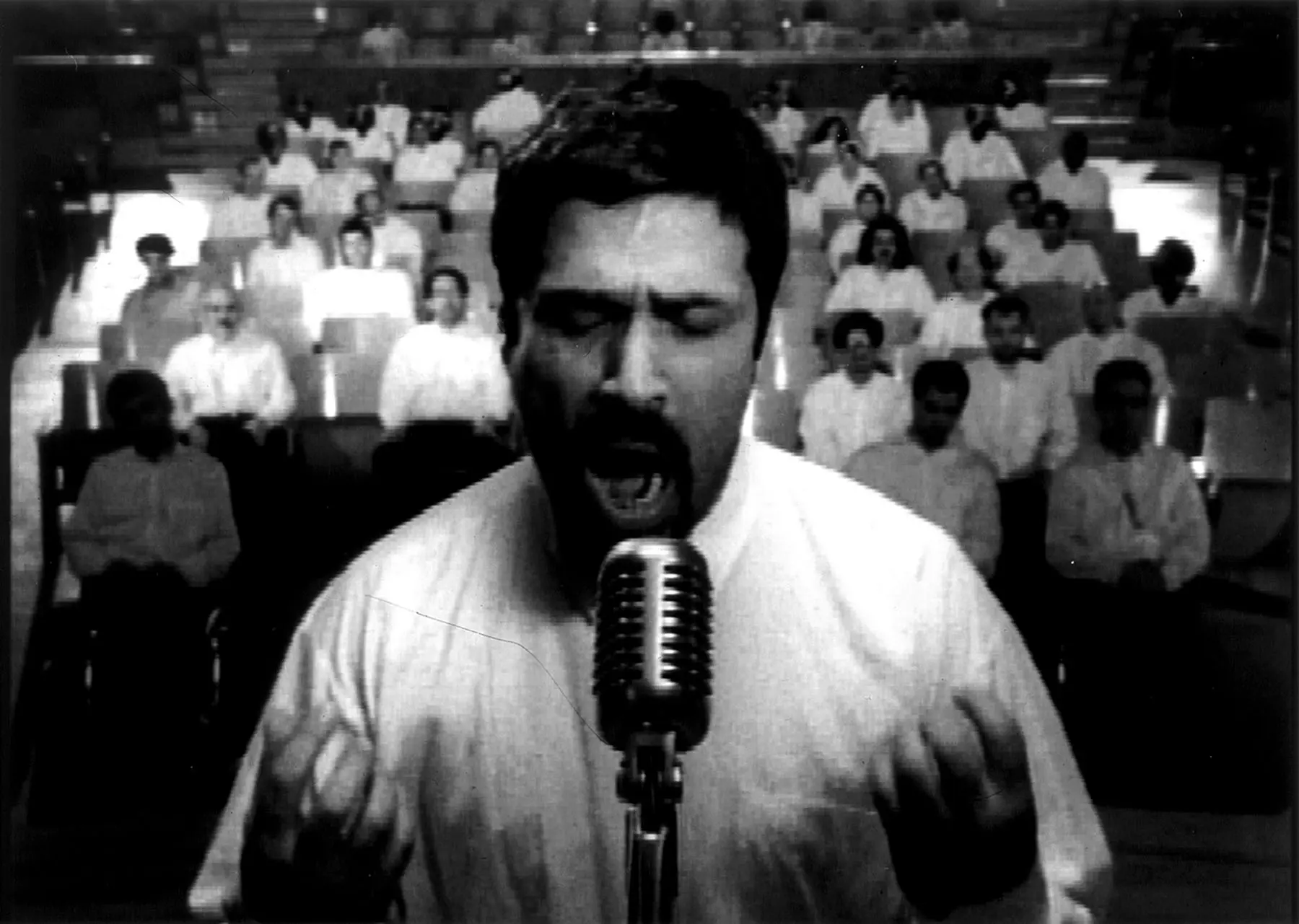
In terms of story, like the photographs where one topic sort of leads to the next, in film one project has led to another following a natural course. Turbulent as you can see, is the closest to still photography because the camera does not move very much. Rapture took up where Turbulent left off, both in terms of the notions of the masculine and feminine in relation to social structure, but also in the sense of opposite, where instead of a man versus a woman there are one hundred women versus one hundred men, thus raising the question of gender relations. Fervor closed the chapter; Turbulent, Rapture, and Fervor created a trilogy and Fervor was the final part. I had a series of questions in mind about how women as opposed to men are treated in our country. By studying those differences we can learn about the general ideological structure of the society. I think they all take the same direction in the sense that the women become very rebellious and the men become the ones who conform and stay within the rules. I believe that is the state of affairs.
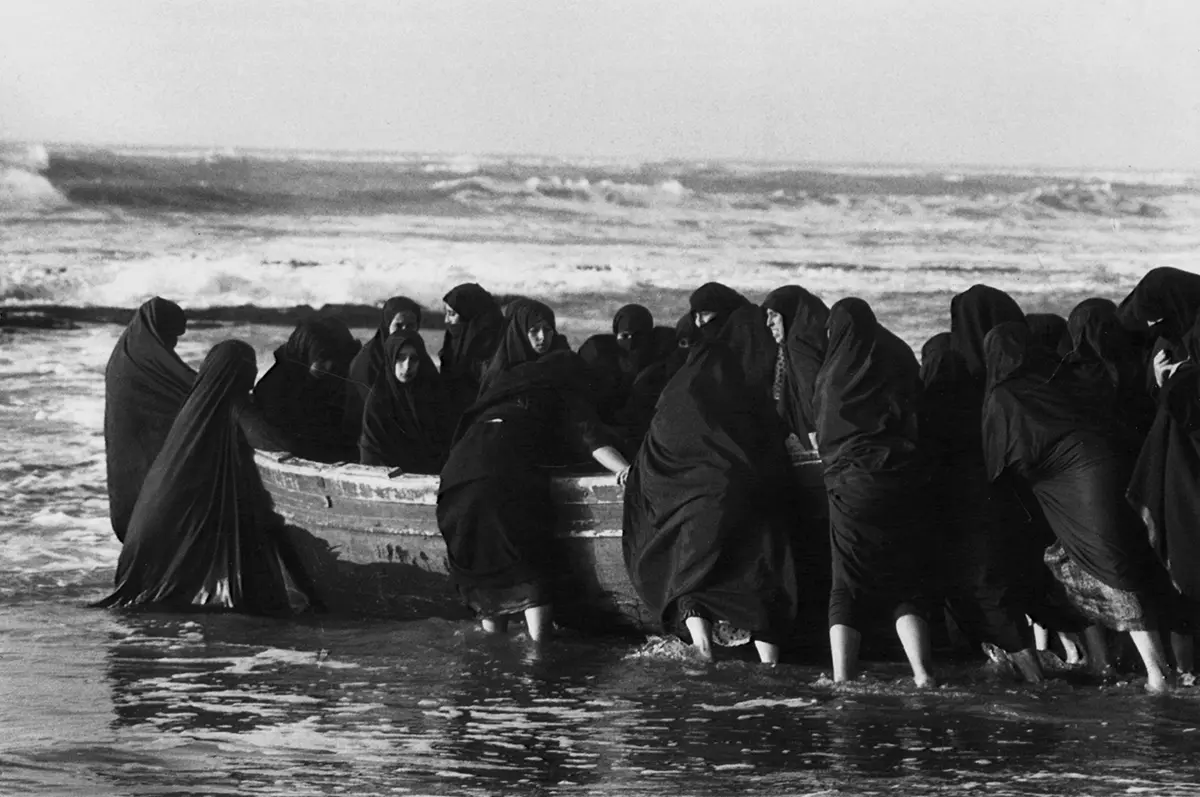
Because of the pressure, women become more creative and protest against the rules. In Turbulent the woman sings this unbelievable music while the man sticks to the rules. In our culture women are not allowed to sing in public and her response is, “ok, you think I can’t sing? Well, I sing in a way you can’t understand!” To me, her guttural high note is an expression of music. In Rapture, at the end of their journey through the desert, so to speak, the women get on the boat and leave. Whether their departure is suicidal or liberating, we do not know. But we do know they are very, very courageous, and they are choosing their destiny. In Fervor, while some of the men and women are attracted to each other and enjoy flirting, they are confronted with a man who represents authority and goes on and on about how simple it is to feel sexual attraction. A man and a woman are flirting and as this man’s speech becomes more intense, the woman feels the urge to get up and leave in protest, but the man stays behind. Every time I made one piece it made me think of another question and so on, you see? I can continue explaining every project; they have a very interesting evolution. I sometimes think artists don’t quite comprehend themselves, or why they do some things, but I trust my intuition. In a way, it tells me what to do and what not to do.
FB: Another passage, technically speaking, is the move from black and white to color. From a visual perspective, it has an impact on the way you portray something and what you want to convey.
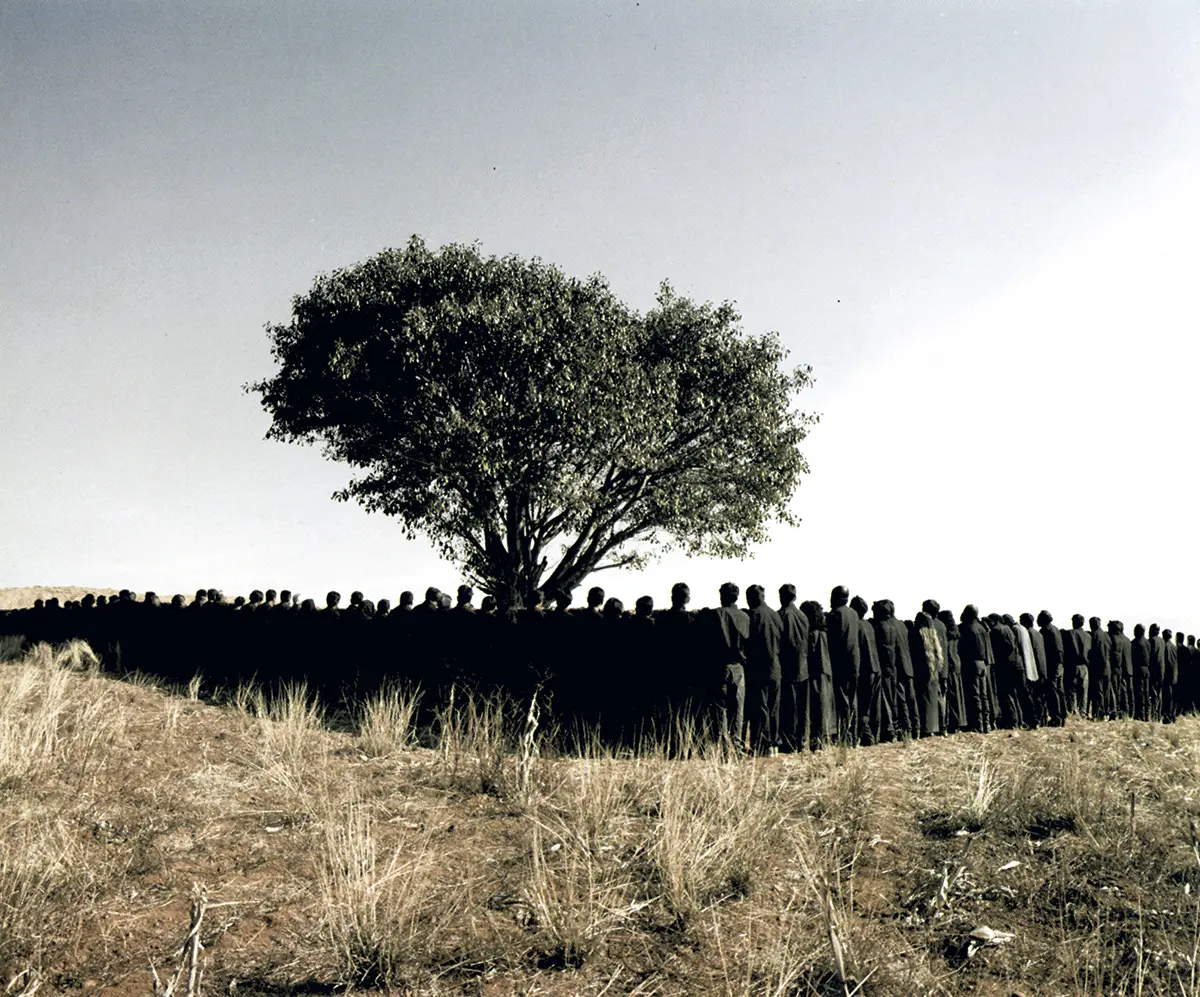
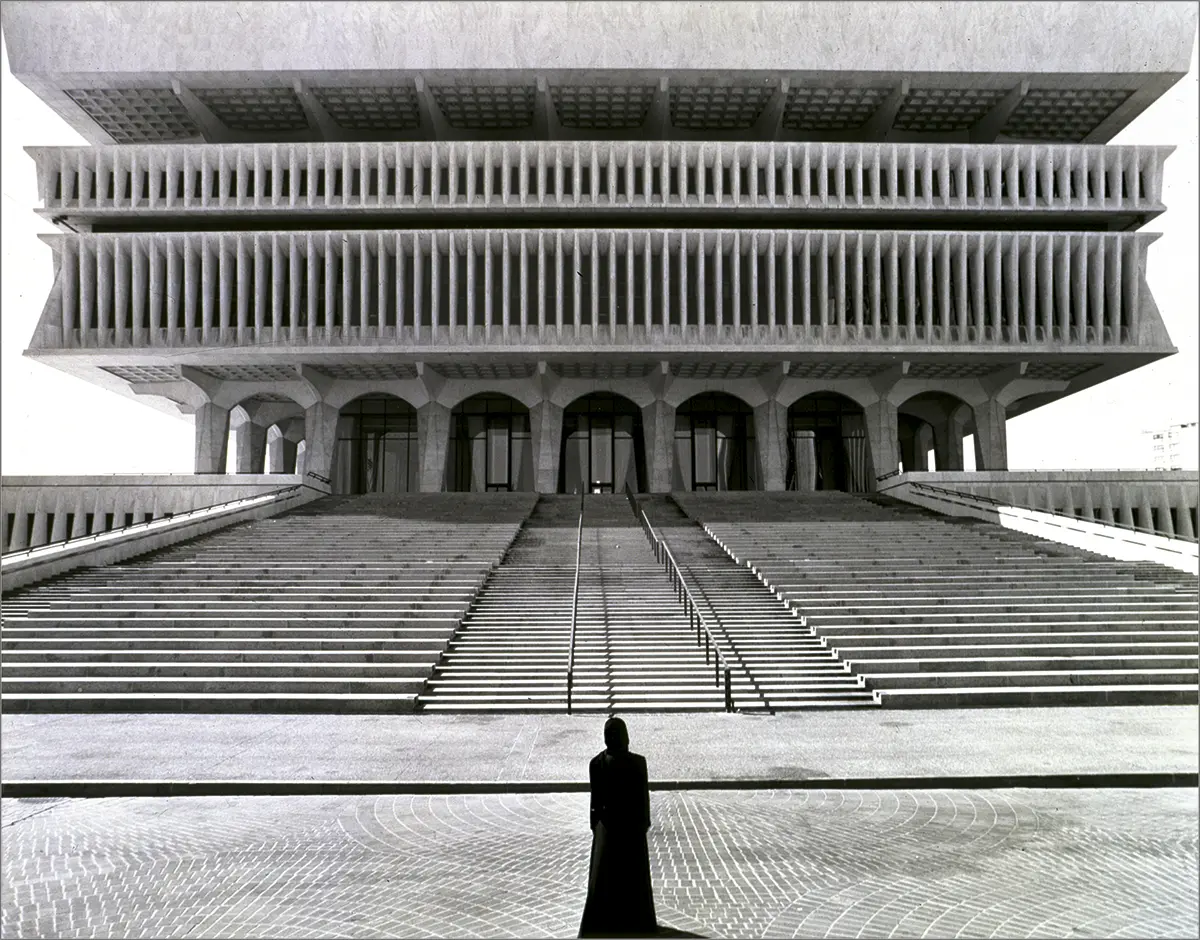
SN: Are you asking me why I use color? To me, color is very dangerous because it is very seductive and very desirable, and distracting in a way. I always go back to my culture. I do not see much color. I see a culture that is very black-and-white, and I only use it because it helps me to reiterate or exaggerate a concept. For example, in Passage we are talking about natural landscape versus men and women in the process of mourning, all in black. It is always essential to separate the people in black from the landscape. I really like the idea of these people as silhouettes, walking through the landscape, and maintaining the contrast between the dead and living: having no life in terms of color and then the landscape with color. It is more like a conceptual decision. It is the same with Soliloquy. There you have architecture, which to me is representative of the culture and dominant in the way that it represents history, tradition, rules, and everything. Yet, this single woman going around in black seems so fragile. As her silhouette moves all the spaces change. Something had to be constant. If she changed in color or if the film was in black and white, everything would have dissolved. I just wanted to separate them. I think I have to be very selective about color.
FB: You deal with issues that are very specific and very personal, but at the same time extremely universal. Your first photographs were taken in Iran, and then you moved to Morocco and other Middle Eastern locations. Now you are reaching beyond the Middle East and covering other cultures. You recently worked in Mexico and you are expanding to cultures that have similar issues regarding gender, nature, life passages, and funerary rites.
SN: I had been shooting mainly in Morocco and Turkey. After September 11, I wanted to go to Iran to make a film but it became difficult. I felt the urge to change, to go to a non-Arab country. I thought it would be great to go to a space that was not politically tense. I was having a hard time in New York after September 11 and my son was deeply affected. I have no idea what happened to me. One day I thought, you know something? I just feel like going in the opposite direction. I had a friend in Mexico and I called her up and said, “I would like to come and do some location scouting because I want to look for a landscape that looks Iranian.” The story of my film is about a woman who is also a tree, a symbol that comes from the Koran, the sacred tree. I was very interested in the idea of the garden and its meaning, how it was our country, it was paradise, and it had political meaning in terms of independence and freedom. The story I wanted to tell needed a vast dry landscape with an amazing tree in the middle that could accommodate a woman inside. We went to Oaxaca, Mexico, and of course, it is very green! On the last day, I found a sort of small mountain with one tree, a fig tree, on it. But what was so interesting, and I did not know this before, is that Oaxaca is called the “State of Trees.” And to my surprise, in one of the small towns in Oaxaca, I found a big sculpture in a plaza with a woman inside a tree. We started the audition and I found one woman that I absolutely loved. She was a Native Indian and her name was Maria de Los Angeles. I thought this is just too much coincidence: that I come all the way to look for the tree, that it is a fig tree—which is very special, and that this is the “State of Trees.” When I chose the woman she said, “I knew I would be working with you.” It’s a strange coincidence.
We were working right across the ruins of an incredible old city that had been destroyed and I felt its power as the sun set. I felt an incredible energy coming from the ruins. I was a little nervous at first. I had to cast 200 people, actually 250 people, men and women from Oaxaca, all Indians, and all of them a lot older, and I was not sure whether we would have the same incredible report that we had in the Middle East. I have to tell you, it was one of the most astonishing experiences in terms of how we bonded, and how we worked together. It felt like it was almost my own country. I really fell in love with Mexico and its culture, and from then on I felt very connected to Latin America.
I was in Brazil when I had a big show there. I realized that yes, we are very different in that part of our culture is so dark and so sad because of our history, and of course, we are so inhibited because of all the taboos we have, because of our religion, yet we are very similar in the sense of the political oppression that we have experienced; the repeated dictators; the connection to religion and how it rules our lives; or the kind of human interactions that exist. In Mexico, there is true warmth and it is so intensely human!.
Even though I meant for the work to have an Iranian look, it has a very Mexican presence of course, in the beautiful face of the American Indian. Amazing! And now we are going back to show the film in Mexico City, but we are also going to Oaxaca to show it to the local people in the village, and I really hope to work there again.
FB: You are an extremely sensitive person. You are going back to Mexico to show your film, which shows you are interested not only in doing your work but also in giving back to the community. That interaction, that relationship with the people that participate in your work is very important.
SN: People don’t realize that the best part of the work is the human interaction I have with the people. None of them are professionals. It is so deep and so moving because ultimately I just produce there. I find that in the work you open yourself up to people having no idea who they are, and they open themselves up to you with no idea. It is like a blind date. You dance around each other and even though you are coming from opposite and totally different cultures, you have one thing in common and that is the work of art, the ultimate vision.
To me, it is like an adventure. Every time I make a piece I do not know what is ahead of me. It is scary and on the other hand, it is exciting. I always feel incredibly sad about leaving and then something magical happens and I am afraid I will never experience it again. And I really believe that is why we make the next film.
I do not think I will ever again be an artist who goes to a studio to work alone. There is so much about the element of discovery and adventure, of giving and taking. I think about the people who work with us and about all the things they need. They are paid and are very well fed, but they also have a great time for a few days. Can you imagine something more bizarre than a woman from Iran making a film about the Middle East in Oaxaca with Native Indians? We talked to them about their understanding of the Muslim community, and this was just after September 11. It was such an incredible experience! It removes you from all the superficiality of the art world and all the elements of organized structure and it puts you in touch with something very primal, something very essential and I love that!
This element of adventure and discovery becomes addictive and I think we all leave feeling very fulfilled or charged. I am sort of high for many days afterward. I feel certain countries understand what it is like to suffer like my country has. We have more poverty, we have more pain, and I do not know, maybe it sounds too strange but I feel I can work in these countries that experience life with the greatest joy and the best pleasure, but also understand pain. I really like traditional countries because I have always been skeptical about modernity and technology.
FB: You also chose a country that is very rich in tradition, in terms of visual arts, music, and dance, which is something that is very valuable in your work. Particularly in Passage, in the choreography and the movement, the women become one.
SN: I am glad you see that. I do not know if you are familiar with the Russian filmmaker, Sergei Eisenstein. At some point, he left his country in exile and went to Mexico. He made a film called Viva Mexico. It is unbelievable! Mexico has been a refuge for a lot of people in exile, and although you try not to be influenced by the culture the work still has such a Mexican look! It is a benign landscape, but when you see it you truly feel it. I was honored because I have always been a big fan of Frida Kahlo and Diego Rivera, but more because Mexico is at the forefront of contemporary filmmaking.
I cannot tell you what this experience meant to me! It is as though a door opened and I said to myself, you know what? The world is even smaller. I do not have to be restricted to the Middle East. Mexico could be my home. We are talking about an individual who no longer completely belongs to America, and I do not belong to my country either, but in a way, the world becomes my studio and my home. I go to places and I really feel good. It is an amazing revelation because, I tell you, it does not happen very often. It really doesn’t. So for me, Latin America is a new opening, a new discovery.
*All images illustrating this article are courtesy of Barbara Gladstone Gallery.
FRANCINE BIRBRAGHER
Ph.D. Candidate in Latin American History, University of Miami. Art historian specializing in contemporary Latin American art.